SERC.. a wonderful Smithsonian Adventure STEM Science on the River

ontent

4894_115871911326_8275176_n

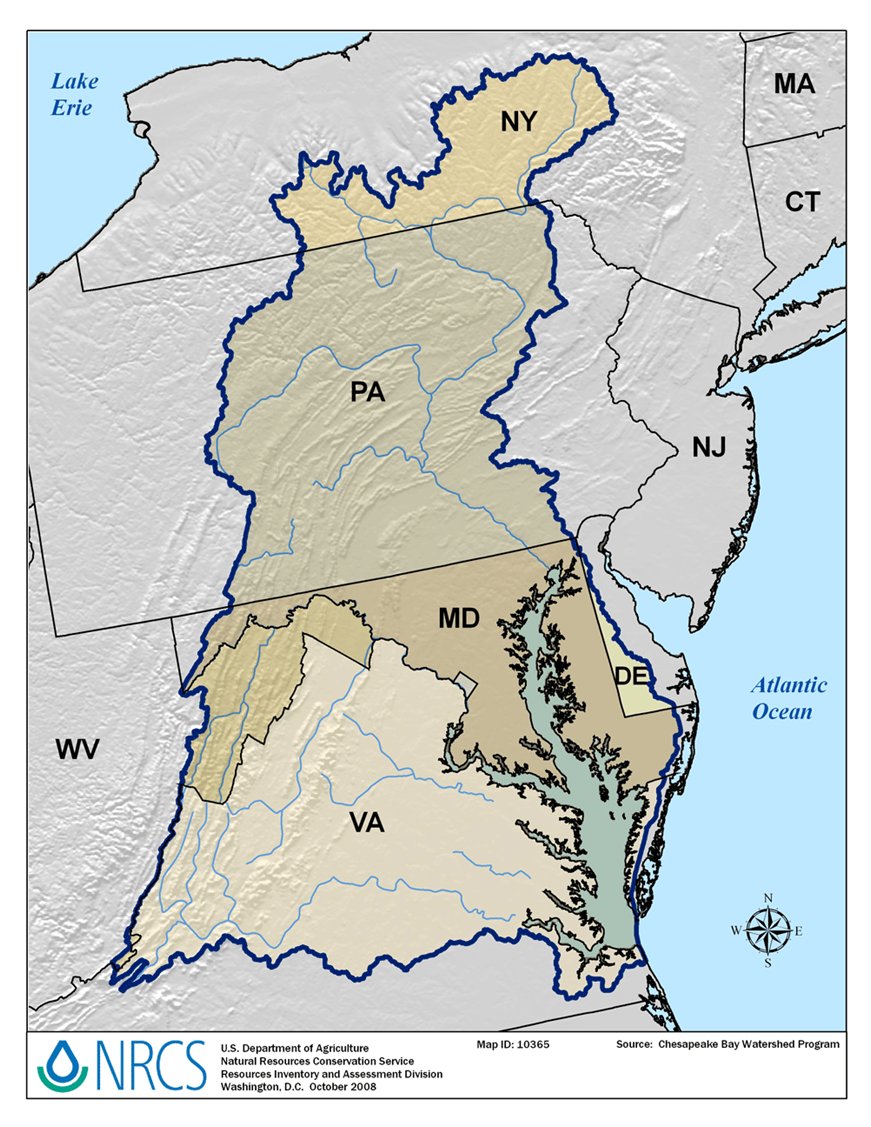
One of my favorite field trips, is not too far away from DC. It is environmental , historical, beautiful, and all STEM and STEAM. It links the students and parents to the Chesapeake Bay in wonderful and unforgettable ways. Parents want to go, and take workshops to qualify to go on the trip. What is great is that those parents also create the possibility for re-visits. It is just that great a place.

What

We begin the year planning to write grants to cover the cost for all students.
4894_115870601326_3361947_n
I like to do a covered dish orientation for parents and their families about the Chesapeake Bay. I ask them to bring in dishes from around the Chesapeake Bay and one copy of their recipe. We eat, we have fun singing and making up Chesapeake Bay Cinquains.
We create a year-long committee to plan the SERC trip/
We display books, posters and resources about the Chesapeake Bay and share the information about SERC. We share their Powerpoint.

I have an invited speaker from Fish and Wildlife, NSF , National Geographic , ESRI or Earthwatch.

The Smithsonian Environmental Research Center
(SERC) leads the Nation in research on linkages
of land and water ecosystems in the coastal zone and provides society with knowledge to meet critical environmental challenges
in the 21st century.

Where

Smithsonian Environmental Research Center

Why should you go?

This is a place that serves lots of learning communities.

There are programs for various age groups , internships, and serious scientific work going on.
19557_328666201326_3330411_n

GPS, GIS comes to urban students in a neighborhood setting

ESRI , and National Geographic provide resources for all.

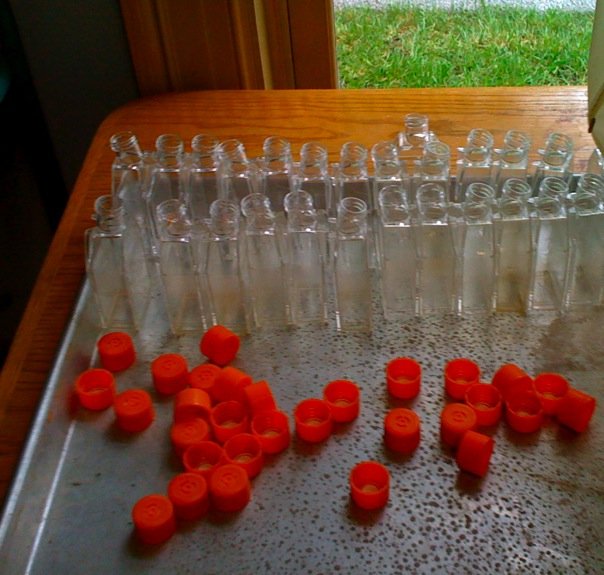
This is one of the most interesting, fascinating place to take children to learn about the environment. There is a fully equipped lab with lessons and things for them to learn, and there are several hiking trails. The children love the learning activities especially the seining, which is one of several exercises that they learn about before they come.4894_115870586326_2833140_n

They go out on a pier with a leader and do several exercises, a turbidity study, a study of microscope things in the Rhode River, the study of winds and tides.. the seining activity.. and they carefully take notes on their findings.
I combine this work with the “Living in Water”curriculum from the National Aquarium in Baltimore.

http://www.amazon.com/Living-Water-Aquatic-Science-Curriculum/dp/0787243663
The geography of and interconnection of the places around the bay are highlighted in this interactive presentation.
http://www.nationalgeographic.com/chesapeake/interactive/index.html?s1=0|timePeriod=1|tourStop=0
We use a map and mark the various locations. We do some of the locations from time to time. We also have a table full of books on the Chesapeake Bay.
4894_115871906326_4955821_n
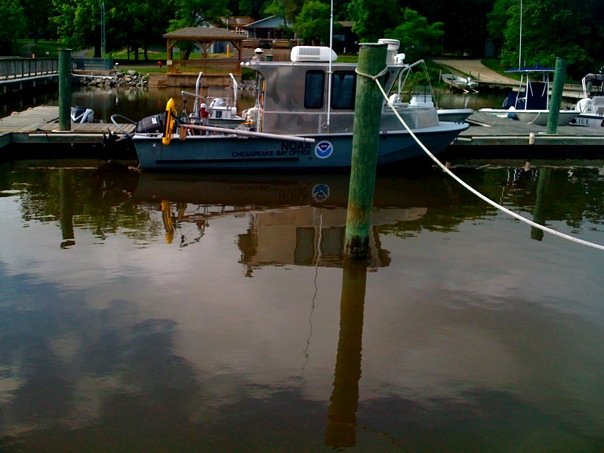
The center is a beautiful wild place away from the main road on the river.

Teachers and parents have to do a workshop which is shared here. http://estuarychesapeake.wordpress.com This is from the website( About Estuary) Chesapeake Estuary Chesapeake is SERC’s most popular education program and involves a series of five stations at SERC’s dock and the Java History Trail. The class is divided into 5 groups that each rotate through all stations.

The five stations of Estuary Chesapeake are: About Crabs, Water Testing, Oyster Bar Community, Investigating Plankton, and Going Fishing (seining). For parents and teachers there on the site a training presentation powerpoint.

Check out the Parent/Teacher Training Presentation — this powerpoint teaches you all you need to know about SERC, the Estuary Chesapeake program, and how to be a Station Leader.

Stations

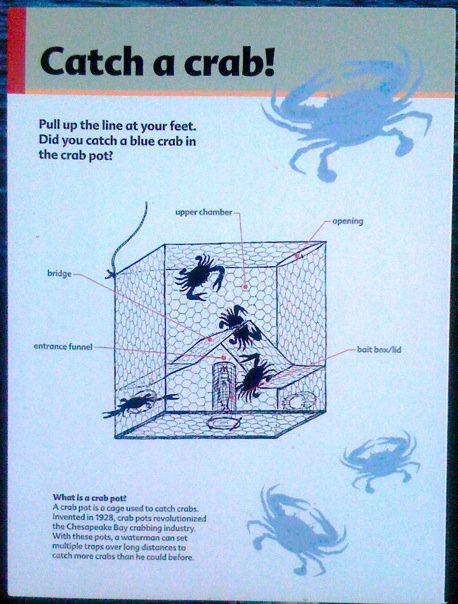
About Crabs Using hand lines and a hand trap, students catch their own crabs and study them to learn about their anatomy and behavior. Crab habitat is also discussed. Resources are shared so that leaders can have good information to share with students from the Estuary Chesapeake Manual about the crab station, and for Blue Crab talking points.
Here are most of the Blue Crab Talking Points

Station 1: About Crabs

Learn ways to catch crabs and study
their anatomy and behavior
.
Background
The blue crab is a well known inhabitant of the Chesapeake Bay. Crabs can tolerate water that ranges from very salty to nearly fresh and are well-suited to live in the ever-changing salinity of the estuary. Because they are abundant and also a popular food, they are an important commercial and recreational resource.
Most often crabs act as predators and eat live clams, fish, and other crabs.However, they also act as scavengers by eating dead organisms, which helps to clean up the Bay. They will eat bait such as raw chicken and can be caught with baited lines, collapsible traps,and commercial traps.The abundance of crabs varies seasonally.
In April they begin to enter rivers and creeks, and,throughout the summer, they increase in numbers at these locations. In the fall they go to warmer, deeper Bay waters, where they burrow into the sand.
4894_115871841326_1962450_n
Key Points to Emphasize
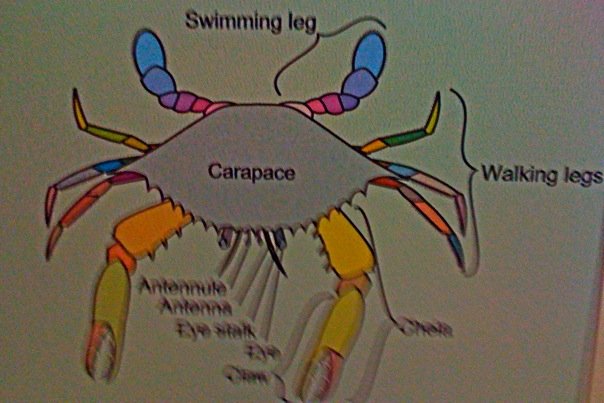
Parts of the crab include the shell, abdomen, mouth, eye stalk, claws, swim paddles, and walking legs.
Crabs are both predators and scavengers.Crabs swim, however they spend most of their time on the floor of the Bay.
A crab can be identified as female or male by the appearance of its abdomen. The shape
of a male’s abdomen resembles the shape of the Washington Monument. An immature
female’s abdomen is triangular shaped. Once matured,she carries her eggs in her abdomen and therefore a mature female has a wider abdomen. It has a shape similar to the shape of the Capitol Dome.

Water Quality
4894_115871066326_4245105_n
4894_115870521326_5024076_n
.

Water Testing Using a variety of tests, students will measure the water quality parameters salinity, pH, turbidity, and temperature, and discuss the results. The dock where we will do our water testing is right on the Rhode River in Edgewater, MD.

Oyster Bar Community Students learn about the habitat that oyster shells provide for small crabs, fish, and invertebrates. They also will learn about oysters’ ability to filter water. (Fun fact: Oysters can filter about 50 gallons of water a day!) Investigating Plankton After completing a plankton tow from the dock, students use microscopes to observe plant and animal plankton found in the Chesapeake Bay.

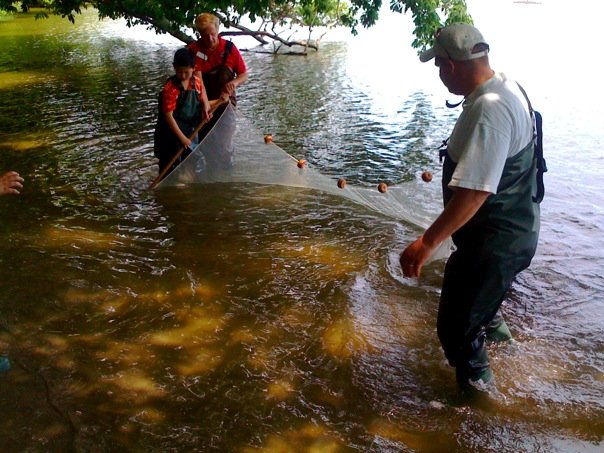
Seining (Going Fishing) Donning chest waders, students wade into the water to catch fish and other organisms with a seine net.Think high waders, a big sweep of a net, and walking in the river to collect what you can.. you gotta do this. It is awesome.The students then identify the animals they find. Physiological aspects of fish anatomy are also discussed. We put the things we find back into the water.

ImageImage

School to Prison Pipeline- the Achievement Gap

008At the SITE.org conference there was a presentation, a keynote referencing the trouble of boys, minority boys. People seem to have just discovered this problem. It may be because of the President’s initiative. I have known so many people who got lost in the system, I did not want to go and cry and think about them.I lived in Alexandria, Virginia when the city’s population was mostly black and white. People came to Alexandria from the deep south to go to school. Most everyone in my family has done some teaching. I dedicated my working life to making change, but not a lot of change has happened.

it is Spring on the Chesapeake. Gone are the days of using Oystering for a living, crabbing and a little truck gardening for a sustainable life. Today, one need to code, use computers, and have lots of other skills. But the industrial arts seem to have disappeared here and there.

IMG_0264

When I first started teaching in a school, a black school, there was a place right outside my window where day laborers huddled around a fire. Lots of the kids that were in that class had relatives who were out there. I didn’t have to say much about why it was important to learn. Those huddled around the fire, said it all.We never teased about it, but people’s relatives were there.
You just had to look.

SOCIAL JUSTICE AND DIGITAL EQUITY- SIG DE NOTES FOR NOVEMBER

My dad was a high school shop teacher. He was also a mentor for many troubled boys. I have seen them come and go. When he died so many came to say goodbye.. but all of them could not, as some of them did not escape the prison system.

Fortunately ,many did and talked about mentorship, how he counseled them and helped them. My mother fussed a lot about these boys, who ate, sometimes slept and who hung around our family. My dad paid them regular wages when they crawled under houses and wired people’s homes.This was good for them to learn to earn, manage and have a plan for getting to go to school, if that was what they wanted. Some of them used Industrial Arts to earn money to go to college. * I was married by one of his students, who paused in the ceremony to speak of my father. Lots of those types of opportunities have disappeared from career education.

When integration happened, my father got the dregs, the people no one wanted to teach. They used to always put them into shop. My father was a no nonsense kind of guy who was able to teach bricklaying, electrical shop and carpentry. He had a wry sense of humor that helped a lot too. I am not sure where he learned to be able to teach people with disabilities. He was excellent in that skill. There were students who did really well, but they had to go by the rules.

My father and a Jewish friend of his, re-habbed houses for people who escaped the Holocaust, and poor people who came up from southern states as well. During those days, the NAACP and Jewish leaders worked together because they understood the problems of exclusion.

The things that people said about the prison pipeline were nothing new. But I am glad they said them. Maybe people new to the problem will care. We still have discretional segregation and some of it is done so skillfully that many people are not aware of it.

Here is an excellent written presentation of the problem from Teaching Tolerance.

Publications
The School-to-Prison Pipeline

Blogs and Articles: Discipline and Behavior
Printer-friendly versionPrinter-friendly version
Number 43: Spring 2013

Illustration by Chris Buzelli
In Meridian, Miss., police routinely arrest and transport youths to a juvenile detention center for minor classroom misbehaviors. In Jefferson Parish, La., according to a U.S. Department of Justice complaint, school officials have given armed police “unfettered authority to stop, frisk, detain, question, search and arrest schoolchildren on and off school grounds.” In Birmingham, Ala., police officers are permanently stationed in nearly every high school.

In fact, hundreds of school districts across the country employ discipline policies that push students out of the classroom and into the criminal justice system at alarming rates—a phenomenon known as the school-to-prison pipeline.

Last month, Sen. Richard Durbin, D-Ill., held the first federal hearing on the school-to-prison pipeline—an important step toward ending policies that favor incarceration over education and disproportionately push minority students and students with disabilities out of schools and into jails.

In opening the hearing, Durbin told the subcommittee of the Senate Judiciary Committee, “For many young people, our schools are increasingly a gateway to the criminal justice system. This phenomenon is a consequence of a culture of zero tolerance that is widespread in our schools and is depriving many children of their fundamental right to an education.”

A wide array of organizations—including the Southern Poverty Law Center, the NAACP and Dignity in Schools—offered testimony during the hearing. They joined representatives from the Departments of Education and Justice to shine a national spotlight on a situation viewed far too often as a local responsibility.

“We have a national problem that deserves federal action,” Matthew Cregor, an attorney with the NAACP Legal Defense Fund, explained. “With suspension a top predictor of dropout, we must confront this practice if we are ever to end the ‘dropout crisis’ or the so-called achievement gap.” In the words of Vermont’s Sen. Patrick Leahy, “As a nation, we can do better.”

What is the School-to-Prison Pipeline?
Policies that encourage police presence at schools, harsh tactics including physical restraint, and automatic punishments that result in suspensions and out-of-class time are huge contributors to the pipeline, but the problem is more complex than that.

The school-to-prison pipeline starts (or is best avoided) in the classroom. When combined with zero-tolerance policies, a teacher’s decision to refer students for punishment can mean they are pushed out of the classroom—and much more likely to be introduced into the criminal justice system.

Who’s in the Pipeline?
Students from two groups—racial minorities and children with disabilities—are disproportionately represented in the school-to-prison pipeline. African-American students, for instance, are 3.5 times more likely than their white classmates to be suspended or expelled, according to a nationwide study by the U.S. Department of Education Office for Civil Rights. Black children constitute 18 percent of students, but they account for 46 percent of those suspended more than once.

For students with disabilities, the numbers are equally troubling. One report found that while 8.6 percent of public school children have been identified as having disabilities that affect their ability to learn, these students make up 32 percent of youth in juvenile detention centers.

The racial disparities are even starker for students with disabilities. About 1 in 4 black children with disabilities were suspended at least once, versus 1 in 11 white students, according to an analysis of the government report by Daniel J. Losen, director of the Center for Civil Rights Remedies of the Civil Rights Project at UCLA.

A landmark study published last year tracked nearly 1 million Texas students for at least six years. The study controlled for more than 80 variables, such as socioeconomic class, to see how they affected the likelihood of school discipline. The study found that African Americans were disproportionately punished compared with otherwise similar white and Latino students. Children with emotional disabilities also were disproportionately suspended and expelled.

In other studies, Losen found racial differences in suspension rates have widened since the early 1970s and that suspension is being used more frequently as a disciplinary tool. But he said his recent study and other research show that removing children from school does not improve their behavior. Instead, it greatly increases the likelihood that they’ll drop out and wind up behind bars.

Punishing Policies
The SPLC advocates for changes to end the school-to-prison pipeline and has filed lawsuits or civil rights complaints against districts with punitive discipline practices that are discriminatory in impact.

According to the U.S. Department of Justice, the number of school resource officers rose 38 percent between 1997 and 2007. Jerri Katzerman, SPLC deputy legal director, said this surge in police on campus has helped to criminalize many students and fill the pipeline.

One 2005 study found that children are far more likely to be arrested at school than they were a generation ago. The vast majority of these arrests are for nonviolent offenses. In most cases, the students are simply being disruptive. And a recent U.S. Department of Education study found that more than 70 percent of students arrested in school-related incidents or referred to law enforcement are black or Hispanic. Zero-tolerance policies, which set one-size-fits-all punishments for a variety of behaviors, have fed these trends.

Best Practices
Instead of pushing children out, Katzerman said, “Teachers need a lot more support and training for effective discipline, and schools need to use best practices for behavior modification to keep these kids in school where they belong.”

Keeping at-risk kids in class can be a tough order for educators under pressure to meet accountability measures, but classroom teachers are in a unique position to divert students from the school-to-prison pipeline.

Teachers know their students better than any resource officer or administrator—which puts them in a singularly empowered position to keep students in the classroom. It’s not easy, but when teachers take a more responsive and less punitive approach in the classroom, students are more likely to complete their education.

The information in “A Teacher’s Guide to Rerouting the Pipeline” highlights common scenarios that push young people into the school-to-prison pipeline and offers practical advice for how teachers can dismantle the school-to-prison pipeline.

>> Avoiding the Pipeline

How can school districts divert the school-to-prison pipeline?
1. Increase the use of positive behavior interventions and supports.
2. Compile annual reports on the total number of disciplinary actions that push students out of the classroom based on gender, race and ability.
3. Create agreements with police departments and court systems to limit arrests at school and the use of restraints, such as mace and handcuffs.
4. Provide simple explanations of infractions and prescribed responses in the student code of conduct to ensure fairness.
5. Create appropriate limits on the use of law enforcement in public schools.
6. Train teachers on the use of positive behavior supports for at-risk students.

What is the School-to-Prison Pipeline?
Policies that encourage police presence at schools, harsh tactics including physical restraint, and automatic punishments that result in suspensions and out-of-class time are huge contributors to the pipeline, but the problem is more complex than that.

The school-to-prison pipeline starts (or is best avoided) in the classroom. When combined with zero-tolerance policies, a teacher’s decision to refer students for punishment can mean they are pushed out of the classroom—and much more likely to be introduced into the criminal justice system.

Who’s in the Pipeline?
Students from two groups—racial minorities and children with disabilities—are disproportionately represented in the school-to-prison pipeline. African-American students, for instance, are 3.5 times more likely than their white classmates to be suspended or expelled, according to a nationwide study by the U.S. Department of Education Office for Civil Rights. Black children constitute 18 percent of students, but they account for 46 percent of those suspended more than once.

For students with disabilities, the numbers are equally troubling. One report found that while 8.6 percent of public school children have been identified as having disabilities that affect their ability to learn, these students make up 32 percent of youth in juvenile detention centers.

The racial disparities are even starker for students with disabilities. About 1 in 4 black children with disabilities were suspended at least once, versus 1 in 11 white students, according to an analysis of the government report by Daniel J. Losen, director of the Center for Civil Rights Remedies of the Civil Rights Project at UCLA.

A landmark study published last year tracked nearly 1 million Texas students for at least six years. The study controlled for more than 80 variables, such as socioeconomic class, to see how they affected the likelihood of school discipline. The study found that African Americans were disproportionately punished compared with otherwise similar white and Latino students. Children with emotional disabilities also were disproportionately suspended and expelled.

In other studies, Losen found racial differences in suspension rates have widened since the early 1970s and that suspension is being used more frequently as a disciplinary tool. But he said his recent study and other research show that removing children from school does not improve their behavior. Instead, it greatly increases the likelihood that they’ll drop out and wind up behind bars.

Punishing Policies
The SPLC advocates for changes to end the school-to-prison pipeline and has filed lawsuits or civil rights complaints against districts with punitive discipline practices that are discriminatory in impact.

According to the U.S. Department of Justice, the number of school resource officers rose 38 percent between 1997 and 2007. Jerri Katzerman, SPLC deputy legal director, said this surge in police on campus has helped to criminalize many students and fill the pipeline.

One 2005 study found that children are far more likely to be arrested at school than they were a generation ago. The vast majority of these arrests are for nonviolent offenses. In most cases, the students are simply being disruptive. And a recent U.S. Department of Education study found that more than 70 percent of students arrested in school-related incidents or referred to law enforcement are black or Hispanic. Zero-tolerance policies, which set one-size-fits-all punishments for a variety of behaviors, have fed these trends.

Best Practices
Instead of pushing children out, Katzerman said, “Teachers need a lot more support and training for effective discipline, and schools need to use best practices for behavior modification to keep these kids in school where they belong.”

Keeping at-risk kids in class can be a tough order for educators under pressure to meet accountability measures, but classroom teachers are in a unique position to divert students from the school-to-prison pipeline.

Teachers know their students better than any resource officer or administrator—which puts them in a singularly empowered position to keep students in the classroom. It’s not easy, but when teachers take a more responsive and less punitive approach in the classroom, students are more likely to complete their education.

The information in “A Teacher’s Guide to Rerouting the Pipeline” highlights common scenarios that push young people into the school-to-prison pipeline and offers practical advice for how teachers can dismantle the school-to-prison pipeline.

Saturday class at JEF

Saturday class at JEF


Avoiding the Pipeline

How can school districts divert the school-to-prison pipeline?
1. Increase the use of positive behavior interventions and supports.
2. Compile annual reports on the total number of disciplinary actions that push students out of the classroom based on gender, race and ability.
3. Create agreements with police departments and court systems to limit arrests at school and the use of restraints, such as mace and handcuffs.
4. Provide simple explanations of infractions and prescribed responses in the student code of conduct to ensure fairness.
5. Create appropriate limits on the use of law enforcement in public schools.
6. Train teachers on the use of positive behavior supports for at-risk students.

Personalizing education and teaching career skills help also.Jack Taub used to say . “When inequality is everyone’s problem, maybe something will be done about it.”
Superhero kid. Girl power concept
Well the problem is a national one now.
Jack said that we could empower students to have superpowers.

Let’s do it.

http://cloakinginequity.com/2014/05/16/brown-v-board-fails-resegregation-is-accidentally-on-purpose-brownat60/

The Creativity Revolution , Some of Us were Integrating Art into Science Long Ago

Teachers and professors on the tour

A lot of people who never entered a classroom that I used to teach in, began to chastise me about inserting art into my curriculum. When I stopped laughing, because my side hurt, I started to tell them that the insertion of art, and STEM is how I start to teach.

What is Black History

This student is searching for home, which for her is South Africa


The Winds of Politics changes education. Sadly it can keep creativity out.
NCLB, etc.

Initially .for a long time I was privileged to be a teacher of the gifted. Because I am of color, I always added a few more students to my class who were minority, immigrant or special ed. Why? Think about it. Never did I want to walk through a class of 75 kids in a team when I only had 15 students. Never did I want to exclude minority kids.

Some of my best students were the children who were given to me who were not considered to be G and T. So what you need to know is that innovation, creativity and problem solving can be taught to all. Technology allows us to do many things, but the powers in education do not let most teachers develop their skills in personalizing education.The way in which I teach cannot be done in many cases because it is complicated. It depends on a belief in a teacher and staff development.

orienteering
What was funny was that teachers always gave me the children they thought were a problem, in fact most people considered gifted and talented students to be a problem because they were innovative, curious, asking questions and wanting to fly through the work.

Thinking about Ancient Egypt

I have turned my room into Ancient Egypt.. with mummies and inscribed walls.This was a beautiful room, with books , movies , digital information on Egypt. There was at one time a web site entitled Little Horus.. and I had learned to make papyrus, 

Once in a while we were a space station with the wonderful posters and artifacts from space and science fiction, We used visualization and modeling and wonderful information from supercomputing in the humanities.


.

Coding
Engineering, Geography, World Cultures

Egypt
I read about Egypt as a child.There was a man with a red Fez who told me stories of Ancient Egypt who lived on my block.He was a black man from Egypt who told us about the country.

I read the accounts of the finds of Sir Howard Carter. I read these books and more.I saw the exhibit in Washington of King Tuts treasures and kept the catalogue for a very long time.There was a book of the Dead, This book told people dead people , who were buried with it, how to get to the kingdom of Osiris.
THere was a store called Ancient Discoveries in Alexandria , Virginia I learned a lot there, and then later in life I visited Egypt.I found things there to teach with.

Reading

I used ESS Structures for the engineering and a book given to me during Engineering week for the lessons.
We built a lot of things, using different materials, and tested structure.

THere are many books that we, the students and I read, some of which are copied here.
Pyramids
by David Macaulay ( ISBN 0-590-99518-9, Trumpet)
This is one of my favorite books for teaching about Egypt.

This book takes an impressive look at what many consider to be among the most awesome of man’s creations-the pyramids of Egypt. Macaulay, through word and blackline drawings, shows Egyptian life and how the pyramids were built. He also talks about the way that Egyptians were readied for the next life. This is a wonderful book about the architecture of the pyramids. THe illustrations are great and simply tell the story.ˆ

The Great Pyramid by Elizabeth Mann
This picture book contains a story within a story as it tells about the building of the great pyramid. While reading about King Khufu and his life, one, also learns why he wanted to build a pyramid, and how the pyramid was constructed. Great detail is given as to the Egyptian life style, including the life of the farmers, who became slaves while building the great pyramid. Beautiful illustrations help capture the essence of this time in history. This is a great book to read to the class, as well as have available for students to enjoy on their own. ˆ

Pyramids by Anne Millard ISBN #0-590-63247-7 (Scholastic)
Ever since ancient times the pyramid as a structural shape has captured out imaginations and played a meaningful and fascinating part in civilized societies. From the ziggurats of Babylon and the Valley of the Kings in ancient Egypt to the towering monuments built by the Aztecs and Maya in Central America, Pyramids examines the mythology and the history of these massive and intriguing creations. ˆ

The Egyptian News by Scott Steedman
This is an over-sized book that is written like a newspaper, telling about the life in Ancient Egypt. The articles are fun and informative, and written as though the events were just happening. Events such as “HYSOS HAMMERED”, “BOY-KING DIES”, “THE LONGEST BOAT IN OUR COUNTRY”, which tells of Pharaoh Khufu’s famous funerary boat. There are clever advertisements, a fitness quiz, a Who’s Who list of the famous men, The Top Gods, and how to mummify your body. There is a great gossip section telling about the latest banquet, what was eaten, and who was there. A great book to share while studying this fun time in history. It is fun to see a book that teaches facts in such a fun way. One forgets they are learning while enjoying the articles. ˆ
Hieroglyphs from A to Z by Peter Der Manuelian (ISBN 0-590-40008-8, Scholastic)

Hieroglyphs are drawings of ancient symbols found on Egyptian tombs and temple walls. On each page of this book there are hieroglyphs and information about Egyptian culture. The narrative is written in rhyme. Using a stencil of the hieroglyphs, you can learn how to write secret messages with Egyptian symbols.
*This book comes with a stencil of hieroglyphs. ˆ

Mummies, Tombs, and Treasure by Lila Perl ( ISBN 0-590-96226-4, Scholastic)
What happens to people after they die? The Egyptians thought if they mummified a dead person, his spirit would live forever. At first nature did the job; the desert sun dried and preserved bodies buried in shallow sandpit graves. Mummifying methods became more elaborate with time, as did after-life dwelling places. Eventually, the Egyptians built the largest known tombs-the pyramids-in which wealthy Egyptians were buried with food, household items, and treasure. The ancient Egyptian way of death has left us a rich legacy of information about a way of life of which there is no other record. Lila Perl’s thoroughly documented account is as fascinating as it is revealing. ˆ

But to have a good read, there are books of the discoveries of Sir Howard Carter, or reports about Howard Carter.
.
This is a book I read over and over.
There was also some book that shared how to make a mummy.
I was fascinated. THen there was a laser disc program about the examination of a mummy.I always wanted to know how they extracted the brain of the mummy through the nose.
I think I could have been an archaeologist if I had more knowledge in my early life of how to follow that career
Here is an online sharing about Sir Howard Carter.
http://www.touregypt.net/featurestories/carter.htm

I learned to make Koshari, and an Egyptian breakfast, but food was not the subject of my teaching .. the art teacher
and I had students making personal names in Egyptian symbols, and we learned a little astronomy, so different than American teaching of the night skies. Online there is a “Windows to the Universe” There are three levels of astronomy and culture on this site.

Technology? Web site

Little Horus was the first Egyptian website especially designed for children. The website consisted of over 700 pages of information and illustrations that address children between the ages 6 to 15 in both Arabic and English. Little Horus provides a comprehensive journey that transcends Egypt’s 7000 years of civilization into an educational and cultural experience for children, adults, educators and professionals. Not only this, but Little Horus also offered children games, fun and entertainment to suit all ages. The site offered a variety of portals that provide a contemporary view of Egypt through Pharonic, Coptic, Greek and Modern civilizations. Teachers and students from several countries use the site as an educational reference material.

Little Horus received both national and international recognition for its excellence and commitment to edutainment within the Arab region. The continued success of Little Horus resulted in prestigious awards and received the 1st place in the Cable & Wireless Childnet International Award, the best Achiever of the Internet Society of Egypt (ISE) 1999 Annual Award, and was published in Bill Gates book as one of the best sites for children but sadly, it is no longer on the Internet.

Most of the time I used museums and places of hands on as well, but this post is not about me, I am sharing ideas from International Art, and some words to the wise from friends of mine who are scientists.


http://www.windows2universe.org/mythology/myths_stories_art.html

Let me give you one other example.

%255BUNSET%255D-6

Rainforests, Reefs, and Jungles

When I taught Rainforests, I used resources from the National Geographic ( Started with the journey of a bar of chocolate), Earthwatch, The Jason Project. As a teacher I could Mix and match and use ( laser disks provided by the Lucas Foundation) we could create our own little stories.

Games became a focus. Do you remember Amazon Trail?http://www.myabandonware.com/game/the-amazon-trail-1mf the Voyage of the Mimi had its own games too. Navigation, Map Making.

Oh how we loved their focused programs, and Dr. Robert Ballard’s sharing of field trips into jungle environments. As a teacher of a group of National Geographic teachers I had access to the tapes of programs developed by George Stuart, on the Maya. Those tapes were archaeology, science, culture, history, astronomy and so much more and games.

The collective name for those was the “Voyage of the Mimi“.Here is the video, which then starred Ben Affleck. https://www.youtube.com/watch?v=3re1ROrBZsg

http://www.windows2universe.org/mythology/myths_stories_art.html

Let me give you one other example.

Rainforests, Reefs, and Jungles

When I taught Rainforests, I used resources from the National Geographic ( Started with the journey of a bar of chocolate), Earthwatch, The Jason Project. As a teacher I could Mix and match and use ( laser disks provided by the Lucas Foundation) we could create our own little stories. The Jason Project is powerfully innovative.http://www.jason.org

Games became a focus. Do you remember Amazon Trail?http://www.myabandonware.com/game/the-amazon-trail-1mf the Voyage of the Mimi had its own games too. Navigation, Map Making.

Oh how we loved their focused programs, and Dr. Robert Ballard’s sharing of field trips into jungle environments. As a teacher of a group of National Geographic teachers I had access to the tapes of programs developed by George Stuart, on the Maya. Those tapes were archaeology, science, culture, history, astronomy and so much more and games.

The collective name for those was the “Voyage of the Mimi”.Here is the video, which then starred Ben Affleck. https://www.youtube.com/watch?v=3re1ROrBZsg

Vinton Cerf says in a Magazine, Child Art, January -March 2014,

There are ways of collaborating on the Net Now that would allow multiple people to create works of art together. Those works of art may be in the virtual space. They could also be in the real world-suppose you created something that a three dimensional
printer could print. Collaboration is one thing .”

Vinton Cerf says in a Magazine, Child Art, January -March 2014,

There are ways of collaborating on the Net Now that would allow multiple people to create works of art together. Those works of art may be in the virtual space. They could also be in the real world-suppose you created something that a three dimensional
printer could print. Collaboration is one thing .”

He further says, “Another possibility is melding so many different modalities through one medium. I can send and receive imagery, sound and I have the opportunity to manipulate the perimeters of images, sound and other properties of something I’m working with.”

Most teachers don’t get a chance to do this type of innovation , based on the models of teaching and learning that have been presented to them in their educational landscape. To tell the truth, I was asked to leave a school, because the principal wanted me to teach only out of the book, and to prepare only for testing. I found a principal, Camay Murphy, who went on the learning journeys with me and took the rest of the staff. We won many prizes. But, as successful as I was, I could not find a home for creativity, innovation and new learning landscapes.

So I consult , write and dream.monday 050

Water, Water Everywhere, One Ocean- One Planet ( US Russian Best Practices)Vodakanal

href=”https://thepowerofus.org/wp-content/uploads/2014/03/gulffinland.jpg”>GulfFinlandTravel and Networking with Educators Stem and IT in Russia


Part One-Museum of Water-Saint Petersburg, Russia

The Project was the SEE U.S. Russia Expertise Exchange, Eurasia Foundation. It was a life-changing experience.
There is an international projection on water, All One Ocean, www.alloneocean.org
and there are courses that teachers from all over the world take on observing the oceans.Citizen science or youth and education projects are common in the US and in Russia.

Meeting the Challenge

Meeting the Challenge

1836866_10152188341376327_1972478766_o-2
Here is an interactive game at the Children’s ecological center in St. Petersburg, Russia. This game table has different water-related educational and interactive games. This one teaches geography of the Baltic Sea countries. (Documentation for Youth and Education Working Group, US-Russia Social Expertise Exchange Fellowship 2014)image001

Welcome to Russia
voda

I found fascinating projects on science, technology, engineering and math. I was assisted in language by two outstanding Eurasian Fellows whose specialty was the Russian Language. Sarah Choi and Alexandra Kohut. They were taught Russian in College and the languages were their specialty, both had lived in various places in Russia and had a network of friends and language specialists with intense knowledge of Russia.That was very helpful.

Water is important to the earth. In photographs taken from space, we can see that our planet has more water than land. It is unexpected and somewhat inconceivable that less than three percent of Earth’s water is fresh water. According to the U.S. Geological Survey, most of that three percent is inaccessible. Over 68 percent of the fresh water on Earth is found in icecaps and glaciers, and just over 30 percent is found in ground water. Only about 0.3 percent of our fresh water is found in the surface water of lakes, rivers, and swamps. Of all the water on Earth, more than 99 percent of Earth’s water is unusable by humans and many other living things! It seems extraordinary that the water that supports all terrestrial, as well as aquatic, life on our planet is actually so scarce. With this stunning realization comes a recognition that we have to utilize this resource very wisely. An important first step is to educate ourselves and future generations of citizens. 563689_297167427070212_770290619_n

Russia and the US cooperate in space to share the mapping of the earth and its waters.
Children in the schools of Saint Petersburg, and in particular Epi School are involved in the Vodakanal Water studies. One project is a Crayfish. Yes, a crayfish. In the Chesapeake Bay, we study the crab. So it was wonderful to see the interactive resources and lab testing that the students participated in , in the Interactive program.

A lead character of this excursion is a Crayfish,” Where Do Crayfish Winter? ‘ will be a very unusual employee of Vodokanal – the Neva Crayfish. Participants of the program together with the Neva Crayfish will make a trip around ‘The Underground World of St. Petersburg’, learn how water is treated in a big city and find out how living creatures – crayfish, snails, little fish – help people in their work.
Museum complex specialists have also developed more than ten interactive programs, intended for children of different ages – from preschool children to teenagers.Here are some pictures of the testing, and other projects.

In the United States, my studies are on the Chesapeake Bay , and the Atlantic Ocean. It was great to find best practices in Russia and new ideas while studying the The Baltic Sea, and the Gulf of Finland. Here are the descriptions of the Interactive programs of the museum. http://www.vodokanal-museum.ru/en/interaktivnye_programmy/programmy_dlya_detej/

I learned from the Baltic competitions, which the Russians won, ways in which students learn about the environment that were interactive.I loved the interactive programs.

The Baltic Sea

The Baltic Sea is the least salty sea in the world. It is one of the youngest seas in the world and it is approximately 4000 years of age.In XIX century the Gulf of Finland was named ” Markizovz Luzha”The Marquis’ Puddle) due to its shallow depth ( the average depth-38M).Saint Petersburg is the biggest city at the Baltic Sea Coast. Both marine and freshwater species live in the Gulf of Finland

The Baltic Sea Project (BSP) is an international network among young people and teachers for a better environment in the Baltic Sea catchment area.
The Baltic Sea Project (BSP) is an international network among young people and teachers for a better environment in the Baltic Sea catchment area.https://www.facebook.com/unesco.bsp

Digital Citizenship, a SITE Initiative

When I started thinking about the use of the Internet, I remembered all of the people who could not read who asked me to teach them to read when they found out I was a teacher.  That was many years ago and reading literacy is still a problem.

Now I have a new way of thinking, there needs to be more than just reading literacy, I believe digital literacy is a civil rights issue. The headline here talks about the urban poor but it is more than just the urban poor who are worried.

Digital Divide

Without Internet, Urban Poor Fear Being Left Behind In

Digital Age


You must read this article and then think urban, rural, distant, tribal and isolated .http://www.huffingtonpost.com/2012/03/01/internet-access-digital-age_n_1285423.html

Originally published: March 1, 2012

Author: Gerry Smith

[Commentary] An estimated 100 million Americans have no way of accessing the Internet at home. They are on the wrong side of the so-called “digital divide” — the chasm between those who are connected to technology and those who are not.

Some live in remote areas where broadband service doesn’t exist. Many live in blighted urban neighborhoods, unable to afford a computer, let alone Internet service. But being disconnected isn’t just a function of being poor. These days, it is also a reason some people stay poor. As the Internet has become an essential platform for job-hunting and furthering education, those without access are finding the basic tools for escaping poverty increasingly out of reach. “The cost of being offline is greater now than it was 10 years ago,” said John Horrigan, vice president of policy research at TechNet, a trade association representing high-tech companies. “So many important transactions take place online. If you don’t have access to high-speed Internet, you’re missing out on a lot.

 FCC workshops ,  taught me these descriptors.

Barriers to Use

  • Affordability: 36 percent of non-adopters, or 28 million adults, said
    they do not have home broadband because the monthly fee is too
    expensive (15 percent), they cannot afford a computer, the installation
    fee is too high (10 percent), or they do not want to enter into a
    long-term service contract (9 percent). According to survey
    respondents, their average monthly broadband bill is $41.

    We know that there are initiatives for that change. We also know that community organizations can create learning spaces such as libraries, civic centers and chapter houses, or other venues to allow people to have community access.


    Digital Literacy: 22 percent of non-adopters, or 17 million adults,
    indicated that they do not have home broadband because they lack the digital skills (12 percent) or they are concerned about potential
    hazards of online life, such as exposure to inappropriate content or
    security of personal information (10 percent)

    This is a gating reason for many, not just homes but schools. We hope to create awareness , information and resources that will create a pathway to great use of the Internet in our project.

    Relevance: 19 percent of non-adopters, or 15 million adults, said they do not have broadband because they say that the Internet is a waste of time, there is no online content of interest to them or, for dial-up users, they are content with their current service.

    Having been a  teacher Internet pioneer, and having many professionals in our SITE.org to help disseminate  best practices, we in the educational field can help to bridge the gap. There are long-standing projects like Project Zero that provide a model of dissemination. There is the Digital Generation Project. Many of today’s kids are born digital — born into a media-rich, networked world of infinite possibilities. But their digital lifestyle is about more than just cool gadgets; it’s about engagement, self-directed learning, creativity, and empowerment if they have the right learning landscape. The Digital Generation Project tells their stories so that educators and parents can understand how kids  can learn, communicate, and socialize in very different ways than any previous generation was able to do.


    Digital Hopefuls, who make up 22 percent of non-adopters, like the idea of being online but lack the resources for access.
    Few have a computer and, among those who use one, few feel comfortable with the technology. Some 44 percent cite affordability as a barrier to adoption and they are also more likely than average to say digital literacy are a barrier. This group is heavily Hispanic and has a high share of African-Americans.

    There are still some community center initiatives and funding that are created that need replication. Tutor Mentor in Chicago is a great example. 


Literacy today depends on understanding the multiple media that make up our high-tech reality and developing the skills to use them effectively

Years ago Andy Carvin wrote this.

Giving people access doesn’t instantly solve the manifold woes of our communities and schools. If it did, every kid with Internet access would be getting straight A’s and every adult with access would be gainfully employed and prosperous. It’s just not that simple. Technology access is only one small piece of a much larger puzzle, a puzzle that if solved might help raise the quality of life for millions of people. None of us can rightfully say we’ve found all the individual pieces yet, but some of the pieces are obvious enough that we can begin to put the digital divide puzzle together:

The digital divide is about content. The value of the Internet can be directly correlated to the value of its content. If all you can find online is shopping, Pokémon trading clubs, and porn, you could make a pretty good argument that it’s not very important to give people access to the Internet. As anyone who’s used it knows, the Internet can offer a wealth of opportunities for learning and personal enhancement, but we’ve only scratched the surface in terms of its potential. As more underprivileged and disenfranchised communities gain access, the Internet itself must provide the right tools so people are able to take advantage of and use it for more varied purposes, more learning styles, more languages and cultures. The Internet may feel like a diverse place, but when compared with the wealth of diversity and knowledge amongst humanity in the real world, it’s still pretty weak. Until the Net contains content that has true value to all of its potential users it will remain a place for the elite.

There is a bifurcation in use as well. Many only play with 2.O applications, they are good users of simple tools, but building the Internet and creating ideas takes computational thinking. But that’s another subject. Thinking about data mining, visualization, use of languages to build, and other skills needed to do Supercomputing are not in the thinking of educators. Here is the problem, ten years later, there are still people who are not on the Internet.The Pew Charitable Trust gives an update to Andy’s ideas. The slides are here In short they say,.Pew – The emerging information landscape – 8 realities of the “new normal”

“Pew Director Lee Rainie gave a keynote at the NFAIS annual conference about the way the internet and mobile connectivity have transformed the worlds of networked individuals. He discussed how normal life has changed in the past decade because of three revolutions in technology: 1) the spread of broadband; 2) the rise of mobile connectivity; and 3) the emergence of technological social networks. He discussed trends and likely future developments in technology that will shape the way people learn, share, and create information. The slides are here.”

The digital divide is about literacy. As much as we hate to admit it, functional illiteracy amongst adults is  one of America’s dirty little secrets. Millions of adults struggle to fill out forms, follow written instructions, or even read a newspaper. The 1993 National Adult Literacy Survey suggest as many as 44 million American adults—one out of four—are functionally illiterate, while another 50 million adults are plagued by limited literacy. We often talk about the importance of information literacy when it comes to using the Internet. Information literacy is an obviously vital part of the equation, but how can we expect to conquer the digital divide when nearly half of all American adults can’t even process written information competently? Literacy must be tackled at the most basic level in order to afford more people the opportunity to use technology effectively.

The digital divide is about pedagogy. As I wrote recently in the e-journal the Digital Beat  Internet access in schools isn’t worth a hill of beans if teachers aren’t prepared to take full advantage of technology. Research has shown that educators who are resistant to constructivist teaching practices are less likely to utilize the Internet in their lessons, while educators who are more comfortable with constructivist practices are more likely to do so. Teachers who employ more real-world interaction are thus more inclined to employ online interaction. How can professional development be reformed to take these differences into account?

The digital divide is about community. One of the greatest strengths of the Internet is in its facility for fostering communities. Communities often appear in the most low-tech of places: You can surf the Web until your knuckles implode and yet not feel like you’ve actually bonded with anyone, but you can subscribe to a simple e-mail listserv and join a gathering of people who have been enjoying each others’ wisdom for years. It’s paramount for people coming to the Internet for the first time to have opportunities to join communities and forge new communities of their own. Public spaces must be preserved online so that people can gather without feeling like direct marketing or more popular and powerful voices are crowding them out. If people can’t build meaningful relationships online, how can they be expected to gravitate to it? 

We must continue fighting the scourge of illiteracy—among students, their parents, and among the community—by expanding formal and informal opportunities that improve reading and critical-thinking skills. We must demand engaging content from online producers and refuse to buy into mediocre content when it doesn’t suit our teaching needs. We must encourage all learners to be creators as well, sharing their wise voices both online and offline. And we must open our schools and libraries to more connections with our communities—no computer lab or training room should sit idly during evening and weekend hours. These are but a few examples of what the education community can do.These five puzzle pieces—access, content, literacy, pedagogy and community—may not be enough to complete the entire digital divide puzzle, but they go a long way in providing us a picture of what’s at stake. Giving people access to technology is important, but it’s just one of many issues that need to be considered. Schools, libraries, and community centers have taking that first step in getting wired, but they must also consider the needs of the learners, the teachers, and the communities that support them. Broadband accessibility and speed are a problem.

Digital Citizenship is a concept which helps teachers, technology leaders and parents to understand what students/children/technology users should know to use technology appropriately. Digital Citizenship is more than just a teaching tool; it is a way to prepare students/technology users for a society full of technology. Too often we are seeing students as well as adults misusing and abusing technology but not sure what to do. The issue is more than what the users do not know but what is considered appropriate technology usage.

Cyberbullying and Adults

Cyberbullying isn’t just for kids. It never was. But when adults are involved, it’s called “cyberharassment” not “cyberbullying.” WiredSafety’s award-winning website dedicated to the issue of cyberbullying and young people is StopCyberbullying.org . It’s the most popular cyberbullying website in the world. Adult cyberharssment is handled here at WiredSafety.org’s cyberbullying section
* Pew – The emerging information landscape – 8 realities of the “new normal”

“Pew Director Lee Rainie gave a keynote at the NFAIS annual conference about the way the internet and mobile connectivity have transformed the worlds of networked individuals. He discussed how normal life has changed in the past decade because of three revolutions in technology: 1) the spread of broadband; 2) the rise of mobile connectivity; and 3) the emergence of technological social networks. He discussed trends and likely future developments in technology that will shape the way people learn, share, and create information. The slides in PDF are here.”

.

  Facebook’s Digital Citizenship Research Grants

Introduction

Facebook’s Digital Citizenship Research Grants support world-class research to improve our understanding of how social media can impact the next generation. In August 2011, we invited academic and non-profit institutions to apply for the $200,000 in grants funding research that highlights trends associated with digital citizenship. Nearly 100 researchers from more than 10 countries submitted outstanding applications. Based on in-depth evaluation from a team of Facebook employees and our Safety Advisory Board, we are awarding the inaugural Digital Citizenship Research Grants to FOUR researchers who will advance our global understanding of digital citizenship.

Original

Our leader

Dr. Michael Searson, SITE

Dr. Searson is President of the Society for Information Technology & Teacher Education (SITE) and heads the School for Global Education and Innovation program at Kean University. SITE represents approximately 1500 educators, from about 500 institutions of higher education throughout the world. In these roles, Dr. Searson works with educators across the globe to explore issues related to information technologies, informal learning, mobile devices and social media.The SITE project will bring together a coalition of international scholars, researchers and practitioners who will develop an open source course and course modules for the preparation of future teachers to teach digital citizenship.

Original

http://www.netfamilynews.org/?p=31281

Transformational Learning in a CyberLearning Summit

Some of us as pioneers in STEM and in technology, have been working in computer learning and use of technology so long that we had begun to think that change would never happen. Working in minority areas we are always running to catch up.

I was participating in technology well  enough to be on the National Information Infrastructure Advisory Council. We helped to frame the vision of what technology would be in the United States. We wrote documents and shared methodology. But change was slow in coming. Years have passed and not much has happened in some teaching and learning spaces. Some of our dreams and ideas are still waiting to be fulfilled, like Broadband for all. In case this information is history here is a link if you need a history lesson.

So we go from conference to conference and speak those who believe change will come. We continue to learn and try to keep carrying the message of the use of technology. But it has been hard. We pioneers are talking about computational sciences and the latest headlines from Apple regarding the repurposing of textbooks. You have to look at that picture, because the end of the conference talked about the reality of that happened. That was Chad Dorsey of Concord.org. He is the reason I was able to sit and sit and sit.. though the conference was great it was a long time to actually BE on line. Did I mention NSF? I take it for granted having taught in Arlington, with access  to their information. I remember being laughed at when we used the first iterations of digital media, but NSF was firmly in support. CUSEEME? the reporters said it was stupid. So much they did not know.

There was a reference to a cyber conference from the National Geographic . If you have ever had professional development from the National Geographic you would jump at the chance….the resources for teachers are so many. Their  training is outstanding and it is inclusive learning. So with NSF and SRI and National Geographic  I knew the offerings would be outstanding.  You can still participate in the portal to help build knowledge.

This was the site, for the webcast. If you know me,You know that I do not love webcasts because so many of them are really bad.  I also love the excitement of talking to the participants and the exchange of ideas. What I usually do  to go to the National Academy of Sciences and attend the workshops , when I know about them. It is a singular joy to learn in this way, but the experience from yesterday expanded the audience, created a collaborative group of people even beyond the projects that I love the most wbich are the Supercomputimg Comference and Cilt.org which is no longer an entity but a great model for what happened yesterday.So I was not included.. well really I was, there was the online group  you can look here to see the program  for the webcast. My friend from SRI gathered the best and the brightest to inform the public and to share the resources. I knew their work was from excellence since they were a part of Cilt.org. This may be their new way of :

What a powerful example of transformational learning . Here’s to the creators of the conference. You should join the thought parade. Thanks to all who created an inspirational day. Hopefully some of these ideas will be made a part of the national conversation on the use of technology.

Passport to the World, Geography! Are you Up to Date?

On the Great Wall

No one has ever described the Great Wall in the media to my satisfaction

There are children who do not know the intersection of geography, history, story and maps.

Actually there are lots of people reporting the news to us from various media platforms who have little in the way of geography education or real knowledge. It is a national shane.

There is a tool that we can all use at http://www.mywonderfulworld.org.

There are resources for teachers that are incredibly wonderful at the National Geographic Society.

There are also alliances, that you can join in your state. The alliancesare here.. More resources are here. Resources

The Alliances

Geography Education Alliances connect K-12 teachers with university faculty, offering professional development opportunities and promoting improvements in geographic education at state and local levels.( http://education.nationalgeographic.com/education/program/geography-alliances/) The alliances breakj the silos of education , you have the professors, researchers, professional photographers, teachers , all working for change in a state. The resources and the opportunities are many.. My principal joined the alliance and went to some conferences with me.  I love going to Geographic conferences. They are an experience to learn a LOT from.!!! Geography is an adventure.

Vendor solutions for Geography? Well there is a lot that is free on the National Geographic Education site.

Classroom materials have been developed by geographers and geographic educators to teach the field as a discipline rather than through fact and recall. I was lucky enough to be a geographic educator a teacher, before technology called me to national service with the White House for a long term initiative. NIIAC.

Cast the students as researchers who use geography to solve real world problems. Each activity:introduces a skill for analyzing data geographically provides information about a specific place employs a specific kind of map (isoline, choropleth, profile, etc., illustrates a useful explanatory theory of modern geography. What is geography? See this cartoon for a visual definition

The 21st Century Partnership has added geography to their skills bank.

Here is a philosophical discussion about geography. Title:

Reconceptualizing Geography as Democratic Global Citizenship Education

Find the reference here in a PDF

(Bednarz, 2002)

Teaching geography in this manner is far better than didactic traditions if one values critical thinking and the development of transferable student insight about spatiality. Yet this still falls short of what we have described as democratic citizenship education.

As a teacher, I was lucky enough to be involved in a National Summer Workshop from the National Geographic Society. I was teaching in Virginia and there was a great Alliance that I was able to learn from and work with. My mentor was killed in the (/11 crash at the Pentagon. They were taking students to a meeting in California. The Virginia Geographic Alliance was a rich resource for me and other teachers.

History can be boring, but not if you use the resources available to make it real. GIS, GPS, Stories and pictures , the Internet and You Tube, enhance a lot of what you THINK you know.

In reality do you know place geography? Interactive Maps?

What is Geography?

Children, parents and the media audience see the world without really knowing much about the cuture of the groups that we talk about. A real friend of mine has NO understanding of the cultures that are in the Middle East. He told me that “we” liberated Arab women? I was too challenged to peacefully explain that he did not know the culture to reply. I think that also such misconceptions are best solved by the person with the misunderstanding. But what would lead him to such a misunderstanding. What does he read? What did he learn? What is his guide to the world? Perhaps some one of the many media minute mavens. Those reading the scripts on TV. often have no geographical idea of where the place is that they are talking about.

Maps. Maps. Maps. are here.

I like the articles that talk about geography education. Many school systems do not use geography as a subject of interest, because it is not tested. It may be offered after the fact. That is because of the politics of education, and the lack of knowledge of those with the power to make a difference in real world education.

My husband and I have traveled to many places in the world. Vic has lived in Africa, and started his career teaching English as a foreign language in Africa. His parents were missionaries to China,

I have lived in Greece. I thought I knew Greek History and the literature. I thought I did. I only touched the surface of the information available at the time. I loved living in Athens, and studying various elements of the Greek History. I particularly loved the  studying in the museum in Thessalonki, Greece.

All Roads Lead to Rome

I started my world ttravels late, on a Fulbright to India . Travel experiences, seeing your own country from afar are also quite an education. You can believe we have some very interesting discussions in our household about various elements of culture in the places we have lived and worked.

Earthwatch was a project related to something I was doing in the geographic. It was my first scientific study sponsored , to learn archaeology , of the Beaker people. But what little real history of the area of the Med did I have. Not much. That experience was eye opening to me.

But the definition geo-literacy probably is best for us in a media centric world. You will love the visualization of the topic on the page. You might also like the longer definition and explanations by Dr. Danny Edelson Photo: Daniel Edelson.

A geo-literate population can make far-reaching decisions about their health, their environment, and their community.

http://education.nationalgeographic.com/education/geoliteracy/?ar_a=1&ar_r=1

National Geographic Society Education Network www.ngsednet.org 

For updates and newletters, sign up here.

This is a beta site

http://education.nationalgeographic.com/education/programs/?ar_a=1&ar_r=1

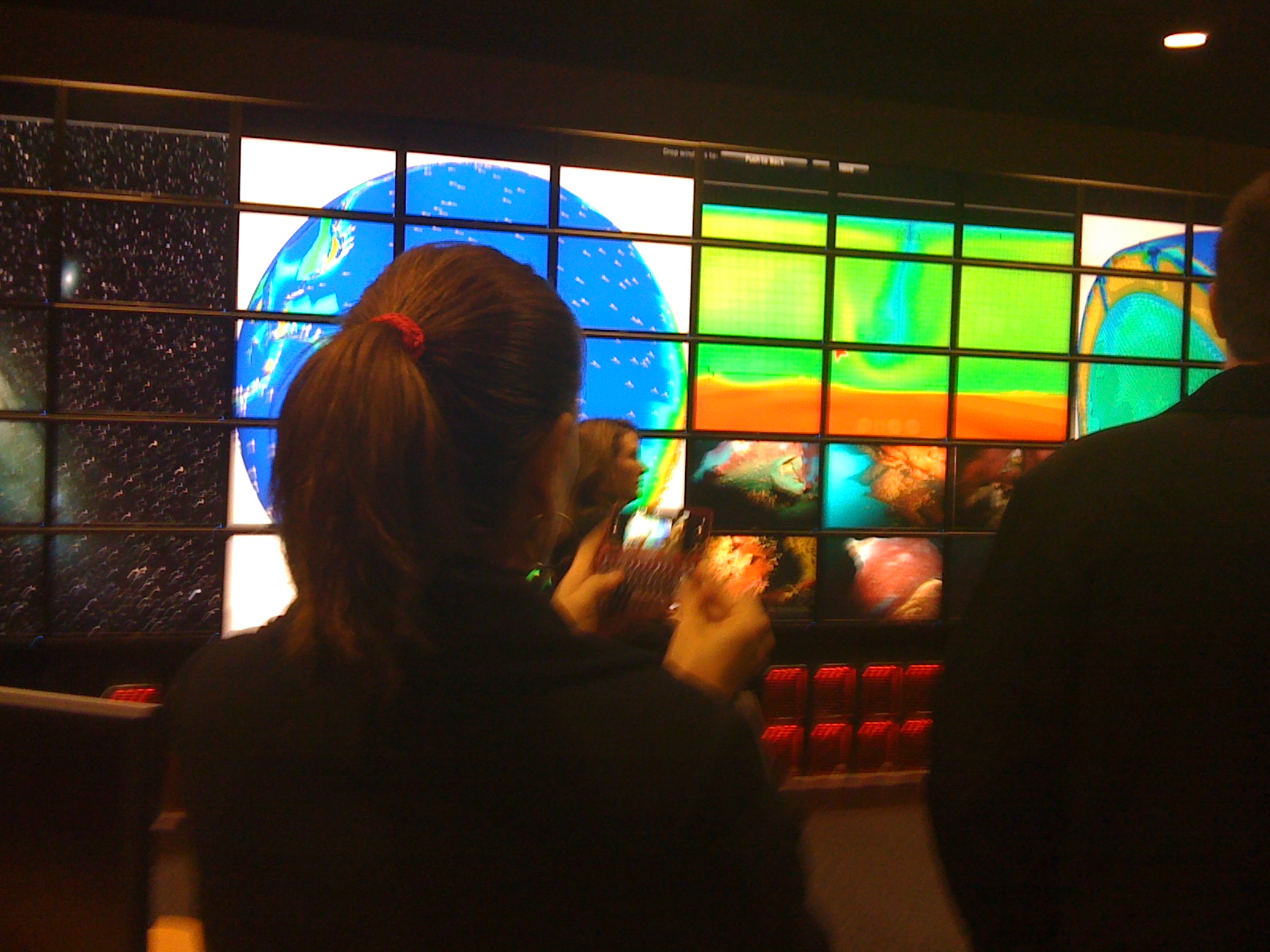
Do you know Science on a Sphere. It is a transformative use of media to teach. It is awesome.

I was working with NTIA, NOAA, when I was pulled away from Geography as my main sphere of Interest.
NOAA is a federal agency focused on the condition of the oceans and the atmosphere. It plays several distinct roles within the Department of Commerce with a broad mission. Some of NOAA’s more widely-known divisions include the National Weather Service, The National Hurricane Center, and the National Marine Fisheries Service.

Science On a Sphere (SOS)® is a room sized, global display system that uses computers and video projectors to display planetary data onto a six foot diameter sphere, analogous to a giant animated globe. Researchers at NOAA developed Science On a Sphere® as an educational tool to help illustrate Earth System science to people of all ages. Animated images of atmospheric storms, climate change, and ocean temperature can be shown on the sphere, which is used to explain what are sometimes complex environmental processes, in a way that is simultaneously intuitive and captivating.

Science On a Sphere® extends NOAA’s educational program goals, which are designed to increase public understanding of the environment. Using NOAA’s collective experience and knowledge of the Earth’s land, oceans, and atmosphere, NOAA uses Science On a Sphere® as an instrument to enhance informal educational programs in science centers, universities, and museums across the country. Science On a Sphere® is available to any institution and is currently in operation at a number of facilities in the US.

See if you can get a kid to move, when there is this exhibit to learn from. It is mostly in museums or may be coming to a conference near you.

FInally, the 21st Century Partnership now shares the ideas of geography, and they have involved schools in the blueprint. Here is their set of resources.

   Games in Education , yes, yes and yes,

Featured Games

  • Photo: A screen from the games Lost Chronicles-Fall of Caesar, showing Brutus walking through an ornate hall

    Lost Chronicles: Fall of Caesar

    Reveal the conspiracy behind Caesar’s murder in this hidden object investigation. Meet historical figures, including Marc Antony, and learn of their role in the conspiracy.  Explore historically-detailed locations in Rome and Greece, searching for clues, as you follow the path of Marcus Brutus after he murdered Caesar.  Play various mini-games, puzzles, and more, and access informative articles courtesy of National Geographic in this compelling game.


  • salem-game.jpg

    Lost Chronicles of Salem

    Help a mother and daughter who have been accused of witchcraft escape superstitious mobs in this captivating hidden object thriller. Explore 1692 Salem in richly detailed screens, and play mini-games like word jumbles, puzzles, and more.


  • Photo:  A photo montage of migrating animals--zebras, crabs, butterflies

    Great Migrations

    Based on the breathtaking National Geographic Channel miniseries Great Migrations, this game challenges you to protect and guide your animals on their dangerous migration journeys. Select a leader, collect your herd, evade predators, and heal all wounds!


  • Photo: Logo of the game Build It Green--Back to the Beach

    Build It Green: Back to the Beach

    You love this tropical island, and now it is up to you to protect it and everything around it. Build it green

    I cannot share everything that is of the National Geographic. Go to the home page, sign up, sign in and get working.

    Bonnie Bracey Sutton

    Victor Sutton

    PowerofUs

What Science Pipeline? Making Sense of STEM Offerings! Part One

Family Outreach Days at AAAS Family Days  - Teragrid Booth

Students explore visualizations of the oil spill.

We all know that many students are not anywhere near talented teachers who can give them the information they need to be curious, understanding, interested and involved in the STEM initiatives. For many there is no pipeline, no indepth knowledge of any of the subjects that will create workforce, or future readiness for careers.

As a career STEM teacher, I was teaching science, math, problem solving, engineering and the use of technology early, i caught a lot of flack.  There were helpful groups of people and organizations that  reached out to me, to others and who helped us to become the teachers that need to be STEM educated. There were these teachers an d we were ridiculed during the Bush administration for teaching science. It was the bottom of the needs totem pole for M. Spellings. So we were not groomed, by our school systems or regarded in a good light. Political winds blew us away.

There was

NASA has many resources that a teacher can personalize and share with no cost.

Astronomy , space science education, the Chalenger Center Programs, so many offerings

,  NASA’s Education Materials Finder will help teachers locate resources that can be used in the classroom. Users may search by keywords, grade level, product type and subject. With hundreds of publications and Web sites indexed, the finder is the best way to locate NASA educational resources.

›  Find Materials Now

We meet the world on the news , but do students know where in the world the news is coming from?

The National Geographic Society and its Outreach to Teachers

Community, Education, and Student Outreach, http://www.informationweek.com/news/231003049

education.nationalgeographic.com  

Most remarkable in the way of transformational and experiential teaching was the experience offered by the National Geographic. It was not just an experience for me. There are Alliance groups within the Geographic. There are opportunities. I had a month of involvement in all things geographic. What they have to offer changes as the programs expand. There is a section on education, there are special programs, , there are lesson plans and there are mentorships to be had in the AAGE.

National Geography Standards

The first ever national geography standardsGeography for Life, were published in 1994 and are being voluntarily adopted around the country. These geography standards are benchmarks against which the content of geography courses can be measured. Standards will affect the education of all children in the United States, and they should be part of the program of instruction of schools in your community. Copies of Geography for Life are available for purchase from the NCGE store.

The Geography Standards Framework consists of two levels. At the first level, the subject matter of geography is divided into six essential elements. By essential we mean that each piece is central and necessary; we must look at the world in this way. By element we mean that each piece is a building block for the whole. At the second level, each essential element contains a number of geography standards, and each geography standard contains a set of related ideas and approaches to the subject matter of geography.

National Geography Standards

The first ever national geography standards, Geography for Life, were published in 1994 and are being voluntarily adopted around the country. These geography standards are benchmarks against which the content of geography courses can be measured. Standards will affect the education of all children in the United States, and they should be part of the program of instruction of schools in your community. Copies of Geography for Life are available for purchase from the NCGE store.

The Geography Standards Framework consists of two levels. At the first level, the subject matter of geography is divided into six essential elements. By essential we mean that each piece is central and necessary; we must look at the world in this way. By element we mean that each piece is a building block for the whole. At the second level, each essential element contains a number of geography standards, and each geography standard contains a set of related ideas and approaches to the subject matter of geography.

 Earthwatch Education

Earthwatch fellowships enable critical partners to participate in research expeditions worldwide. Each year, Earthwatch’s Fellowship Programs enable hundreds of studentsteachersconservation professionals, and corporate employees to join expeditions at little or no out-of-pocket expense. Earthwatch Fellows are emissaries of the Earthwatch mission, sharing their experiences and new knowledge with thousands of students, teachers, and colleagues upon their return.

Educator Fellowships

Summer Fellowships
Get out of the classroom and head into the field to learn about cutting edge research and conservation efforts, to develop professional skills, and to make a difference for our shared environment! As a summer educator fellow, you’ll spend 1-2 weeks of your summer recess on an Earthwatch expedition alongside a diverse team of volunteers led by prominent field researchers. After your expedition, you’ll bring the world back into your classroom and to your students as you’ve never done before.

Learn more about our Summer Fellowship program.

Live From the Field
Live From the Field educator fellows join Earthwatch research teams during a brief portion (7 to 10 days) of their school year and share their experiences with classrooms at home using blogs containing, photos, videos, lessons, and activities. Live From the Field educator fellows also connect with students through live video and phone conferencing at scheduled times during their expedition.

I joyously participated with other teachers in Earthwatch Outreach.  It was fun to be an Earthwatch fellow. Working with a scientist in the field using technology to share the archeological findings was hard work, but rewarding. I learned the culture of the island, the history of Mallorca, I learned about archeological excavation , and how we could use technology to map the site and the finds. Many teachers have been Earthwatch Fellows. The experience can be a life -changing event. Who knew about the other history I learned so much about . The cultures of the Med were unknown to me. Dr. William Waldron was the PI at the time. I participated in a further grant, we mapped the Mongoose popution of St. Martins .. and then volunteered to do Turtle nests , at night , another project. Nothing in a textbook can match the experience. Nothing!

K-12 classroom educators of any subject(s) from public or private schools nationwide are eligible to apply for Earthwatch fellowships. The strongest applicants are those who are passionate about teaching, excited about making a difference with their time and talents, and committed to engaging their communities using their knowledge, passion, and energy.

A starting point is the Education Department of the National Geographic. I don’t remember why I knew about them, or what I saw that made me apply to a summer institute.

, NSTA and their workshops, NCTM and their initiatives , Shodor.org and their free resources, the Fish and Wildlife Service, 4H and the SET program, the Exploratorium, and wait there are more, but I won’t name them all.

There is a digital divide, and there are resources everywhere, if teachers can access them, but given the state of broadband, in many areas that are rural and distant , the people who are concerned about STEM , are creating a false illusion that teachers create the problem.

There is also the knowledge that we in the classrooms have a mandated methodology which we can tweak but the management, ie the school boards and policy people make most of the decisions. So, what ‘s a teacher to do? Stay tuned. The age of Sputnik is over!!

The age of Transformation , has begun in Education.

http://chronicle.com/article/A-Size-That-Fits-All-for-the/128421/

Exploring the Teragrid

Outreach to the public sharing research = Oil Spill simulation

Michael Morgenstern for The Chronicle

By Hal Salzman and B. Lindsay Lowell
The strength and size of the nation’s science-and-engineering work force are the subject of much concern, following the Obama administration’s education initiatives; international testing that shows students in Shanghai at the top of the world; and, last year, an update of the influential report “Rising Above the Gathering Storm.” That report finds the deterioration of America’s competitiveness so severe that it is likened to a Category 5 hurricane. It calls for the United States to create a “New Sputnik” education initiative and expand our science-and-engineering work force. It reinforces a common worry over American students’ lackluster international standing compared with those in several Asian nations and in a handful of small European nations.

We believe that those concerns are overstating and misidentifying America’s challenges in science and engineering, and that they are missing the real opportunities for improving the nation’s education and work force. As we examined the evidence, several points became clear: The United States needs to improve education broadly rather than expand particular fields of study; look inward rather than abroad for exemplary educational models, in light of the limits of international comparisons; and focus on the core lessons about improving the lowest-performing group of students. There is actually no compelling evidence that, over all, the educational pipeline is failing to meet demand.
Our recent analysis of Department of Education data for three decades followed students from high school to the job market. We found little in the way of overall change in students’ pursuit of science-and-engineering studies or their entry into those careers over the past 30 years. We found that while a steady proportion of college students graduated in science and engineering, no more than half of them landed jobs in a formally defined core science or engineering occupation.
So, given a steady supply, why do companies report difficulty in finding ideal workers? Listen carefully and it sounds as if the employers would like entry-level workers to have skills not typical of newly graduated students. Leading engineering companies seek technologists with a depth of skill in a technical area combined with a broad education across technical fields, business, and the social sciences. Colleges find it difficult to develop all of that in only four years. So the hiring difficulty may reflect problems with pedagogy, the structure of higher education, the unwillingness of some employers to train new workers, and a lack of collaboration between academe and industry. It does not, however, indicate a loss of student interest or a shrinking pool of science-and-engineering graduates.
Nevertheless, some policy makers and industry leaders believe that to meet the demands of our knowledge economy, more such education is needed. They even think it is preferable to other fields of study. While acknowledging the value of science-and-engineering knowledge, we find that it is but one of many forms of valuable knowledge. Moreover, the science-and-engineering managers we interviewed expressed dissatisfaction with the “soft” communication, or teamwork, skills of their new engineers. And changes in hiring patterns suggest that the nation’s economic future depends on developing a balanced portfolio of well-educated workers across the spectrum of skills, knowledge, and disciplines.

Finally, some industry lobbying groups and high-tech companies seek to augment the supply of domestic workers by importing foreign labor on temporary visas. But this confuses the purpose of those programs with the country’s immigration policy for citizens-in-waiting. Immigration policy is driven by a long-term vision and a wide range of social and political objectives. The original intent of temporary-visa programs, on the other hand, was to meet short-term, not structural, labor shortages. Ensuring that labor markets are not distorted by short-term visas, which in their current form lead to a number of labor-market and social problems, is not anti-immigrant, and does not undermine the strength of U.S. science and engineering. In fact, raising the numbers of temporary visas for foreign workers during cyclical talent shortages can distort labor markets and discourage domestic students from careers in engineering and the sciences.

While we do not maintain that our study, or any one study, is definitive, we do believe that influential groups should consider new evidence in their quest to advance science, technology, and economic growth. When we look at the past three decades, the data support a far more favorable set of conclusions on student performance and supply than those promulgated by critics of the so-called STEM (science, technology, engineering, and math) pipeline. At the same time, our research supports the widely recognized fact that women and minorities are the most likely future source of STEM workers, and, discouragingly, that where the education system is most clearly failing is precisely for those populations. Of course, focusing on the big picture leaves out clear-cut examples of unfilled shortages of workers in esoteric but crucial occupations.
The classic tried and true formulation is that supply follows demand or, less sanguinely, that depressed wages and discouraged workers result if supply outstrips demand. To avoid those problems, a number of demand-side policies should receive support from all quarters. These policies include stable and increasing government financing for research, reinvigoration of lagging private-sector investments in research, tax breaks and other incentives for research-and-development activities, and the creation of an environment that encourages entrepreneurship. In terms of education, however, the evidence clearly points to improving basic education for low-performing students, schools, and populations—not an attempt to artificially inflate the number of science-and-engineering degrees awarded.
Hal Salzman is a professor of public policy at Rutgers University at New Brunswick. B. Lindsay Lowell is director of policy studies at the Institute for the Study of International Migration at Georgetown University.

THE JACK  kENT COOKE FOUNDATION

No Gifted Child Left Behind?  First, the good news: It turns out, millions of kids from low-income families are acing standardized tests. Now, the bad news…http://www.jkcf.org/news-knowledge

With the tests we find that there are many who have the capacity to learn, to create to innovate, but, sadly nothing happens.  Download the report, here is the summary.

Today in America, there are millions of students who are
overcoming challenging socioeconomic circumstances
to excel academically. They defy the stereotype that poverty
precludes high academic performance and that lowerincome
and low academic achievement are inextricably
linked. They demonstrate that economically disadvantaged
children can learn at the highest levels and provide hope
to other lower-income students seeking to follow the
same path.
Sadly, from the time they enter grade school through
their postsecondary education, these students lose more
educational ground and excel less frequently than their
higher-income peers. Despite this tremendous loss
in achievement, these remarkable young people are
hidden from public view and absent from public policy
debates. Instead of being recognized for their excellence
and encouraged to strengthen their achievement, highachieving
lower-income students enter what we call the
“achievement trap” —
educators, policymakers, and the
public assume they can fend for themselves when the facts
show otherwise.
Very little is known about high-achieving students
from lower-income families — defined in this report as
students who score in the top 25 percent on nationally
normed standardized tests and whose family incomes
(adjusted for family size) are below the national median.
We set out to change that fact and to focus public attention
on this extraordinary group of students who can help
reset our sights from standards of proficiency to standards
of excellence.
This report chronicles the experiences of highachieving
lower-income students during elementary
school, high school, college, and graduate school. In
some respects, our findings are quite hopeful. There
are millions of high-achieving lower-income students
in urban, suburban, and rural communities all across
America; they reflect the racial, ethnic, and gender composition
of our nation’s schools; they drop out of high
school at remarkably low rates; and more than 90 percent
of them enter college.
But there is also cause for alarm. There are far fewer
lower-income students achieving at the highest levels than
there should be, they disproportionately fall out of the
high-achieving group during elementary and high school,
they rarely rise into the ranks of high achievers during
those periods, and, perhaps most disturbingly, far too few
ever graduate from college or go on to graduate school.
Unless something is done, many more of America’s brightest
lower-income students will meet this same educational
fate, robbing them of opportunity and our nation of a
valuable resource.
This report discusses new and original research on
this extraordinary population of students. Our findings
come from three federal databases that during the past 20
years have tracked students in elementary and high school,
college, and graduate school. The following principal
findings about high-achieving lower-income students are
important for policymakers, educators, business leaders,
the media, and civic leaders to understand and explore as
schools, communities, states, and the nation consider ways
to ensure that all children succeed:

I Kids..IPhone, I Read with Joy..I Read

Recently a small relative, who is under 2 yeas old made me think a lot about the new ways of learning that we should be considering and monitoring, and learning from. The participatory culture has a new addition. None readers can do interactive learning. He had books, and I think I saw Nemo over and over again until I was tired of it. But the IPad changed his habits. I also had some other tricks up my sleeve, but I never had to use them. He still gets a good reading activity from his mother, a bedtime story that is in traditional form.

Using the IPad

New ways of exploring learning, vaulting the digital divide

The article, the rise of the IKids caught my attention.

http://www.mercurynews.com/news/ci_16860666?nclick_check=1

I am from the Grandma and Me generation. That is there were some CD Roms, that I used to teach students , at a higher level than non reader, and I was fascinated then by the attention, time and interest of students.  A principal challenged me to make use of the programs and I did. Unfortunately, the programs worked so well, that I had to find a new way to schedule students into the lab. We were a small school with a tiny lab, with a window to the world.  Linda Roberts did not approve of the programs, but I used them to enrich and change the interest level of readers. Ok, I also was able to do individualized conferencing since all of the kids were busy, and to introduce children to many books in that format with ease, no matter which language they spoke at home. The school I worked in was a school in which there were many immigrant children. English was.. sort of spoken by most , but not necessarily by the book.

I started the use of the CD Roms ( which I found in a closet) with special education students. I liked the individual ways in which students could progress through the materials and it also gave me time to do small group work.

I knew the materials were a hit when some of the children literally ran with their walkers to the lab with a smile on their faces trying to escape going to recess. There were about ten programs in this category and those that I did not have, we purchased.

A lot of people would say.. how is that reading??  Well the program could read to you, you could click on the images on the program, and you could go through the program in Spanish, in English and Japanese.  There were variable resources as well. Many people thought that these little books were not academic enough. I saw them as an invitation to read, to explore, to think, to be imaginative to get lost in the reading experience. Living Books they were called. I individually purchased every one I could get. They were that inspirationally different from the thick , boring textbook with the workbooks and word tablets that were never ending. I am not sure but this is what Wikipedia says about where the Living Books are and how they can be found except on UTube.  I am just learning to be a facilitator for a pre-reading child. I should explain that I escaped teaching for a while, the tedium of the reading circles got to me.  But I did return.

“The Living Books series was a series of interactive animated multimedia children’s books produced by Brøderbund and distributed on CD-ROM for Apple Macintosh and Microsoft Windows. The series began with the release of Just Grandma and Me (an adaptation of the book by Mercer Mayer) in 1992; other titles in the series included The Tortoise and the Hare,Arthur’s Teacher Trouble (and other adaptations of books by Marc Brown), Dr. Seuss andBerenstain Bears titles. [1]

Living Books became quite popular in the mid-1990s and were even used in some classrooms to teach English. Some home-computer users reported purchasing CD-ROM drives and sound cards specifically to run Living Books.

Many of them had selections for other languages, namely Spanish and Japanese.

The series did have an official website, http://www.livingbooks.com[1], but after the series was canceled by Broderbund, the site was up for grabs and bought by Scholastic. It was then converted into a jungle book series website that sold books published by Scholastic.

So , now on IPad and IPhone there are newer interactive programs. How do we use them in schools? Do we?

Little Critter certainly helped me to charm a group of students who were not all that interested in reading to read. We progressed to the Jack Prelutsy poetry, to the other offerings of this genre. The special education teacher and I were on a roll for a long time until the teachers saw the excitement in the lab through our goldfish window. Then, even the teacher who gave me the programs stating that the were useless, demanded lab time.

We had a solution. earphones from the Dollar Store, and a selection of the programs for the special education class so that they could continue their explorations during class.

Reading is a very special joy, interactive reading , is a new way of sharing. Soon there was the Cat in the Hat and other offerings.. I loved being able to take the kids from the CDRoms to a real book, but I also had surprises. One day a child spoke the story to me in Japanese.

This opened my eyes to limitations we place on students with gated reading. Often teachers would not let you go to the next level. You know, it was a grade leveled thing reading. NOT.

The IPad and other reading programs give wings to students who enter the world of reading with true interest, and joy. The little relative who wanted to find sites on IPad, was introduced to the stories, and demanded them from time to time. I have been told that there are applications on the IPhone as well that are of interest to students.

Award Reading uses the magic of the technology in a cloud based reading program and I suppose that there are other programs who see the new ways of learning that are personal. interative and individual. Certainly the textbooks as we know them, good stories carved out of books that are a year long assignment are doomed.

Individualized learning … personalized learning. Do read the article. It is an eye opener.

Here is a small segment. This will calm the fears of those who think we will run out of reading materials and ideas in teaching and learning.

“Before, during and even between classes at Hillbrook School this fall, seventh-graders have been spotted on the Los Gatos campus, sometimes burbling Spanish or Mandarin phrases into the glowing screen in their hands, other times staring into it like a looking glass.

iPads — the Apple of almost every adolescent’s eye — are being provided to students at several Bay Area public and private schools this year, including Hillbrook, which claims to be the only K-8 school in America using tablet computers in class and sending them home. This has led to a lot of 12-year-olds swanning around the wooded hillside campus, talking to their iPads.

“Summoning up a virtual keyboard recently, Sophie Greene quickly typed a note to herself in iCal, a calendar program, then played back an audio file in which she was speaking Spanish. “We record a conversation, e-mail it to our teacher, Señorita Kelly,” she explained, “then she critiques the lesson in Spanish and sends that back to us.”

Conquering the digital divide to provide the mobile tools. Well, that’s another problem. Not mine to solve. I believe that the inattention and the behavior problems in schools of need are caused by the old fashioned idealogy and ideational scaffolding .. using industrial models of reading to teach 21st Century media kids. There are probably students who would love school even more with the right tools. I know that the students I had loved games, books, and the personalization of knowledge. We must transition into new ways of sharing good ideas. What are yours in reading? What magic have you seen?

I have a friend who does 3 dimensional reading .. but I don’t know if that work is in books. One of the things that Living Books did was to encourage me to have students write their own books. Little books. Now with gaming technology , I believe we could at higher levels create some animations of our own to share the ideas of the book.

What have you seen? What captures your imagination in new ways of reading?

I love technology, but I still have a house full of books. That however is a different discussion we can have. What is the best mobile  tool? I certainly don’t know.

What is the power of us to make reading exciting, enchanting, involving and imaginative? That power, give to the disaffected students can change their world and ours. I am thinking three dimensional books. Works for me.

Much Ado About Education.. Circa 1995, So Why has it Not Happened?

Alex Repenning

What book are you reading?.. I have three on education that are catching my attention. Some of us have been talkking about preparing for the 21st Century for about 20 years.  Some of this has happened, but many people are on the digital dark road.

Time to put the Edge into Education


Revisiting Common Ground. an NIIAC Document 1995 -Why didn’t this happen?
by Bonnie Bracey Sutton
How much of this has happened? Take a look.
What are the impediments besides the lack of broadband.
I believe the lack of sufficient teacher professional development and the lack of school infrastructure are a part of the problem. Bad teachers? Who says?What about the lack of
understanding what was needed to meet the challenge of transformation?What about the slow understanding of how the world has changed with social media and the ways in which
the whole world has become internationalized? How has thinking changed about content?

Your thoughts , ideas ? What happened? Why did not a lot of this happen?


A Transformation of Learning:

Use of the NII for Education and Lifelong Learning

Bonnie Bracey <bbracey@aol.com>

Today, we have a dream for a different kind of superhighway that
can save lives, create jobs and give every American young and old,
the chance for the best education available to anyone, anywhere.

I challenge you. . .to connect all of our classrooms, all of our
libraries, and all of our hospitals and clinics by the year 2000.

Vice President Al Gore, speaking to communications industry
leaders, January 11, 1994

I am a classroom teacher. I am a member of the National Information
Infrastructure Advisory Council, appointed by the President and we are
involved in sharing our documents, which we wrote and the “Common Ground”
that links the ideas that will allow Americans to see the future, using
technology.

I want to share with you scenarios of technology at work from the Office of
Technology Assessment video, the overarching themes, or Common Ground of the
National Information Infrastructure Advisory Council
and the National Institute of Standards vision for the thinking which will
take us into technology.

Education and Lifelong Learning

Communications technology is transforming the way we live by
connecting us with information and each other. The National
Information Infrastructure (NII) promises every business,
government agency, hospital, home, library, and school in the
nation access anywhere to voice, data, full-motion video, and
multimedia applications. The impact of these capabilities on
learning — for the children, for higher education students, and
for lifelong learners — will be substantial.

The way Americans teach, learn, transmit and access information
remains largely unchanged from a century ago. We find the following
conditions in American education and training:

– The textbook remains the basic unit of instruction. Absorption of
its contents tends to be the measure of educational success.

– Teachers and instructors use “chalk and talk” to convey
information. Students are often recipients of instruction rather
than active participants in learning.

– School teachers work largely in isolation from their peers.
Teachers interact with their colleagues only for a few moments each
day. Most other professionals collaborate, exchange information and
develop new skills on a daily basis.

– Although half of the nation’s school teachers use passive video
materials for instruction, only a small fraction have access to
interactive video, computer networks, or even telephones in the
classroom.

– While computers are a frequent sight in America’s classrooms and
training sites, they are usually used simply as electronic
workbooks. Interactive, high performance uses of technology, such
as networked teams collaborating to solve real-world problems,
retrieving information from electronic libraries, and performing
scientific experiments in simulated environments, are all too
uncommon.

– “U.S. schooling is a conservative institution, which adopts new
practice and technology slowly. Highly regulated and financed from
a limited revenue base, schools serve many educational and social
purposes, subject to local consent. The use of computer technology,
with its demands on teacher professional development, physical
space, time in the instructional day, and budget … has found a
place in classroom practice and school organization slowly and
tentatively.”[note 1]

Events of the last two decades have proven that we can do better.
We have found that most American children are capable of learning
at dramatically higher levels — levels of performance we now
expect only of our best students. We have learned this from
research in cognitive science, from the educational achievements of
other countries, and from pioneering efforts in our own schools.
Moreover, after 35 years of research, we have found that technology
can be the key to higher levels of achievement.[note 2]

Similarly, in the American workplace we have found that workers can
achieve levels of productivity and quality equal to the best in the
world.[note 3] Well-educated, well-trained, motivated workers can
produce high-quality goods and services at low cost, enhance
industrial productivity and competitiveness, and sustain high
living standards. High-quality education and training payoff for
the individual whose skills are upgraded, for the company seeking
a competitive edge, and for the nation in achieving overall
productivity and competitiveness.

Our major foreign competitors place much greater emphasis on
developing and maintaining workforce skills than we do. Experienced
production workers at Japanese auto assembly plants, for example,
receive three times as much training each year as their American
counterparts. Research in our country has shown that workers who
receive formal job training are 30 percent more productive than
those who do not. Again, we have found that technology is the key
to making training accessible and affordable — especially for
small- to medium-sized firms with few resources of their own to
devote to producing and implementing the training and lifelong
learning their workers need and for workers who, on their own, are
attempting to improve their skills or transfer them to new areas of
endeavor.

Finally, in preparing students for the workplace, we have learned
that interactive, high performance technology can produce
immersive, real world instructional environments. These
environments can smooth longterm school-to-work transitions while
helping to meet the immediate objectives of both schools and
workplaces. Our efforts to develop this capability have been
fragmentary and shortlived at best.

A Vision for the Use of the NII

The NII, will be the vehicle for improving education and lifelong
learning throughout America in ways we now know are critically
important. Our nation will become a place where students of all
ages and abilities reach the highest standards of academic
achievement. Teachers, engineers, business managers, and all
knowledge workers will constantly be exposed to new methods, and
will collaborate and share ideas with one another.

Through the NII, students of all ages will use multimedia
electronic libraries and museums containing text, images, video,
music, simulations, and instructional software. The NII will give
teachers, students, workers, and instructors access to a great
variety of instructional resources and to each other. It will give
educators and managers new tools for improving the operations and
productivity of their institutions.

The NII will remove school walls as barriers to learning in several
ways. It will provide access to the world beyond the classroom. It
will also permit both teachers and students access to the tools of
learning and their peers — outside the classroom and outside the
typical nine to three school day. It will enable family members to
stay in contact with their children’s schools. The NII will permit
students, workers and instructors to converse with scientists,
scholars, and experts around the globe.

Workplaces will become lifelong learning environments, supporting
larger numbers of high skill, high wage jobs. Printed books made
the content of great instruction widely and inexpensively available
in the 18th Century. The interactive capabilities of the NII will
make both the content and interactions of great teaching
universally and inexpensively available in the 21st Century.

Education and Lifelong Learning Applications for the NII

The NII will provide the backbone for a lifelong learning society.
Education and training communities will better accommodate an
enormous diversity of learners in an equally diverse variety of
settings. In addition to schools and work places, interconnected,
high-performance applications will extend interactive learning to
community centers, libraries, and homes. Education, training, and
lifelong learning applications available from the NII may include:

– Multimedia interactive learning programs delivered to homes to
immigrant children and their parents to collaborate on learning
English as a second language.

– Troubleshooting and operating applications that access the
computer-assisted-design (CAD) databases used to design workplace
technology and to integrate the CAD data with instructional and
job-aiding capabilities to provide just-in-time training and
maintenance assistance.

– Comprehensive interconnectivity for students that allows them to
receive and complete assignments, collaborate with students in
distant locations on school projects, and interact with teachers
and outside experts to receive help, hints, and critiques.

– Simulated learning activities such as laboratory experiments and
archeological digs.

– Universal access interfaces for computers and telecommunications
devices for students, workers and others with disabilities to allow
access to the NII.

– Affordable, portable personal learning assistance that tap into
the NII from any location at any time and provide multimedia access
to any NII information resource.

– Immersive, realistic interactive simulations that allow emergency
teams made up of geographically dispersed members to practice
together on infrequently used procedures that may be urgently
needed to meet local exigencies.

The Educational Benefits of Technology

Evidence from research, schools, and workplaces around the country
tells us that communications technologies are powerful tools in
reaching the highest levels of educational performance.

– Students with disabilities, who previously had at best limited
access to most educational and reference materials, will have
fuller access and will have the ability to participate in the
learning experience with their peers.

– A 1993 survey of studies on the effectiveness of technology in
schools concluded that “courses for which computer-based networks
were used increased student-student and student-teacher
interaction, increased student-teacher interaction with
lower-performing students, and did not decrease the traditional
forms of communications used.”[note 4]

– Research on the costs of instruction delivered via distance
learning, videotape, teleconferencing, and computer software
indicates that savings are often achieved with no loss of
effectiveness. Distance learning vastly broadens the learning
environment, often providing teaching resources simply not
available heretofore. Technology-based methods have a positive
impact on learner motivation and frequently save instructional
time. Savings in training time produce benefits both by reducing
training costs and by shortening the time required to become and
remain productive in the workplace.

– A review of computer-based instruction used in military training
found that students reach similar levels of achievement in 30% less
time than they need using more standard approaches to
training.[note 5]

– A Congressionally mandated review covering 47 comparisons of
multimedia instruction with more conventional approaches to
instruction found time savings of 30%, improved achievement, cost
savings of 30-40%, and a direct, positive link between amount of
interactivity provided and instructional effectiveness.[note 6]

– A comparison of peer tutoring, adult tutoring, reducing class
size, increasing the length of the school day, and computer-based
instruction found computer-based instruction to be the least
expensive instructional approach for raising mathematics scores by
a given amount.[note 7]

– A landmark study of the use of technology for persons with
disabilities found that “almost three-quarters of school-age
children were able to remain in a classroom, and 45 percent were
able to reduce school-related services.”[note 8]

Of course, these benefits depend upon several contextual factors,
including the instructional methods used, the quality of the
applications, the availability of professional development for
educators, accessibility of instructional materials, the presence
of school technology support staff, and family involvement.[note 9]
We must learn through experience how best to ensure that the
benefits we intend to obtain from NII-based applications become
routinely realized in practice.

Telecommunications networks provide a range of resources to
students and educators that were never before available or
affordable. Students and workers can now gain access to mentoring,
advice, and assistance from scientists, engineers, researchers,
business leaders, technicians, and local experts around the globe
through the Internet, using a level of access and connectivity that
was previously unimaginable. High school students in West
Virginia, for example, can now study Russian via satellite and
telephone with a teacher hundreds of miles away. Few West Virginia
school districts could afford to offer such a course any other way.
Less well understood are changes in the types of learning that
occur with the use of certain technologies. Current evidence
suggests that some technology applications are more effective than
traditional instructional methods in building complex problem
solving capabilities for synthesizing information and in improving
writing quality. The effects are achieved in part by permitting
alternate methods of “reaching” and motivating learners.

The Administration’s National Information Infrastructure initiative
can trigger a transformation of education, training, and lifelong
learning by making new tools available to educators, instructors,
students, and workers and help them reach dramatically higher
levels of performance and productivity. The impact of this
transformation in teaching and learning is in-estimable, but
clearly enormous. Knowledge drives today’s global marketplace. The
NII will permit us to take learning beyond the limitations of
traditional school buildings. It will take our educators and
learners to worldwide resources. Learning will be our way of life.

PART II: Where Are We Now?

Today, compelling teaching and learning applications are the
exception, not the rule. Several federal agencies provide services
that meet specific, focused needs, while hundreds of state and
local networks and private service providers have begun to address
the technology needs of education. Current uses, while expanding
rapidly, reach only a small number of technologically-literate
school communities.

Current application of NII capabilities to work place training is
more extensive and technologically advanced than educational
applications, yet it lags well behind what is needed and available.
The story of workplace training seems to be a case of the haves
receiving more and the have-nots remaining neglected. Small firms,
those with 100 employees or less, provide about 35 percent of total
U.S. employment, but they lack the expertise to provide in-house
training, the resources to pay for outside training, and sufficient
numbers of people who need training at any one time to justify
focused training efforts. Larger firms are more likely to provide
training than smaller ones, but the training they provide is mostly
limited to college-educated technicians and managers. The lower the
level of skills possessed, the less likely the worker is to receive
training from any source. Transportable, quality controlled
training and lifelong learning could be made readily and
inexpensively accessible using the NII and will have a major impact
on improving worker skills and workplace productivity.

While much remains to be done, the opportunities offered by the NII
put many of the needed capabilities within reach of schools, homes,
and the workplace.

Current Uses of Telecommunications for Education

The existing telecommunications infrastructure is composed of
telephone, broadcast, cable, and electronic networks. It is used
for education, training, and lifelong learning in five basic ways:
1) instructing with video; 2) gathering information from remote
libraries and databases; 3) communicating using two-way
asynchronous capabilities such as e-mail and information bulletin
boards; 4) distance learning; and 5) electronic transfer of
instructional software and simulations.

– Instructional video. Seventy-five percent of America’s schools
have cable television, and half of its teachers use video material
in their courses.[note 10] The Stars Schools program is reaching
200,000 students in 48 states with advanced placement courses in
mathematics, science, and foreign language instruction using fiber
optics, computers, and satellites.[note 11] Cassette videotapes
for instruction are widely used in schools and work places, and the
development of these videotapes for both education and training has
become a vigorous industry.

– Information collection. This activity includes location and
retrieval of documents such as lesson plans and research reports,
but it also includes newer data sources such as CAD databases for
workplace technologies and equipment, and multimedia information
retrieval from digital libraries that can be accessed by students,
workers, or people in homes, libraries, and museums. Over 60,000
electronic bulletin boards are used by more than 12 million
Americans every day.[note 12] The annual rate of Gopher traffic on
the Internet, which directly represents an effort to use NII
facilities to gather information, is growing at an annual rate of
approximately 1000%[note 13] The Department of Education has a
Gopher server which points to or contains educational research
information, such as the AskERIC service and information from
sources such as CNN, Academy One, and the Educational Testing
Service. NASA Spacelink makes lesson plans on space flight and
related science topics available on the Internet.

– Two-way communication. This includes communication via electronic
mail and conferencing among teachers, students, workers, mentors,
technicians, and subject matter experts of every sort.
Approximately one-quarter of the teachers in Texas regularly sign
on to the Texas Education Network, or TENET, to share information,
exchange mail, and find resources. A professor at Virginia
Polytechnic Institute and State University teaches a writing course
entirely online. Students swap writing projects and discuss their
assignments online. In the workplace, electronic mail is used by
more than 12 million workers, increasing to over 27 million workers
by 1995. Just less than a sixth of U.S. homes now have at least one
computer connected to a modem, and this percentage is growing
rapidly. As of July, 1993, there were four Internet hosts for
every 1000 people in the United States. There are now 60 countries
on the Internet. About 137 countries can now be reached by
electronic mail.[note 15]

– Distance learning.
Hundreds of thousands of students in schools,
community colleges, and universities now take courses via one-and
two-way video and two-way audio communication. In South Carolina,
high school students across the state study with a teacher of
Russia based in Columbia through South Carolina Educational
Television. Boise State University offers a masters degree program
conducted entirely over networked computers to students all over
the country. The Department of Defense is investing well over $1
billion in the development and implementation of networked
distributed interactive simulation. This technology, which allows
dispersed learners to engage in collaborative problem solving
activities in real time, is now ready for transfer to schools and
workplaces outside of the defense sector.

– Transfer of instructional software and simulations. Instructional
programs, simulations, materials, and databases can all be accessed
over the NII and delivered to schools, homes, libraries, and
workplaces wherever and whenever it is desirable to do so.
Currently, there are massive exchanges of software, databases, and
files using the Internet, but relatively little of this activity
occurs in the service of education, training, and lifelong
learning.

Nonetheless, compelling applications that will become indispensable
to teachers, students, and workers are not yet available. All the
capabilities of computer-based instruction and multimedia
instruction can be distributed using NII facilities to schools,
workplaces, homes, libraries, museums, community centers, store
fronts — wherever and whenever people wish to learn. Yet the
infrastructure and applications to support this level of
accessibility for education, training, and lifelong learning uses
have yet to be developed. Until compelling applications are
available, educations will not realize the potential of the NII.

Efforts to Build the NII for Education and Lifelong Learning: Roles
of the Private, Nonprofit, and Public Sectors

Successful implementation of the NII to serve the nation’s
education and lifelong learning needs will require significant
contributions by the private sector, state and local governments,

Reference

D. Lewis and E. McCracken, Common Ground: Fundamental Principles for the
National Information Infrastructure, NIIAC,
March 1995.(gopher@ntiaunix1.ntia.doc.gov)

A new book by Milton Chen of the George Lucas Educational Foundation, picks up the discussion.

Where are we now?

Since information is no longer bounded by time and space, and I know you are all savvy digerati who get all your information from the Internet, you can listen to the live stream or archive at this link, where you’ll also see info on how to call in or send an email during the show:

http://www.kqed.org/radio/programs/forum/

For more info about the book and a short video of me introducing it on edutopia.org:

http://www.edutopia.org/educationnation

Now that we’re into a new school year, it’s time to put “the edge into education”!