Two Americas, Two Ways of Thinking About Education?And Technology?

There was  a recent headline that concerns me.

Do ‘top’ college graduates really make better teachers?

Teachers have been a target this year and most of the time, after responding to few blogs, I gave up on trying to share the inequalities in teaching based on location,the population being served, the difference in economics, income , access and permission within the field. We should also cite access to supportive in technology use and tools. A lot of the people talking to teachers on the Internet , don’t even know that access is a problem in the US.

ACCESS IS A PROBLEM

This was shared by the Chairman of the FCC at a New Foundation Event in DC about broadband.

In the US  lots of people think everyone has access to Broadband. That is still a national goal. People however treat educators as if there is broadband everywhere. Note that I sometimes put the URL though we know how to make it clickable. In rural and distant areas people are still using dial up.

Julius Genachowski 

 BARRIERS TO USE

Affordability: 36 percent of non-adopters, or 28 million adults, said
they do not have home broadband because the monthly fee is too
expensive (15 percent), they cannot afford a computer, the installation
fee is too high (10 percent), or they do not want to enter into a
long-term service contract (9 percent). According to survey
respondents, their average monthly broadband bill is $41.

Digital Literacy: 22 percent of non-adopters, or 17 million adults,
indicated that they do not have home broadband because they lack the
digital skills (12 percent) or they are concerned about potential
hazards of online life, such as exposure to inappropriate content or
security of personal information (10 percent)

The blocking of school sites is a national problem for those who have access to broadband.

Relevance: 19 percent of non-adopters, or 15 million adults, said they
do not have broadband because they say that the Internet is a waste of
time, there is no online content of interest to them or, for dial-up
users, they are content with their current service.

Digital Hopefuls, all of the people who hope to be able to use technology in the future but who are not a part of the digital revolution. We cannot fail to reference Cyberbullying, perhaps in the cloak of Digital Citizenship. Schools are in fear about online safety.

Insulting Teachers it the new sport.  

Some of the insults I take personally. No one ever went into teaching for the money.

I have lots of awards, citations, workshops and have participated in  national initiatives. I went to Virginia State College, an HBCU. You may not be aware of MSO’s, Minority Serving Institutions. Those of us who are across the digital divide , and the education divide have had to work really, really hard to be a part of the conversation in education. My inspiration was my mother who felt marginalized by a rural education. She went to college and became a teacher.  She worked in the area of rural Virginia that closed down rather than accept the integration of schools. She felt that the ten and twenty year old books that she was given to teach with were not the best tools for learning. Of course there was no Internet.

My uncle taught at Lincoln University in Pennsylvania. Back then Einstein used to drive to the college to inspire the minority students to learn physics. The lack of lab resources was his concern. Einstein packed things in his car and made the trip to teach the students of Lincoln.

My digital divide now is tools. I do not have the most recent of all digital tools, but that makes me understand the people who don’t have but the Powerpoint reader, or who only have free software. Checked the price of a professional Microsoft suite lately?Price of the conferences , plus travel and hotel? Every teacher does not get to attend the big conferences. Economics is a big concern , and I imagine that the people who attend the best universities get the latest of tools of all kinds. There are people who help  teachers by sponsoring grants, like the people at EDC who set the vision of the possibilities, and Manorama Talaiver who works to create equity  from Longwood University in rural Virginia.

But, I digress, look  below and  read the whole article and then think of all the people who worked in MSO’s , minority serving institutions, each with a different set of missions. Is this another kind of prejudice? I think so. Maybe another divide. We often think of all the divides that separate us, the information divide, the technology divide, the resource divide, the support / technical divide. But now we are being told by some that top universities produce the best teachers. Think again.

PROFESSIONAL DEVELOPMENT IS A PROBLEM!!

Think of teachers as the help who often need support and don’t get it.
If a doctor, lawyer, or dentist had 40 people in his office at one time, all of whom had different needs, and some of whom didn’t want to be there and were causing trouble, and the doctor, lawyer, or dentist, without assistance, had to treat them all with professional excellence for nine months, then he might have some conception of the classroom teacher’s job.  ~Donald D. Quinn

What makes a great teacher? Here is one of mine. A relative of students I had in class who mentored me . The children told me he knew more physics than I, so I wrote to him, and he sent me videos, and eventually came to visit.  We worked together later for President Clinton.

One of my mentors, his young relatives were in my class .

Bill Nye the Science Guy

As a teacher in some instances, you are always learning; especially with transformation in the way of the use of technology.  Technology is a moving target.

Sources of Information and Training? Sometimes Great Universities!

At George Mason, when Chris Dede was there, he worked with the schools in the community to make a difference. It was not one way. We went to his classes to talk to preservice teachers as well.The students visited our classes and learned from us. He is at Harvard now, but he was user-friendly to the learning community in our area.

Many of us have learned a lot from the University of Illinois, because the National Center for Supercomputing is there. It has been invisible learning because the media hardly acknowledges Supercomputing. Weather models,  earthquake patterns, tsunami examples,  visualization and modeling, the features are used in the news, without mention. How wonderful it would be if the science was acknowledged. Norm Augustine tells the story of the Senator who said that we did not need NASA because his local weather station could provide the data we need to know about weather.  The stations don’t acknowledge often , the source of their super doppler information.

I never attended the University of Illinois but. The universities have outreach to America. Most of us are in learning mode from resources that are for teaching and learning. The problem has always been the lack of sustained professional development. Some people think that a 2 hour explanation of a topic is sustained professional development. There is so much support available from interested groups, But, you must have enough broadband to reach out and be touched. Also , I hate to say this, but a lot of in service within school systems is not so effective.  Here are some good resources that have teacher outreach and training in mind.

One example:   Bugscope  http://bugscope.beckman.uiuc.edu/

Another powerful examplehttp://mynasa.nasa.gov/portal/site/mynasa/index.jsp?bandwidth=high

National Geographic.   http://education.nationalgeographic.com/education/?ar_a=1&ar_r=1

Thinkfinity     http://www.thinkfinity.org/

River City   http://muve.gse.harvard.edu/rivercityproject/index.html

Fieldscope  http://www.fieldscope.org/scop

Scalable Game Design Alexander Repenning’s Project

http://scalablegamedesign.cs.colorado.edu/gamewiki/index.php/Scalable_Game_Design_wiki

Dr. Henry Neeman  and Scott Lathrop who chairs the Supercomputing Conference reach out to help create a Supercomputing program for educators during the Supercomputing Conference, and there is Broadening engagement as well. These are researchers who want to help transform teaching and learning.

There are teachers who do not know these sites or people as resources. I could share a thousand more. School systems often do not use these as resources. Why ever not? There is no excuse for teachers not knowing except that the riches of the Internet and professional development are limited in many school systems . Technology is one thing , content is another. Time is another. The benefit of social media is that we share. The benefit of social media are the tools we use to teach each other.

Some say that the vendors own education since NCLB. Testing is the focus and has been since its  inception.

         SOME PEOPLE ARE LOOKING AT THE TOOLS, NOT INFORMED PRACTICE

Sustained Support? Where Found? transformational Learning? Blooms Digital Taxonomy,  TPACK? Chris Dede takes us into the future here. http:/www.nebhe.org/info/pdf/reinventing/Chris_Dede_10-4-10.pdf

All of the technology gurus need to think about deep content.

What is TPACK?

Technological Pedagogical Content Knowledge (TPACK) attempts to identify the nature of knowledge required by teachers for technology integration in their teaching, while addressing the complex, multifaceted and situated nature of teacher knowledge. At the heart of the TPACK framework, is the complex interplay of three primary forms of knowledge: Content (CK), Pedagogy (PK), and Technology (TK). See Figure above. As must be clear, the TPACK framework builds on Shulman’s idea of Pedagogical Content Knowledge. How many teachers know about it?

Here is the Tpack Image. IMAGE Lots to learn here.

There is an organization that supports teacher knowledge. It is SITE.org. AACE

Some of my teachers are from colleges and universities all over the US. We learn in our SIG’s and groups. It is not just about a conference. It is about collaboration, creation of new ideas and community.

Those groups that partner with educators to make a difference provide the best support. Unfortunately supervisors in schools want their signature on the professional development being offered, or do not know of the efforts of the National Geographic, NSTA, NCTM, Supercomputing, CSTA and other enabling groups. 

Why does professional development need help? Teaching and learning has undergone transformational change. It is not your grandmother’s school, or my mother’s idea of school.

Many of us attended , lots of courses from NASA, most from the University of Oklahoma.. Marc Prensky talks about how we in education learn from linking with other groups, associations and those interested in the subjects we are teaching. School systems do not always have the link or knowledge and that is why we have the National School Boards Association, and ASCD, and the various other organizations that break down the areas of isolation in education. But who can afford to attend all of the conferences? Those of us across the digital divide appreciate the online resources.

A stunning example of help is at the Shodor.org site. Computational thinking and learning. In particular, see, Interactivate.

There are people like Idit Caperton working from the various universities to help rural and poor teachers using the teacher network in a project entitled Globaloria. , or Chris Dede who works widely, sharing their messages in conferences , convenings and meetings. Probably most teachers don’t get to attend the meetings, because of costs, but we do have Facebook, G+ and organizations which are where we  , the regular people interested in education work to learn as education changes and transforms.

My concern about it is that there are excellent teachers who did not go to the best colleges  or universities.  More that many teachers did not get the best of professional development. Whose fault is that? 

We know that lots of people have a skill in teaching that is intuitive. There are lots of very smart people who cannot teach. They have the information, but they don’t know how to share, or even worse, don’t know how to frame their knowledge into ideational scaffolding for learning.  Do read the whole article. Lots of support to my concerns are here. I like to say that there are smart people who cannot teach their way out of a wet paper bag. But that would be rude as it is only a small set of people . We probably don’t know of the people who cannot teach. There is little feedback from those who are taught.

Do ‘top’ college graduates really make better teachers?

This was written by Matthew Di Carlo, senior fellow at the non-profit Albert Shanker Institute, located in Washington, D.C. This postoriginally appeared on the institute’s blog.

By Matthew Di Carlo

One of the few issues that all sides in the education debate agree upon is the desirability of attracting “better people” into the teaching profession. While this certainly includes the possibility of using policy to lure career-switchers, most of the focus is on attracting “top” candidates right out of college or graduate school.

The common metric that is used to identify these “top” candidates is their pre-service (especially college) characteristics and performance. Most commonly, people call for the need to attract teachers from the “top third” of graduating classes, an outcome that is frequently cited as being the case in high-performing nations such as Finland. Now, it bears noting that “attracting better people,” like “improving teacher quality,” is a policy goal, not a concrete policy proposal — it tells us what we want, not how to get it. And how to make teaching more enticing for “top” candidates is still very much an open question (as is the equally important question of how to improve the performance of existing teachers).

More segregation, dividing of the nation and educational misleading.

I adore some of the people in great institutions who have shared, resources, materials , workshops and initiatives. The problem is that education is ever-changing and subject to so many influences from people who do not  know schools or what happens in them.

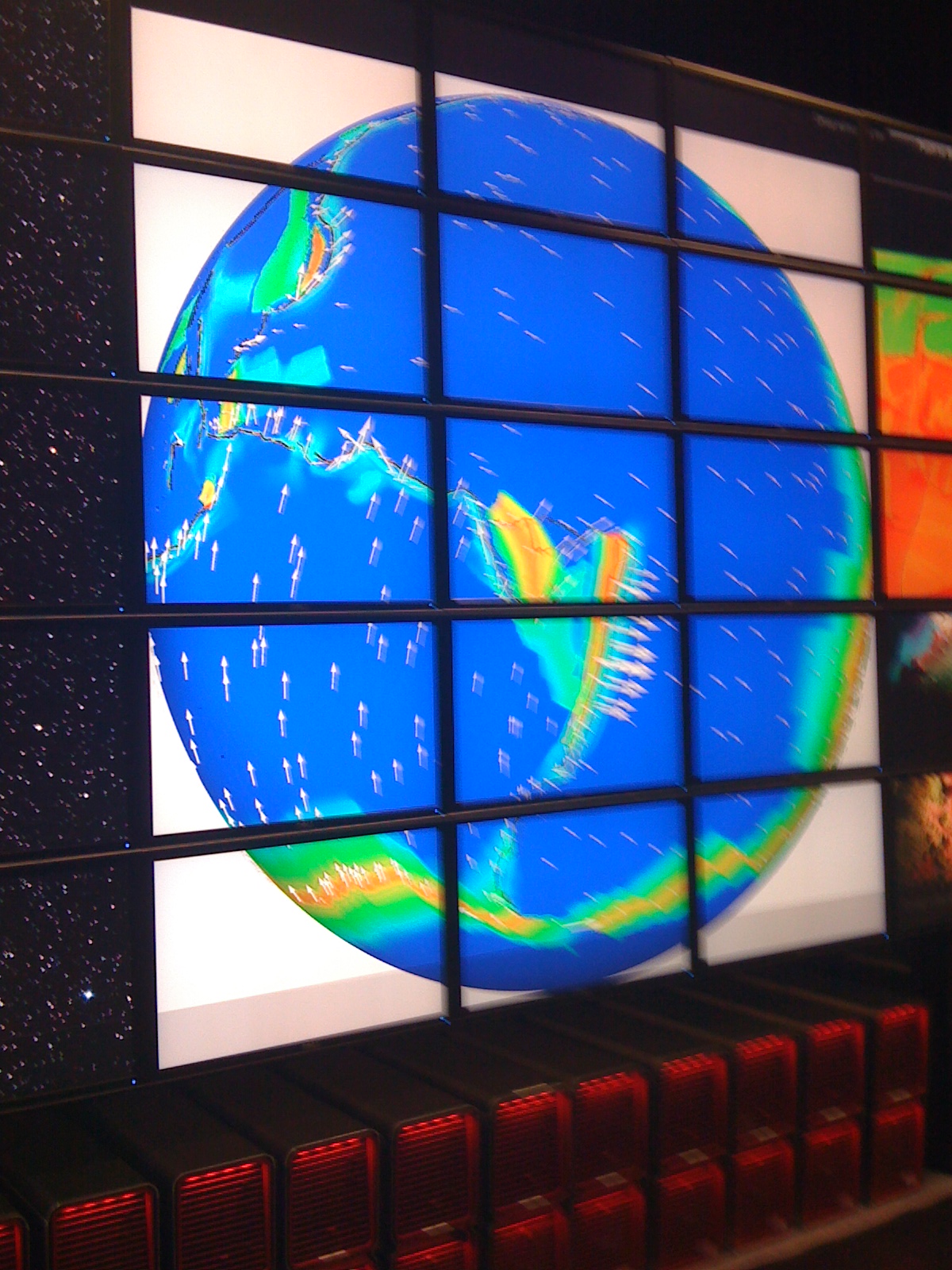
Working with the Teragrid on the National Mall

Outreach to the public .

MAIN IDEA

 Now comes the idea that only people who attend the better schools have the skills to teach?? Being a good teacher is a gift. Content can be given to Preservice students, but that does not alway translate into a better student  or an outstanding teacher.  There are a lot of very smart people who cannot teach because they don’t understand students, their culture, or how students get motivated to learn.

Teaching is a combination of many elements. The school you go to does not make you a good teacher. It gives you contacts, networks and resources , hopefully. In a classroom , you are on your own. The variables in a school setting are so many even the best teacher may have to adjust, recover, revise and rework , ideas in education.

It is class, race, competency, language skills, the interest of the parents, the local resources, the spending within the community , the level of technology infusion, integration and teacher education and the support within the learning community. Few people talk about the real problems in education.

The application of people skills is as necessary as is content, and the skill of multitasking, and of being able to give and take and to integrate practice , performance and pedagogy  into a school day..

Schools are a community in the  learning landscape. Here is the good news. Networking allows me to share the reality of schools and actually some of the mystery of why teachers just either quit, or conform. Dr. Chris Dede, when at George Mason University, did outreach to the communities and that was how lots of us got training in technology. He invited us in, but he also came to our classes. The university partnered in a project with local school systems. Dr. Dede was always ahead of his time most of the school systems did not follow-up on his model.

 There comes a point in time when you have to decide , who is teaching this class, and what is it that I want to do, as often , the political winds shift in strange directions. Sometimes I am in rooms of PhD students who really get it.Sometimes, I know that they are PhD students, and that may mean that they cannot see all the way down to the classroom. If they ever had experiences in the classroom, they did not include newer ways of working, except what they studied.

I insisted on teaching science and problem solving math and thinking about computational sciences. I was right, but what a price I paid. I don’t regret it, but then to see the people who accepted it be thrown out of teaching and learning because they are considered not teaching STEM. It is unbelievable. I did not bow to testing as the reason for teaching. I did the tests and my students did well, but we had SO much testing.

Many of the people pushing NCLB have since changed their minds and are  now eloquent in their new  disbelief of the policy they gave to the nation. Thank goodness.

A generation of students and teachers have been lost by this time.

We who teach, know that the administrators set the tone of learning in a building, that the School Boards help to create the learning landscape and oversee curriculum  in a school system, that there are also the State mandates, and the effects of the Department of Education as there are fundings and programs that overlay everything we do. I have been through the various fashions or modes  in education, theme based, support of Gifted and Talented, Cooperative Teaching, Team Teaching, and I have worked in specialized schools.I have worked in a charter school, and tried to help with a DC Charter School with was an absolute failure. As you work through education you cannot have an opinion or you may find yourself without a job, support or funding. It does not matter if you are right. You have to be politically correct and sometimes that is.. well think, of the politics in a local school. It is often why teachers leave.

Who is the principal , who are the teachers that are liked in the community, who are the hard-working teachers who create miracles, and what is the sense of the school in working together?

There is a project that holds forth much hope if the project is ever funded, beyond the Tracy Learning Center. It is a model that has been in the works for a long time. It is the idea of a person called Jack Taub, who died this year the founder of the Source, which became America Online.. We who know of his dream keep the idea going forth. You can read about it at Emaginos.com.

The Tracy Learning Center is a charter school located in TracyCaliforniaUSA. Serving students in grades K12, it was founded in 2001 and had an enrollment of 125 students.[1] Charter status was awarded in June 2002.[2] It was decided, in June 2003, to relocate the Tracy Learning Center to the Clover Middle School site and to expand it to become a K–12 charter school.[3] Expansion of the school was completed in 2007, with the addition of the senior class, that took numbers up to 850.[1]
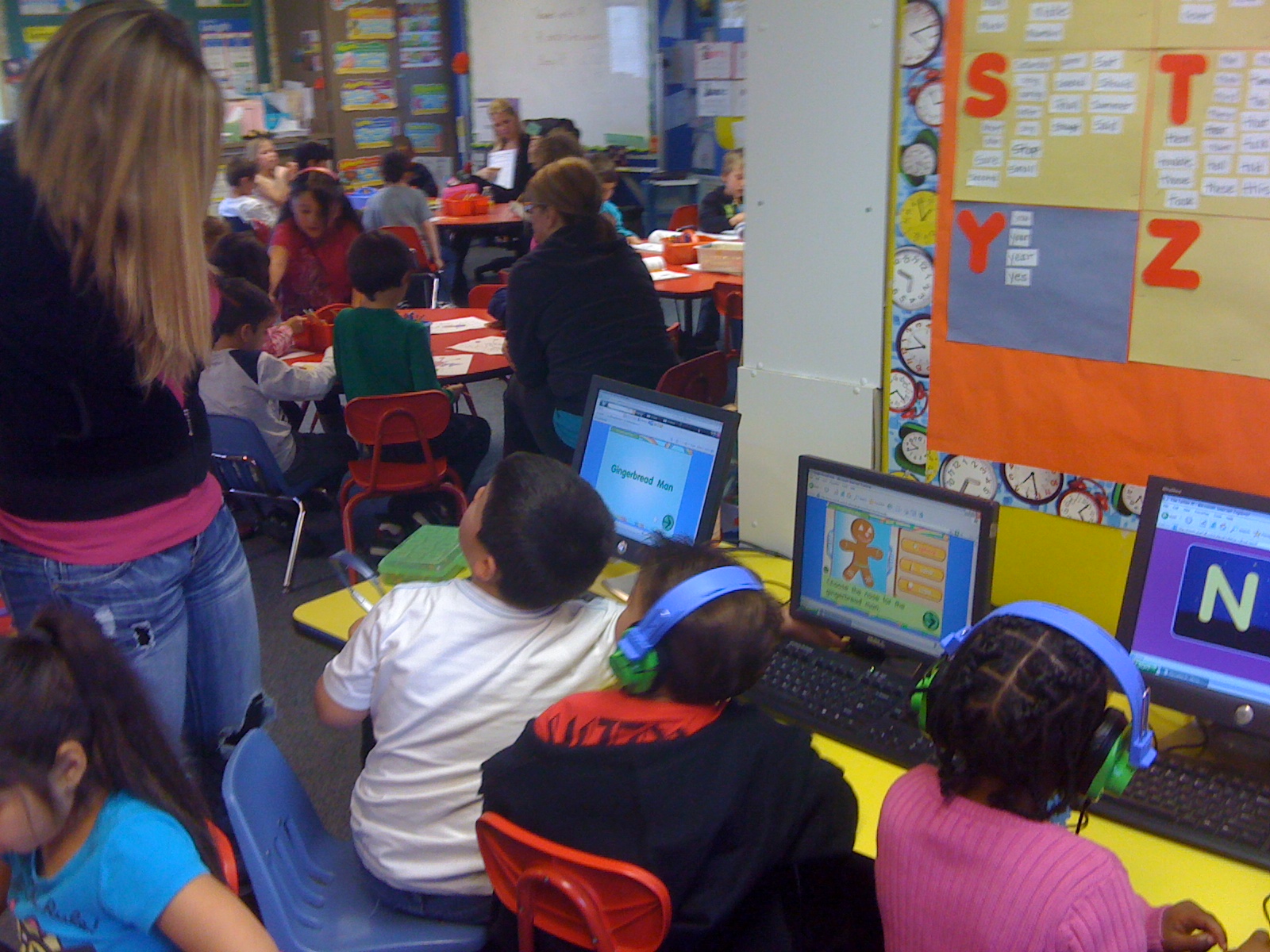
Tracy Learning Center

For the 2011-12 school year, the Tracy Learning Center has a population of over 1100 students K-12. It continues to be one of the highest ranked schools in San Joaquin County.It is a charter school, but we intend for it to go public. Teachers are in charge of the school.

WHY IS TEACHING SCIENCE A PROBLEM?

What happened to Science? Remember that tracking I told you about? People want to find the eleventh graders. Well to be a child in the upper grades interested in science on has to start somewhere. K-12 distribution of science is necessary . 

Sadly, in most of the schools in the nation, science is not a welcome subject. I put it in my curriculum using NASA, National Geographic Society Initiatives such as Kidsnetwork, NOAA weather and sea initiatives, and various NSTA resources.

When I was working in Arlington, there was the pressure of the parents to do new and exciting things in the use of technology. I learned a lot from parents, from one parent who taught me photography, from another who helped me learn to garden. Another teacher I will never forget was a Japanese teacher who came to teach the class and I about Japan, she had artifacts, taught us calligraphy, and all the time was working a meal. I was stunned. She was from the Smithsonian. Hmnn.. another way to involve and invite students. Never learned it in formal education.I incorporated cultural elements into my teaching practice because of her.

Dr. Embry was a forensic biologist who worked to reconstruct dinosaurs. How cool was it that we were able to learn from him at the Smithsonian. He offered, I accepted. Foot in the classroom and then we went to the Smithsonian to watch him work!!

Segregation by race is a national problem!

.When teaching students who were not gifted and talented science , geography, history were not allowed for the students on certain tracks.

Here is a study done by the Jack Kent Cooke Foundation.The report, Achievement Trap: How America Is Failing Millions of High-Achieving Students From Lower-Income Families, written by the Jack Kent Cooke Foundation and Civic Enterprises with original research by Westat, focuses on the educational experiences of high-achieving lower-income students from 1st grade through graduate school. A goal of the report was to examine the numbers of students considered low-income high achievers and to understand how these students were being educated. Using three federal longitudinal studies [Early Childhood Longitudinal Study-Kindergarten Cohort (ECLS-K), The National Education Longitudinal Study (NELS), and The Baccalaureate and Beyond Longitudinal Study (B&B)], students were categorized as high-achievers and further divided into either a higher-income or lower-income group. At this forum, presenters discussed results from the report, comparing the persistence rates, defined as students’ ability to remain in the top quartile of achievers, and improvement rates, defined as students’ ability to move from the bottom three quartiles  to the top quartile of achievers, both from higher- and lower-income families.  The report details the tracking, the dumbing down and the loss of those students who could make a difference in education.

And teachers? Do you see many of us minorities at the conferences presenting? We are “Ralph Ellison” invisible. We are not invited to the table. Broadening Engagement starts to solve the problem. If we are there it is often because we are passionate enough about education to invest in conferences where we are NOT invited. ASCD conferences are more diverse. I also like the resources, that try to combine the two America visions. Here is a book, 

Two offerings from ASCD

THE SIGHTS AND SOUNDS OF EQUITABLE PRACTICES DVD

TEACHING WITH POVERTY IN MIND: WHAT BEING POOR DOES TO KIDS’ BRAINS AND WHAT SCHOOLS CAN DO ABOUT IT

The Need To Transform K-12 Education

As President Obama recently told Congress and the American people,

“In a global economy where the most valuable skill you can sell is your knowledge, a good education is no longer just a pathway to opportunity — it is a prerequisite. Today, three-quarters of the fastest-growing occupations require more than a high school diploma. And yet, just over half of our citizens have that level of education. We have one of the highest high school dropout rates of any industrialized nation. And half of the students who begin college never finish. This is a prescription for economic decline, because we know the countries that out-teach us today will out-compete us tomorrow.”

 I learned that with technology I could reach students with technology who had been restricted to only reading , and math. Tracking is a problem that has been a part of American schools. It was one way to solve the problem of integration. Two schools in one, one for the kids who “could” and one for the people found to be lacking . Tracking is still a big problem. 

 I  also learned the politics of place and power in schools. The NEA rescued me, my union protected me from terrible on the job problems.  I am grateful for their involvement. Teachers don’t usually tell the bad stories. We just move, leave teaching or try to find another school.

Who has the tools? Are they affordable?  I had the science tools. I was a demonstration teacher for AAAS and my principal had my kits and resources thrown out of the window. This was Marge Tracy at Ashlawn. Fortunately , the custodian retrieved most of my things and put them in his truck. We secretly smuggled the things to places in the school where they could be kept and not disposed of. I had microscopes , hands on resources. Her thing was reading out of the book. She considered hands on a ridiculous waste of time. Since I was working with the George Lucas Educational Foundation , I was hearing, listening and learning from the best people in the country. But that nor the fact that I worked for the NIIAC worked to make principals accept science, math, and problem solving computational thinking. 

Finally, I left the school. The principal set the tone and I knew that she was going to transfer me. Being a principal gives you the power to cast out the teachers you do not like or respect. There are others who can tell even worse stories. It is a humiliating thing. It is the reason lots of people leave teaching.

RESEARCH STORY

The Achievement Trap, Jack Kent Cooke Foundation

The report, Achievement Trap: How America Is Failing Millions of High-Achieving Students From Lower-Income Families, written by the Jack Kent Cooke Foundation and Civic Enterprises with original research by Westat, focuses on the educational experiences of high-achieving lower-income students from 1st grade through graduate school. A goal of the report was to examine the numbers of students considered low-income high achievers and to understand how these students were being educated. Using three federal longitudinal studies [Early Childhood Longitudinal Study-Kindergarten Cohort (ECLS-K), The National Education Longitudinal Study (NELS), and The Baccalaureate and Beyond Longitudinal Study (B&B)], students were categorized as high-achievers and further divided into either a higher-income or lower-income group. At this forum, presenters discussed results from the report, comparing the persistence rates, defined as students’ ability to remain in the top quartile of achievers, and improvement rates, defined as students’ ability to move from the bottom three quartiles  to the top quartile of achievers, both from higher- and lower-income families.  The report details the tracking, thedumbing down and the loss of those students who could make a difference in education.And teachers? 

Sadly, from the time they enter grade school through their postsecondary education, these students lose more educational ground and excel less frequently than their higher-income peers. Despite this tremendous loss in achievement, these remarkable young people are hidden from public view and absent from public policy debates. Instead of being recognized for their excellence and encouraged to strengthen their achievement, high achieving lower-income students enter what we call the “achievement trap”—educators, policymakers, and the public assume they can fend for themselves when the facts show otherwise.

http://www.jackkentcookefoundation.o…ent%20Trap.pdf

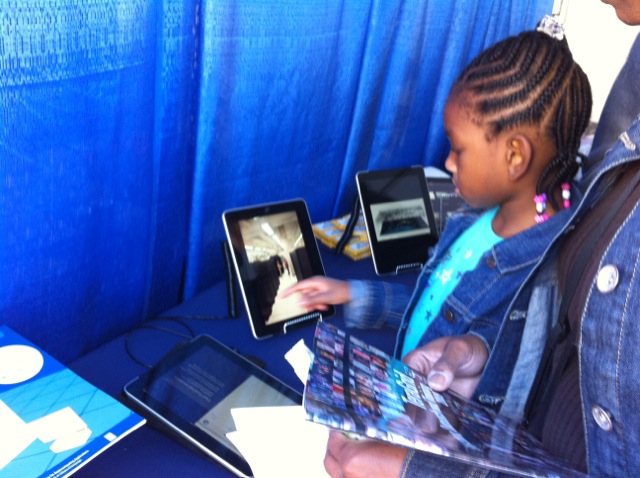
OThis is a student who was at a special project, School Expo and she was able to use technology she had never seen.
Using any means possible to explore technology


Who is connected to be involved? Who has the funding to join the organizations that are pioneering the work?  

 Bonnie Bracey Sutton

Mobile Devices, and Learning, a Cure for the Digital Divide?

I was first intrigued with mobile learning on a flight to Aukland, New Zealand. The small child across the aisle from me, clutched his device for every waking hour of the flight. I could not see what was on the device, I know it was an Apple IPhone. I was too polite to ask what it was that he was using on the phone… In countless planes, trains and even in an automobile, the problem of boredom seemed to be reduced. The mobile device seems to have solved those types of problems. To think of the power of Mobile look at this infographic . It is a good digital display of what is happening.

Some information on the trends  about mobile devices. And here is an infographic on the state of digital education. You won’t believe your eyes.

The Horizon Report and other futuring reports include the use of mobile devices.

It won't replace you, it will enhance the learning environment!

Mobile Devices

At a visit to the National Geographic I had to pay attention to the device that was questioning me about my geographic knowledge. The device was counting answers and giving instantaneous feedback.

But are what mobile devices are  allowed in schools? Are the powerful intersections of visualization, powerful content and models being kept away from the classroom? STEM resources are mostly available in imagery, visualization , modeling and embedded assessment, online.

In her Mindshift Blog, Tina Barsegihan states:

One of the most exciting things about living in the digital age is witnessing huge cultural changes occur in real time.

We’re at just that point now with mobile learning. Whether it’s on an e-reader, a tablet, or a cell phone, there’s great excitement — though not a lot of research yet — around the potential of how these devices can strengthen learning.

“There are frontiers that we’re just beginning to learn how to reach.”

“What if your mobile device had a sixth sense?” asked Harvard professor Chris Dede, who’s researching the diverse dimensions of mobile learning, at the recent ISTE conference.

When most of us consider education, we think of learning happening in isolated places — schools. But mobile devices are upending that assumption. With innovations like augmented reality, different kinds of information and experiences can be superimposed onto the real world, complementing and adding another dimension to “formal” learning institutions.

Pilot programs are springing up all over the country (more on those soon), as educators and researchers determine what kind of learning can happen best with mobile devices.

“We know from generations of work that devices are catalysts,” Dede said. “The device never produces learning, but when coupled with changes in content, new forms of assessment, linking people together, that’s what enables learning.”

Chis Dede talks about mobile learning : ” Learning a variety of content and skills anytime, anyplace wit a small device light enough to be carried in one hand.” Chis Dede, Timothy E. Wirth Professor in Learning Technologies, Harvard University

Jason Ohler.” Virtual learning and the availability of digital content have changed to offer more methods of student engagement, increased customization of learning objects, open resources, and personalized education..

Imaging the Universe, You can't do that with a book

Learning using visual Imagery

Digital citizenship is impossible until we help students live one life instead two. Right now they live two—a digitally unplugged life at school and digitally deluged life outside school. Having them bring their devices to school is a great first step in creating a reality-based environment for the discussion of digital citizenship. But what do we do about those students who have nothing to bring?posted by Jason Ohler
May 19, 2011

” Learning in the 21st Century, Taking it Mobile“ was a conference I attended about a year ago.. We know that the policy, process and technology infrastructures that are adopted over the next few years will shape education for decades. We also know that the lack of broadband is a problem in many places in the US. We have been talking about 21stCentury adaptations and transformation for many years. It is still a goal. . Many think the devices will change the learning landscape and equalize access.

DIGITAL DIVIDE

There is a dark side of the digital divide without broadband. Everyone assumes that people can access high powered sites. The FCC is busy working to create broadband for all but the realization of this will probably be a long time in coming. The sad part of this is the lack of classroom access in some parts of the US. We are told the new E-rate will help to solve this, but it is a BIG problem. Sometimes the people who need access most are out of sight , out of mind.

We had a big discussion on the District of Columbia schools and what the teachers were or were not accomplishing, but no one questioned their lack of technology support in training, in devices, and in content integration. Quietly, the discussions are going on in various school systems, but there is no conclusion as to what really works. 

Teaching online , anywhere anytime, Henry Neeman does outreach to all from Oklahoma

Reaching out to involve students and faculty in Supercomputing

As mobile devices become ubiquitous, students are using then to facilitate learning and enhance productivity in and out of school.  There are roadblocks, but the most difficult to solve is the disconnect of access. After that, there is the concerns about cyberbullying and creating a platform of use that is reflective of the purposes of the task in education.

At the conference we mulled over these questions and they stay with me still.

The Digital Divide is always a question.

What do mobile wireless devices contribute as a platform for bringing education innovation and best practices to scale?

What do mobile wireless devices contribute as an enabler of innovative powerful methods for teaching and learning?

How can we complement the current educational infrastructure( computers, wires) with the emerging wireless mobiles, cloud based infrastructure? What are key challenges in financing, implementation and policy?

How can we plan to accommodate the rapid evolution of mobile devices?

How would you answer these questions?

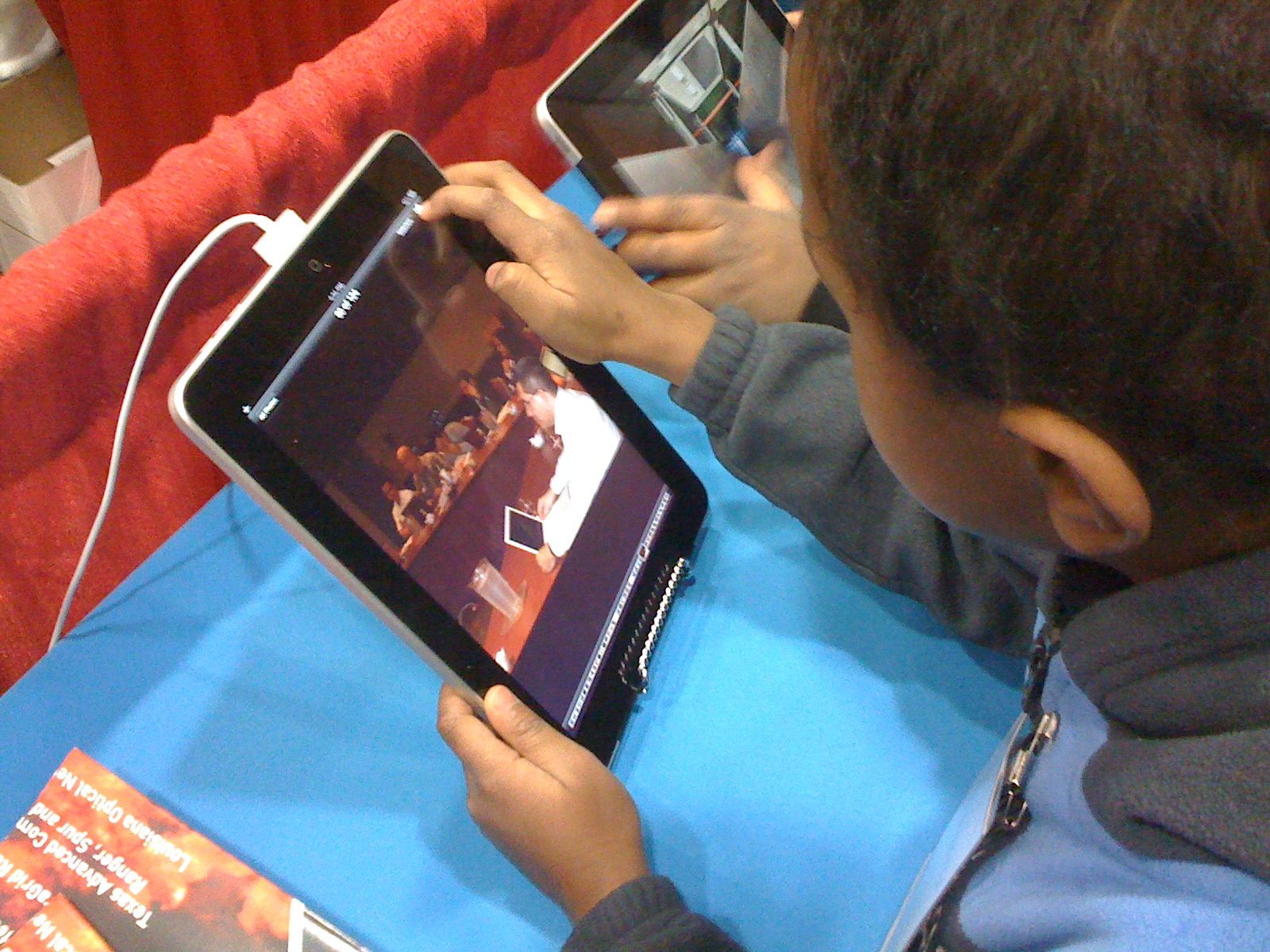
Moblie Device at Blue Waters Kiosk at NSF Expo ExhibitMobile Devices capture the attention of students. who have never seen or used these devices before. This is outreach for the Teragrid.

Research, 2010 and Our Future, Students Speak Up about Their Vision for 21st Century Learninghttp://www.tomorrow.org/

Edutopia 

The Internet is an astonishing source of educational resources: Lesson plans, classroom-product reviews, and even psychological support for those dark days when your students (or your coworkers) are straining your mental balance are only a Google search away. The trick, however, is getting that pipeline of online information flowing throughout your school, including directly into classroom PCs. Computers are often centralized in a media center, building codes can be prohibitive for setting up a broadband feed, and most schools are short-changed when it comes necessary tech support.

Here is a recipe for wireless access for those on the digital dirt road or for the understanding of those who did not get to attend the conference from the George Lucas Educational Foundation that is a how to.. The project is entitled the Digital Generation.

Welcome to the Digital Generation

http://www.edutopia.org/digital-generation-project-overview-video


What Devices?

There are a lot of devices that can be included in this discussion. The ones I know are,mobile and associated technologies, smart phones, IPod, IPhones, Netbooks, digital clickers, chargers and battery packs ,mobile interactive whiteboards.


Wireless to the Rescue

http://www.edutopia.org/tech-teacher-wireless-rescue


Taking it Mobile

Access to smartphones has more than tripled among high school students since 2006, according to a survey report from Project Tomorrow®, a national education nonprofit organization, and Blackboard Inc.

The report ,Learning in the 21st Century: Taking it Mobile!shows that students now view the inability to use their own devices in school, such as cell phones, smart phones, MP3 players, laptops or net books, as the primary barrier to a successful digital education. The various reports can be found here.

Can we Change the Digital Divide with Mobile Devices?

The FCC Chairman indicated in his discussions early in the year that Digital Tools may be the solution to the digital divide

Mobile Divide…. What Can we Learn about Making a Difference with Mobile Technology?

Philosophy of the Mobile Divide In the US

Mobile Digital Divide– According to a new study on U.S. consumers and mobile from the Pew Research Center, an unprecedented 60% of adults in the U.S. access go online wirelessly, whether by laptop or cell phone. Two factors are driving this trend, and shaking up any preconceived notions about America’s digital divide.

Finding #1:“Cell phone ownership is higher among African-Americans and Latinos than among whites (87% vs. 80%) and minority cell phone owners take advantage of a much greater range of their phones’ features compared with white mobile phone users. In total, 64% of African-Americans access the internet from a laptop or mobile phone, a seven-point increase from the 57% who did so at a similar point in 2009.”

Finding #2: “Young adults (those ages 18-29) are also avid users of mobile data applications, but older adults are gaining fast. Compared with 2009, cell phone owners ages 30-49 are significantly more likely to use their mobile device to send text messages, access the internet, take pictures, record videos, use email or instant messaging, and play music.”

What’s driving more Blacks and Hispanics, and older adults, to mobile?

According to Pew spokesman Aaron W. Smith, increased mobile web usage is driven by two key factors: age and economics. A younger demo with an annual income of $30,000 or less a year has jumped in usage, and African-Americans and Hispanics are younger and have less money than the general white population.

Mobile is thus bridging the digital gap between the traditional distinction of haves and have-nots, and while it’s a positive trend, it’s still a gap between those with cellphone-only access and those with computers as well.

About 18% of African-Americans use a cellphone as their sole device for Internet access compared to about 10% of whites. That said, laptop ownership has risen from 34% in 2009 to a current 51% among African-Americans.

Overall, 59% of Americans now access the Internet through mobile devices as opposed to 51% a year ago. So mobile may prove to be the ultimate equalizer, at least on the digital playing field.

Other interesting facts from the study reveal that Americans are using their mobile devices to (as ranked by Pew’s latest stats vs. April 2009)

The most interesting discussions are about the way in which wireless can be deployed. Bring your own wireless, netbooks using the cloud, and a variety of ways to solve the digital divide were proposed.

This from Mindshift

Bring-your-own-device classrooms. Since most kids these days already have access to a mobile device, schools are seizing the opportunity to turn these gadgets from distractions into learning tools by incorporating these devices into classroom lessons and projects. From mobile phones to laptop computers, teachers and students are increasingly bringing technology to the classroom, and in many school districts, it’s being put to good use.Numerous studies have highlighted the benefits of one-to-one computing programs in raising test scores and increasing college attendance, but with many districts strapped for cash and unable to provide devices for each student, this isn’t always a possibility. The solution may be found in asking students to bring their own devices to class, cutting back on the number of mobile devices the school needs to provide while still enhancing the learning experience.

What have mobile devices go to do with STEM and changing education in America?

Eliot Soloway ”

Are cellphones and other mobile devices powerful learning tools or intolerable classroom distractions?

For Elliot Soloway, the answer is a no-brainer. Cellphones, hand-held gaming gadgets, and netbooks—all relatively cheap, seemingly ever-present mobile devices used (and often abused) by today’s teenagers—can engage middle and high school students in learning inside and outside of school, he and other advocates of mobile learning say.”

STEM Applications you can’t replicate by talking or lecturing.

Windows to the Universe  ,Windows to the Universe explores the Earth, planets of our solar system, and the universe. It includes images, animations, and data sets, and information about books .

The Exploratorium,The Exploratorium isn’t just a museum; it’s an ongoing exploration of science, art, and human perception—a vast collection of online interactives, web features, activitiesprograms, and events that feed your curiosity.

Project Lead the Way

The PLTW Innovation Zone (aka the classroom) is an engaging and thought-provoking place, where students develop critical thinking skills through hands-on project-based learning, preparing them to take on real-world challenges. Students will have the opportunity to create, design and build things like robots and cars, applying what they are learning in math and science to the world’s grand challenges.

The PLTW program is designed to serve middle school and high school students of diverse backgrounds from those already interested in STEM-related fields to those who are more inspired by the application of STEM than they are by traditional math and science courses.

Whyville ,
What does it take to build a sustainable, green energy community? 8th Graders are showing us how using WhyPower, an interactive learning game within the largest interactive learning world, WhyVille. Here is an interactive game. http://www.poweracrosstexas.org/projects/whypower-interactive-game

Energy Game:  WHYPOWER

Whyville is a thriving community with its own economy, newspaper, government and much more.  It now has its own power grid!  As part of the WhyCareers program, we are “electrifying” Whyville with a power grid that uses traditional and renewable energy sources.  Students will manage the power grid to select the right mix of coal, natural gas, nuclear, hydroelectric, solar and wind energy. They will build homes in Whyville!  They will observe and measure power use in Whyville, and form good energy behaviors and habits. Finally, they will explore the math, science and career topics related to energy.  Just like in real life, success in Whyville is not pre-programmed!  Students skill, initiative, creativity and teamwork determines the rewards they receive and the “virtual money” they earn in WhyPower.
Whyville. Run a city using energy reources.

National Geographic FieldScope is a web-based mapping, analysis, and collaboration tool designed to support geographic investigations and engage students as citizen scientists investigating real-world issues – both in the classroom and in outdoor education settings. FieldScope enhances student scientific investigations by providing rich geographic context – through maps, mapping activities, and a rich community where student fieldwork and data is integrated with that of peers and professionals, adding analysis opportunities and meaning to student investigations.

NG FieldScope

  • uses cutting-edge technology to make interactive mapping and geospatial data analysis tools accessible to students via the web in an intuitive package that is free and does not require software installation.
  • enables students and classrooms to upload their own field data – including quantitative measurements, field notes, and media, such as photos – and to see it in relation to data from peers and professional scientists.
  • fosters collaborative sharing and analysis of data among the FieldScope community and beyond.

National Geographic is partnering with groups – across a range of scientific disciplines – that are interested in exploring how FieldScope can better support student geographic learning and outdoor investigations.

FieldScope Projects

Chesapeake Bay

http://www.serc.si.edu/education/resources/bluecrab/index.aspxThe Chesapeake Bay FieldScope Project is a “citizen science” initiative in which students investigate water quality issues on local and regional scales and collaborate with students across the Bay to analyze data and take action. Chesapeake Bay FieldScope is a project of National Geographic’s Education Programs in collaboration with theChesapeake Bay Foundation and the NOAA Chesapeake Bay Office.

Online Labs

http://sharingtree.wordpress.com/2011/08/21/onlinelabs-in-virtual-laboratory-simulations-for-science-education/

Resource from the Federal Trade Commission

Admongo.gov kids learn critical thinking skills and apply them to understanding advertising.

It is an on line game.

Digital Citizenship

Living Life Online   there is a book available from the FTC that accompanies this project as a digital citizenship iniative. Bulk orders are available at bulkorder.ftc.gov

Julia Barnathan (standing), curriculum developer for Northwestern’s Office of STEM Education Partnerships, assists a student with a lesson in radiation that uses iLabs to access a geiger counter at the University of Queensland, Australia.
CREDIT: Amanda Morris, Office for Research, Northwestern University

Games? Has Education Got Games? Yes and No

Make a traditional teacher angy..say games and wait for the push back. Sometimes just to be tech savvy and interested can make you lose a friendship. I lost a friend of ten years like that. We traveled India together and met often. But we taught together and I found that she despised the use of technology. “Cut that OFF.!!” She had no ability to see the learning factor in games.

 If you want to get a dressing down in education, all you have to do is to talk about games, interactive media or any infographic.

GAMES IN THE CLASSROOM?

ARE You Kidding Me?

Some people will look at you cross-eyed as if you have NO earthly idea about what goes on in a classroom. Some will hiss ” school time is too important for” games.”. I started using technology when MECC created games for education , and got to demonstrate and work on games. I also at that time was able to create games and to teach student simple game making. The power of taking the information to others in game format was good.In the early days of technology we could make our own games.

 Stopping Transformation

I used to work in a school where the assistant principal hated games so much that when the principal was away she would march to my room, confiscate the games I used in my learning landscape and I would have to wait until the “real‘ principal came back to get them.I learned to make copies of the game and to just endure the charade. My real principal liked my work( but you may know the politics of schools , she knew that I was being harassed by the lady, so we agreed on a strategy.

.Parents understood that I was creating a learning landscape. The kids who had to be in the afterschool program would thry to sneak back into the classroom where I was correcting papers to use the computers. Parents would send me supper and sometims come in and go through the games themselves. This was back in the day of simple games, like Lemonade Stand, http://www.coolmath-games.com/lemonade  ( The Lemonade stand game that I used was devoid of commercials) in fact the web versions are often not the original games.

Odell Lake
en.wikipedia.org/wiki/
Odell_Lake_(computer_game)Hot Dog StandHot Dog Stand – Serve up burgers, fries, drinks and of course hot dogs with ketchup and onions on top. Hot Dog Stand is a well made and fun restaurant game. This was early food chain, and ecology. There are much better games available now. We call them serious games.

www.123-games.net/games/hotdogstand

We used some reading games and stories that I had from a publisher in New Zealand for reading instruction. The reading games are now a part of a cuirriculum that can be cloud based. We were on the right track.

Of course we did the turtle games and we learned turtle language.

I even got to work with my very favorite game through a number of iterations. It was Oregon Trail. Eacn new Oregon Trail got more and more complicated .. I loved the transitions, but most of all I loved creating learning around the game. The geography, the history of trails.

The recipes, the museum trips to look at the kinds of wagons that people traveled in and the posters and information about the various stops along the trail. It was an interesting way to weave in some new kinds of learning. Stack cake, learning not to shoot too many animals because they could not be carried. Researching the tribes that people met along the way.

First I used it with a whole class. Then I learned to borrow computers so the whole class could play and then we wrote grants to get more computers. Five computers worked well for the most part.

Margaret Spelling was not enamored of games. So the initiative within the Dept of Education died on her watch. Funding was cut All of a sudden as a science teacher and a person who believed in games I was suspect.

Arlington Career Center/ Special Initiatives of Choice

 I worked in an after school and Saturday initiative that was wonderful. We linked kids to their interests. We let them learn using computers and games. There are still children who do not have a computer of their own at home. There are children who line up in libraries to use computers, or who work in community centers on their digital skills. In West Virginia there are ways to get digital using volunteer fire stations. The funny part is that we at first had a mish mosh of computers so the games were different on various computers. That was not a problem.

In Arlington County, I also had a wonderful high school principal who was running a career center. He let me work with games, robotics, and innovation. Our classes were always over subscribed, We did a summer program those classes were always oversubscribed. We wove into the offering, some rudimentary knowledge of computers, a side class was to let kids build their own computer, there was the hard core games, and by that there were the kids who accessed games , educational games or games of my choice or access, and then the spinoff for robotics and NASA space science, We used a lot of Lego physics, and built small robots.

Build Knowledge, Build a Dinosaur Park, Meet a Dinosaur Scientist.. we did all of that.

What did the game do?

You had to focus on the information about the Dyno Park to run the scenario. You had to know the details of the various animals you kept. But wait, those are old games. I learned a lot about how children learn watching them choose the book, the game, and build their own dinosaurs. It was more than I knew and I had to work with them

We never have enough spaces for the children who were interested.in being in the courses. We changed it up and made it so that the games was the center or part of the learning landscape. Dinosaur, DynoTycoon, Here you will find a free download of the original Dinopark Tycoon from 1993. The classic Dino Park Tycoon includes of the ideas of new tycoon games, like zootycoon.

http://www.abandon5000.com/download/simulation-games/dino-park-tycoon.html

Smithsonian visits, Visits from an amber collector and we had a real Smithsonian scientist Dr. Embry, who let us come visit and watch him work in this magnificent setting. In the summer we would pick a topic and weave activities, hands on learning , books and field trips into a learning adventure. I got to practice this skill recently at a summer camp at the Smithsonian. It is one of my Tpak Skills. And I admit that when I can I put food into the matrix. Or plants or gardening. We worked hard in school to learn. We combined many ways in which to learn. Tpack is one of the ways that diagrams the ways of using intersecting ways of learning.

I will confess I was never any good at keeping the park going. You can download it free online, What the games did for me, was to destroy the ranking of who was the best learner in the classroom. What the games did for me was to give me an invitation to special education students, to limited English speaking children to learn. The game might be what they wanted to do, but the rest of the learning came along with the package.

I never found the resources in Amazon Trail. The students loved the game so much that I rarly got to play, but I watched them play, and saw their skills and they shared the levels of their play. More than that with the games often I could merger a Jason lesson or initiative, once during my time in the classroom, I was teaching a Jason project on jungles, using games,

Dinopark Tycoon is an excellent game which makes one remember the wonderful times of our youth. This game is great because you get to open your own dino park, and do all of the things, such as manage employees, buy inventory items, choose dinosaurs, and other exciting things to run the dinosaur park. The goal in this game is to create the ultimate dinopark and to become a real Dinopark Tycoon. People come from far and wide to visit your park, so you need to make it the best park that it can be.  My little relatives and I challenged

each other to build the best pak. I never reached excellente. I will use the excue that I got distracted.

You start by buying land, fence, and dinosaurs. The game really gives you quite a variety of dinosaurs to buy. Get a lot of money, and you can get the ultimate dinosaur, careful though, it doesn’t last long and proves to be a waste of your money!
You need to make sure you keep your dinosaurs fed or they may get restless and break out of their pens. That results in having to buy new fencing and new dinosaurs. Who knows where the dinosaurs go after they leave, but it doesn’t matter to you! After you have enough money being a dinopark tycoon, you can buy concession stands and other items to make your park even better for the guests.
The

Screenshots:

game is really easy to use. Help is easily found, in all menus of the game. If you are running low on funds, get a loan from the bank to keep you going. You need to make sure you keep your prices in check so that you are getting some sort of profit, otherwise, you’ll lose money and your dino park ends up bankrupt.
This is a great game for younger children and older children alike. Children as young as 7 or 8 and older would enjoy Dinopark Tycoon because of its easy to use interface and its real world game style. It is both a fun game to play and a fun way to learn. Through playing this game, children are learning money sense and business sense. They are learning what a dollar is worth and that they cannot just buy everything, they need to think wisely before they make a purchase because if they just buy, they will end up with no money and the game will be over.
This is a great game for public schools to have on their 
computers because kids really love to play it and they are also learning at the same time. Anyone can have a wonderful time playing Dino Park Tycoon!

Download Dinopark Tycoon


I had a mentor who was George Lucas. During that time he had games in education. The games were as Seymour Papert said, hard fun. I was able to use those games in my classroom and in my game work. George Lucas was all about innovative learning

He says in his recent blog that it is time to have a conversation about what is going on in our schools.

 Here is the blog.

http://starwarsblog.starwars.com/index.php/2010/10/11/george-lucas-blogs-about-education/

Lucas writes:

” It’s time to have a conversation about what’s right in our schools, what’s working. And as we debate what to do to fix the problems, let’s remember that there are successes in education every day we can emulate. In districts of every stripe and demographic make-up, educators are dedicating themselves to providing their students with a high quality 21st century education and using new technologies to make it happen. They are showing kids how to find and analyze information and how to creatively deploy their analyses to solve problems.”

“These educators are beginning to reinvent the learning process, guiding students through rigorous, real-life projects that integrate core academic topics and personalize the learning experience based on a child’s strengths and weaknesses. They are building confidence and ambition in children, by supporting them emotionally and providing a safe, engaging environment to learn. Most importantly, these innovative educators are creating a next generation of citizens with academic knowledge and problem solving abilities that will serve our country for years to come.”

One Christmas, there was a meeting at the ranch and I got four of the Lucas Games as a present. I have used those games in media expositions all over the world. I mixed fantasy and fiction in the study of space and we were on. In the classroom we had the various resources from the Challenger Center, and youth oriented initiatives that had their own scenarios and simulations.

In my schools I became a problem to other teachers because everyone wanted to be in my classes. I was a hard teacher in that we had to do whatever it was that the school system asked, but then there were the extras.. the MECC games and the projects t would get funding for , computers for, and resources for. The parents and children and I learned a lot about creating a learning environment, one part of it being games. The principal allowed parents to access the games and to be a part of the learning journay. We learned that hands on, minds on, brains on were exciting, we wove books, pictures and resources in to the mix and there were always games as a part of the learning scenario.

We the children, the parents and I were a network for learning. And there was a teacher on my grade level who asked me to teach these games and the Jason Project to her kids. We

became a team for those activities. My children did a lot of the teaching. But we were able to influence that teacher andf her group of kids.

There are other more interesting ways to enter the use of games , some of which I will cite.

I will confess to use of games in education from when I was learning basic. That was a long time ago. We were constructing knowledge and making our own games. Iin the after school program, we had students from all over Arlington County who came to play and who learned a lot more than they did in the regular classroom. One child would not even leave the classroom for popcorn and for a bathroom break. As much as I could I tried to be flexible  one child just would not leave the room. I ended up calling his mother. She said, I have been waiting for your call. He is acting out isn’t he. He has always been a problem in school. I said, „ Excuse me, do I have the wrong numbet? This child was the best of all of my students. He was Egyptian , who knew/ He did not speak English well, Who knew. Games were his passport to learning. I never bothered him again. I figured out a way to let him learn and then the mother and I found a community place where he could use the computer. I loved teaching him a game that a friend of mine constructed about a little Egyptian boy, Little Horus. That game seems to have disappeated, but it was good for socio cultural work.

Games have gotten more complex now. Once at Supercomputing the conference a game maker who created games for sports altered the bodies of the players as he was teaching us game design. It was fun, it was hard fun because he let us do a few alterations.

Dr, Kevin Clark at George Mason University also used games and had a couple of conferences that I went to that gave me more knowledge about the ways in which the armed forces uses games and simulations to attract recruits.

Dr, Chris Dede uses embedded assessements to help teachers evaluate knowledge.

Of course , he has always been far ahead of the pack. Well he was the person who mentored me in the uses of technology. See his latest work here.
https://www.neasc.org/downloads/
dede_presentation.pdf · PDF file

You may not know Idit Harel. She has the program MaMaMedia ,http://mamamedia.com/

kind of an interactive game involvement for kids.It is loud, she says kids like it that way.

She has a new project in games that I have been priviledged to work with , Globaloria.

There is a community of teachers, who learn technology skills, and then teach students to build their own games using Flash.

From Wikipedia, the free encyclopedia

Globaloria is a social network for learning web-game design and simulation production. Invented by the World Wide Workshop Foundation in the spring of 2006, it seeks to create technology-based educational opportunities through a flexible set of virtual learning networks for students in developing nations, and economically disadvantaged and technologically underserved communities. Using a network of educational web 2.0 platforms, students develop 21st-century digital literacy, master social media technology, and gain a deeper understanding of curricular areas, such as sciencemathematics and health. Its activities help students sharpen their communication and critical-thinking skills for leadership online and offline, bringing them closer to the participatory and collaborative nature of work in the 21st century.[1]

[Globaloria]… aims to teach youth how to take control of their new-media world.

Idit Harel Caperton[2]

SERIOUS GAMES

What are games?Some are serious At the Federation of American Scientists, Melanie Stegman invites teachers to try out her game, Immune Attack. It is a serious game.

You must navigate a nanobot through a 3D environment of blood vessels and connective tissue in an attempt to save an ailing patient by retraining her non-functional immune

www.fas.org/immuneattack,

But wait there is more at the Federation of American Scientists Learning Technology site. According to the web site,
The Learning Technologies Program (LTP) studies ways to use technology to improve how people teach and learn.  Well-paid, rewarding jobs in the U.S. depend on a workforce prepared to operate in a fast-paced, technologically sophisticated global economy.  Doing this in an affordable way for a highly diverse population demands new approaches. Since the LTP was founded in 2001, a lot of progress has been made in how educational leaders approach technology in and out of the classroom.  In 2005 when we published our
Summit on Educational Games in 2006, we were one of the few voices.  In 2010, however, the President and Ms. Obama have spoken in favor of video games as a tool for education and for fitness

Source :http://www.fas.org/programs/ltp/index.html

Teachers

Evaluate Immune Attack

Learn More About Immune Attack

Immune Attack is a supplemental teaching tool, designed to be used in addition to middle school and high school biology textbooks.  Immune Attack introduces molecular biology and cellular biology in detail that is usually reserved for college students.  However, it uses the familiar and motivational video game format to introduce the strange and new world of cells and molecules.

Please consider EVALUATING IMMUNE ATTACK in your classroom.  It requires 3 class periods in a computer lab over 2 weeks time.  Register here and we’ll send you the details.

Here is a modern way of using games in the classroom. This iS Dr. Bob’s Blog on games and  assessment.

What Can We Learn About Assessment From Video Games? | edte.ch

Here is one of my favorites,.

http://www.poweracrosstexas.org/

I love the Why Power Game,.

It kept me fascinated trying to run a city.

I love the embedded assessment and standards that are completed by playing this game.
What does it take to build a sustainable, green energy community? 8th Graders are showing us how using WhyPower, an interactive learning game within the largest interactive learning world, WhyVille.

Concord.org

http://www.concord.org/projects/electron-technologies

Here is a serious use of a serious game.


Using war games to treat post-traumatic stress disorder

http://www.sciencedaily.com/releases/201…

Soldiers may benefit from virtual reality applications for the treatment of post-traumatic stress disorder (PTSD). A new study reviews how virtual reality applications are being designed and implemented across various points in the military deployment cycle, to prevent, identify and treat combat-related injuries.

and all the ways that I talked about that come together to help students learn.Dr. Bob Plants has this excellent blog to take the subject further.

http://sharingtree.wordpress.com/2011/08/09/what-can-we-learn-about-assessment-from-videogames-edte-ch/

Teachers to Blame? I don’t think so.. Look more closely at the “politics “of Education

A democratic education means that we educate people in a way that ensures they can think independently, that they can use information, knowledge, and technology, among other things, to draw their own conclusions.
– Linda Darling-Hammond

Transforming Education Using Tools and Well Trained Teachers

Visualization and Modeling with an IPad

Whose to Blame for Poor Urban Schools? Look more closely at the politics of schools to find out.

I am losing a lot of my educational friends lately or at least we are sparring on line. Like the press, they look at the older teachers of America and say, that the problems in education are the fault of the older, teachers the digital immigrants. Well, is it really?

When I question people about what happens in K-12 they rest the problem squarely on the shoulders of the K-12 teachers.

Why is America falling behind in academics? There are many reasons. We are 21st in the world in Science and 25th in the world in Math. We who started the use of the Internet…Well it is so bad that the Congress has created a solution.

US to back 21st century learning
By Maggie Shiels
Technology reporter, BBC News Website, Silicon Valley

The US Congress has given the go-ahead for a new centre to explore ways advanced computer and communications technologies can improve learning.
The National Center for Research in Advanced Information and Digital Technologies will focus on “bringing education into the 21st century.”Supporters said classrooms have failed to keep up with technology innovations.
“America’s reputation as an international leader rests in the hands of our youth,” said Sen. Chris Dodd.
“It should be among our top priorities to provide our students with the tools they need to maintain and build upon this standing.”
The Senator was one of the original sponsors of a bill that proposed the setting up of the centre. Meanwhile Congressman John Yarmuth of Kentucky spearheaded the passage of the bill through the House and said its timing could not be more critical.
“American businesses know that they need a well-educated workforce to face growing competition from China, India and Europe.”
The Federation of American Scientists said, “The creativity that developed extraordinary new information technologies has not focused on finding ways to make learning more compelling, more personal and more productive in our nation’s schools.
“People assumed that the explosion of innovation in information tools in business and service industries would automatically move into classrooms.”
That, the Federation said, has simply not happened.
The centre will support a ‘first of its kind’ comprehensive research and development program aimed at improving all levels of learning from kindergarten to university and from government training to college.
Missed opportunity
“Education is falling further and further behind the rest of the economy and we have to rethink our basic approach to helping people learn,” said Henry Kelly, the Federation’s president.
The FAS said that learning scientists and educators have known for years that people learn faster if education can be personalised and if students are motivated by seeing how their knowledge can help them solve problems they care about.
Story from BBC NEWS:

http://news.bbc.co.uk/go/pr/fr/-/2/hi/technology/7569484.stm

Published: 2008/08/19 07:51:13 GMT

In the past the unmatched vitality of the United States’ economy and science and technology enterprise has made this country a world leader for decades, allowing Americans to benefit from a high standard of living and national security. But in a world where advanced knowledge is widespread and low-cost labor is readily available, U.S. advantages in the marketplace and in science and technology have begun to erode. A comprehensive and coordinated federal effort is urgently needed to bolster U.S. competitiveness and pre-eminence in these areas so that the nation will consistently gain from the opportunities offered by rapid globalization, says a new report from the National Academies.

Given the United States’ history of economic and scientific pre-eminence, it is easy to be complacent about these complex issues, the report says. Following are some indicators that illustrate why decisive action is needed now:

· For the cost of one chemist or one engineer in the United States, a company can hire about five chemists in China or 11 engineers in India.

· Last year chemical companies shuttered 70 facilities in the United States and have tagged 40 more for closure. Of 120 chemical plants being built around the world with price tags of $1 billion or more, one is in the United States and 50 are in China.

· U.S. 12th-graders recently performed below the international average for 21 countries on a test of general knowledge in mathematics and science. In addition, an advanced mathematics assessment was administered to students in 15 other countries who were taking or had taken advanced math courses, and to U.S. students who were taking or had taken pre-calculus, calculus, or Advanced Placement calculus. Eleven countries outperformed the United States, and four scored similarly. None scored significantly below the United States.

· In 1999 only 41 percent of U.S. eighth-graders had a math teacher who had majored in mathematics at the undergraduate or graduate level or studied the subject for teacher certification — a figure that was considerably lower than the international average of 71 percent.

· Last year more than 600,000 engineers graduated from institutions of higher education in China. In India, the figure was 350,000. In America, it was about 70,000.

· In 2001 U.S. industry spent more on tort litigation than on research and development.

Without a major push to strengthen the foundations of America’s competitiveness, the United States could soon lose its privileged position. The ultimate goal is to create new, high-quality jobs for all citizens by developing new industries that stem from the ideas of exceptional scientists and engineers.

Increase America’s talent pool by vastly improving K-12 mathematics and science education.

· Among the recommended implementation steps is the creation of a merit-based scholarship program to attract 10,000 exceptional students to math and science teaching careers each year. Four-year scholarships, worth up to $20,000 annually, should be designed to help some of the nation’s top students obtain bachelor’s degrees in physical or life sciences, engineering, or mathematics — with concurrent certification as K-12 math and science teachers. After graduation, they would be required to work for at least five years in public schools. Participants who teach in disadvantaged inner-city or rural areas would receive a $10,000 annual bonus. Each of the 10,000 teachers would serve about 1,000 students over the course of a teaching career, having an impact on 10 million minds, the report says.

Sowing the Seeds

Sustain and strengthen the nation’s commitment to long-term basic research.

· Policy-makers should increase the national investment in basic research by 10 percent each year over the next seven years. Special attention should be paid to the physical sciences, engineering, mathematics, and information sciences, and to basic research funding for the U.S. Department of Defense, the report says.

· Policy-makers also should establish within the U.S. Department of Energy an organization called the Advanced Research Project Agency — Energy (ARPA-E) that reports to the undersecretary for science and sponsors “out-of-the-box” energy research to meet the nation’s long-term energy challenges.

· Authorities should make 200 new research grants annually — worth $500,000 each, payable over five years — to the nation’s most outstanding early-career researchers.

Hands on Technology

Best and Brightest

Develop, recruit, and retain top students, scientists, and engineers from both the United States and abroad. The United States should be considered the most attractive setting in the world to study and conduct research, the report says.

· Each year, policy-makers should provide 25,000 new, competitive four-year undergraduate scholarships and 5,000 new graduate fellowships to U.S. citizens enrolled in physical science, life science, engineering, and mathematics programs at U.S. colleges and universities.

· Policy-makers should provide a one-year automatic visa extension that allows international students to remain in the United States to seek employment if they have received doctorates or the equivalent in science, technology, engineering, mathematics, or other fields of national need from qualified U.S. institutions. If these students then receive job offers from employers that are based in the United States and pass a security screening test, they should automatically get work permits and expedited residence status. If they cannot obtain employment within one year, their visas should expire.

Incentives for Innovation

Ensure that the United States is the premier place in the world for innovation. This can be accomplished by actions such as modernizing the U.S. patent system, realigning tax policies to encourage innovation, and ensuring affordable broadband Internet access, the report says.

· Policy-makers should provide tax incentives for innovation that is based in the United States. The Council of Economic Advisers and the Congressional Budget Office should conduct a comprehensive analysis to examine how the United States compares with other nations as a location for innovation and related activities, with the goal of ensuring that the nation is one of the most attractive places in the world for long-term investment in such efforts.

· The Research and Experimentation Tax Credit is currently for companies that increase their R&D spending above a predetermined level. To encourage private investment in innovation, this credit, which is scheduled to expire in December, should be made permanent. And Congress and the administration should increase the allowable credit from 20 percent to 40 percent of qualifying R&D investments.

The study was sponsored by the National Academies, which comprise the National Academy of Sciences, National Academy of Engineering, Institute of Medicine, and National Research Council. They are private, nonprofit institutions that provide science, technology, and health policy advice under a congressional charter.
This news release and report are available at http://national-academies.org

THE NATIONAL ACADEMIES
Committee on Science, Engineering, and Public Policy

And Urban Schools? ????????

Academic freedom: the typical urban school district’s personnel and budgeting systems leave principals without much say in hiring teachers or allocating resources.

The Los Angeles Unified School District is the second largest school system in the nation–and perhaps the worst. Slightly less than half of its 75,000 employees are classroom teachers, meaning that Los Angeles spends just 35 percent of its budget on teacher pay. By comparison, the school systems in Houston, Texas, and Edmonton, in the Canadian province of Alberta, spend 49 percent and 56 percent, respectively, of their budgets on teachers. Since 1980, Los Angeles Unified’s enrollment has grown by 180,000 students, but the district has added only 15 schools with a total of 20,000 seats. As a result, nearly 200,000 students must be bused to a distant campus while most attend multi-track, year-round schools that can push more students through but offer 17 fewer days of instruction.

http://findarticles.com/p/articles/mi_m0MJG/is_1_4/ai_111734747

Although elementary schoolers in Los Angeles have made real gains in literacy in recent years, among high-school students, only 23 percent in reading and 34 percent in math meet or exceed the national norm on the Stanford 9. Of the district’s teachers, 27 percent lack full credentials. The system has a chronic shortage of qualified principals.
If Los Angeles is the worst school district in America, its East Coast cousin, New York City, is a close second. And the Chicago schools, while improving, are still recovering from the day in 1988 when William J. Bennett, secretary of education in the Reagan administration, pronounced them the “worst in the nation.” Why are these three school systems in such deep disarray? Certainly not because they are the three largest.

None of them has more than a fraction of IBM or Toyota’s work force, and those companies are icons of good management. Nor is it because they serve high percentages of minority children from low-income families. Houston’s schools, which are equally minority and poor, perform well relative to other urban school districts. The reason is that the school districts in New York, Los Angeles, and Chicago are too centralized, much too top-down in their management, for their size.

I Excellent teaching requires extensive training and experience. A seasoned, excellent teacher would have training in and experience with pedagogy and content. 

“Telecommunications provides the new learning platform of this century and is replacing the textbook as the medium through which a modern education is provided,” Lucas said. “The world’s knowledge is now available online, far beyond what books and materials can provide in schools and libraries themselves.” George Lucas


K-12 was the group that got the blame. Most of the time I was the only K-12 teacher in the audience. But there have been times when I was not, and ageism struck. A young teacher sitting beside me
not knowing my work, or advocacy, said, its the old teachers who are to blame for all of the ills of education. She went on to talk about her mother, who was a teacher and to say that
people like her mother ought to get out of education. I didn’t say much, unusual for me. but I thought what??

I was the only K-12 teacher on a committee, the National Information Infrastructure Advisory Council
. It was a lot of hard work. I learned a lot. I traveled all over the country, in areas of need, and difficulty. My teaching experience is also varied, I have taught in black schools, at the lower socioeconomic areas, in a so called charter school designed to welcome those who were interested in , in a science focused school, done team teaching and I have been a demonstration teacher for AAAS, for the use of hands-on science teaching. I have worked with Karen Buller of Niti.org and we wrote curriculum for American Indians.. and traveled to the schools in Indian country, sharing technology.
I guess most of my life has been teaching, with extraordinary experiences in professional development during the summer. As a legacy teacher. I was trained in a HBCU. Not much was expected of me, and not much was taught . According to the times, we had to be able to teach and to know curriculum to seventh grade level. The math was certainly not old or new. It was drill math. End of story.

So I think what I want to explain is that we had two societies and two kinds of schools. I boldly integrated into schools, teaching in schools as the only black teacher on the faculty of some schools who did NOT teach the tracked students. I taught , initially the gifted and talented students and I was good at it. I am an excellent teacher.

So what happened to me that did not happen to most minority teachers? I rested my professional development outside of the public schools. I was a child of museum study and my Sunday excursions to the Smithsonian, and I am stubborn. I went to the well where the movers and thinkers and those with ideas were working, in workshops, courses, expeditions, and especially had wonderful teaching experiences, learning experiences with NASA and with the National Geographic and three years of Oceanography at the National Aquarium in Baltimore. Sadly, most teachers get the WORST of professional development.

TAUGHT BY THE BEST

My reason for talking about those experiences is that I was taught by the best. From various groups like NCTM, and NSTA I gathered resources, knowledge, networks, and pearls of wisdom. Who can teach the use of geography and visuals like the National Geographic. I feel into a wonderful set of examples of how to.. and it has been a passport for the use of technology for the rest of my life.
That is not the usual case for teachers. Usually the professional development comes from within the school system, or a special group of experts that they trust. It has been wonderful to see school systems allow their teachers to use Blue Webn Videoconferencing for Learning, Exploratorium, Thinkfinity Learning Network, and the resources of the National Geographic. Some school systems , even advise their teachers of learning opportunities and initiatives that occur.

I believe that some of the politics in school systems and the
lack of professional development of merit are to blame for the teachers who do not measure up. Not being new teachers they have been allowed, encouraged to teach as they do. It probably didn’t make much difference.

They were teaching minority kids. Who cared?

There is blame in the politics of teaching, the bad professional development , the use of only in-house knowledge, and the stubbornness of schools resisting change and depth of content knowledge. I worry about the digitally naive and the content deprived teachers. But then, who cares? To people like Michelle Rhee, its the older teachers. I don’t think that rings true for all teachers.

We might also remember that there was a knowledge divide
a content divide , and of course the low expectations exoected for those who teach our most needy students.

SOLUTIONS

http://www.marcprensky.com/writing/Prensky-Lets_Be_Digital_Multipliers-ET-01-09.pdf

Comcast

Thinkfinity

Teachers ask about STEM, is it a Flower? No , It is the flowering of new ways to teach Science, Technology , Engineering and Math

Family STEM Learning

AAAS Science Days

Science, technology, engineering and mathematics (STEM) workers drive our nation’s innovation and competitiveness by generating new ideas, new companies and new industries. However, U.S. businesses frequently voice concerns over the supply and availability of STEM workers. Over the past 10 years, growth in STEM jobs was three times as fast as growth in non-STEM jobs. STEM workers are also less likely to experience joblessness than their non-STEM counterparts. Science, technology, engineering and mathematics workers play a key role in the sustained growth and stability of the U.S. economy, and are a critical component to helping the U.S. win the future.

In 2010, there were 7.6 million STEM workers in the United States, representing about 1 in 18 workers.

STEM occupations are projected to grow by 17.0 percent from 2008 to 2018, compared to 9.8 percent growth for non-STEM occupations.

STEM workers command higher wages, earning 26 percent more than their non-STEM counterparts.

More than two-thirds of STEM workers have at least a college degree, compared to less than one-third of non-STEM workers.

 • STEM degree holders enjoy higher earnings, regardless of whether they work in STEM or non-STEM occupations.

application/pdf iconstemfinalyjuly14.pdf

Robert Ping, sharing visualization and modeling images from the Teragrid

STEM Initiatives,, Outreach, Teragrid , Family Science Days

 
What is a girl to do, earn and learn!!
Just a few NCWIT resources for your perusal
NCWIT Resources

NCWIT offers a range of resources to suit your needs.  All of our resources are FREE, easy-to-use, downloadable, and printable.

  • Practices NCWIT promising practices use social science research as a foundation for advice, case studies, and activities that are proven to attract, retain, and advance girls and women in IT.
  • Talking Points NCWIT Talking Points are a series of easy-to-use conversation cards designed to promote the involvement of women in IT by helping people talk about the issues.
  • Programs-in-a-Box NCWIT Programs-in-a-Box offer turnkey solutions to pressing issues facing the IT community. Programs-in-a-Box provide all the components necessary for quick and strategic action, right out-of-the-box.
  • Workbooks & Guides NCWIT workbooks and guides provide you with practical, hands-on steps for changing your recruitment and retention practices and implementing institutional reform.
Never too early to learn to love science!

Family science days at AAAS in Washington DC

Women in STEM: An Opportunity and An Imperative

Today Commerce's Economic and Statistics Administration released the second in a series of reports on science, technology, engineering and mathematics (STEM). This report, entitled Women in STEM: A Gender Gap to Innovation (PDF), looked at women and STEM. The results offer an opportunity and an imperative for women and America. The results showed that women are vastly underrepresented in STEM jobs and among STEM degree holders despite making up nearly half of the U.S. workforce and half of the college-educated workforce. That leaves an untapped opportunity to expand STEM employment in the United States, even as there is wide agreement that the nation must do more to improve its competitiveness.

Other key findings are:

Although women fill close to half of all jobs in the U.S. economy, they hold less than 25 percent of STEM jobs. This has been the case throughout the past decade, even as college-educated women have increased their share of the overall workforce.
Women with STEM jobs earned 33 percent more than comparable women in non-STEM jobs–considerably higher than the STEM premium for men. As a result, the gender wage gap is smaller in STEM jobs than in non-STEM jobs.
Women hold a disproportionately low share of STEM undergraduate degrees, particularly in engineering.
Women with a STEM degree are less likely than their male counterparts to work in a STEM occupation; they are more likely to work in education or healthcare
For more information on this topic, read Chief Economist Mark Doms's blog post about the report and ESA's first report on STEM: Good Jobs Now and For the Future.
Women in STEM: An Opportunity and An Imperative

Although women fill close to half of all jobs in the U.S. economy, they hold less than 25 percent of STEM jobs. This has been the case throughout the past decade, even as college-educated women have increased their share of the overall workforce.
Women with STEM jobs earned 33 percent more than comparable women in non-STEM jobs–considerably higher than the STEM premium for men. As a result, the gender wage gap is smaller in STEM jobs than in non-STEM jobs.
Women hold a disproportionately low share of STEM undergraduate degrees, particularly in engineering.
Women with a STEM degree are less likely than their male counterparts to work in a STEM occupation; they are more likely to work in education or healthcare
For more information on this topic, read Chief Economist Mark Doms's blog post about the report and ESA's first report on STEM: Good Jobs Now and For the Future.

Post new comment
Comment Policy
To ensure that everyone can participate in polite conversation, these comments may be moderated. For detailed information on how and what we moderate, view our comment policy.

Women in STEM: An Opportunity and An Imperative

Submitted on August 3, 2011 – 11:30am
Categories:
Printer-friendly version

<a href=”http://www.commerce.gov/sites/default/files/images/2011/august/stem-totalworkforcetotalste.jpg&#8221; rel=”lightbox[field_photo][Gender Shares of Total and STEM Jobs, 2009Download Original]”>Gender Shares of Total and STEM Jobs, 2009

Today Commerce’s Economic and Statistics Administration released the second in a series of reports on science, technology, engineering and mathematics (STEM). This report, entitledWomen in STEM: A Gender Gap to Innovation(PDF), looked at women and STEM. The results offer an opportunity and an imperative for women and America. The results showed that women are vastly underrepresented in STEM jobs and among STEM degree holders despite making up nearly half of the U.S. workforce and half of the college-educated workforce. That leaves an untapped opportunity to expand STEM employment in the United States, even as there is wide agreement that the nation must do more to improve its competitiveness.

Other key findings are:

  • Although women fill close to half of all jobs in the U.S. economy, they hold less than 25 percent of STEM jobs. This has been the case throughout the past decade, even as college-educated women have increased their share of the overall workforce.
  • Women with STEM jobs earned 33 percent more than comparable women in non-STEM jobs–considerably higher than the STEM premium for men. As a result, the gender wage gap is smaller in STEM jobs than in non-STEM jobs.
  • Women hold a disproportionately low share of STEM undergraduate degrees, particularly in engineering.
  • Women with a STEM degree are less likely than their male counterparts to work in a STEM occupation; they are more likely to work in education or healthcare

For more information on this topic, read Chief Economist Mark Doms’s blog post about the report and ESA’s first report on

STEM: Good Jobs Now and For the Future.http://awesome.good.is/transparency/web/1107/stem-education/flash.html


Engineering new ideas at Tracy Sdhool, Tracy Learning Center, Tracy, CA.

Girls can learn to engineer.

What Science Pipeline? Making Sense of STEM Offerings! Part One

Family Outreach Days at AAAS Family Days  - Teragrid Booth

Students explore visualizations of the oil spill.

We all know that many students are not anywhere near talented teachers who can give them the information they need to be curious, understanding, interested and involved in the STEM initiatives. For many there is no pipeline, no indepth knowledge of any of the subjects that will create workforce, or future readiness for careers.

As a career STEM teacher, I was teaching science, math, problem solving, engineering and the use of technology early, i caught a lot of flack.  There were helpful groups of people and organizations that  reached out to me, to others and who helped us to become the teachers that need to be STEM educated. There were these teachers an d we were ridiculed during the Bush administration for teaching science. It was the bottom of the needs totem pole for M. Spellings. So we were not groomed, by our school systems or regarded in a good light. Political winds blew us away.

There was

NASA has many resources that a teacher can personalize and share with no cost.

Astronomy , space science education, the Chalenger Center Programs, so many offerings

,  NASA’s Education Materials Finder will help teachers locate resources that can be used in the classroom. Users may search by keywords, grade level, product type and subject. With hundreds of publications and Web sites indexed, the finder is the best way to locate NASA educational resources.

›  Find Materials Now

We meet the world on the news , but do students know where in the world the news is coming from?

The National Geographic Society and its Outreach to Teachers

Community, Education, and Student Outreach, http://www.informationweek.com/news/231003049

education.nationalgeographic.com  

Most remarkable in the way of transformational and experiential teaching was the experience offered by the National Geographic. It was not just an experience for me. There are Alliance groups within the Geographic. There are opportunities. I had a month of involvement in all things geographic. What they have to offer changes as the programs expand. There is a section on education, there are special programs, , there are lesson plans and there are mentorships to be had in the AAGE.

National Geography Standards

The first ever national geography standardsGeography for Life, were published in 1994 and are being voluntarily adopted around the country. These geography standards are benchmarks against which the content of geography courses can be measured. Standards will affect the education of all children in the United States, and they should be part of the program of instruction of schools in your community. Copies of Geography for Life are available for purchase from the NCGE store.

The Geography Standards Framework consists of two levels. At the first level, the subject matter of geography is divided into six essential elements. By essential we mean that each piece is central and necessary; we must look at the world in this way. By element we mean that each piece is a building block for the whole. At the second level, each essential element contains a number of geography standards, and each geography standard contains a set of related ideas and approaches to the subject matter of geography.

National Geography Standards

The first ever national geography standards, Geography for Life, were published in 1994 and are being voluntarily adopted around the country. These geography standards are benchmarks against which the content of geography courses can be measured. Standards will affect the education of all children in the United States, and they should be part of the program of instruction of schools in your community. Copies of Geography for Life are available for purchase from the NCGE store.

The Geography Standards Framework consists of two levels. At the first level, the subject matter of geography is divided into six essential elements. By essential we mean that each piece is central and necessary; we must look at the world in this way. By element we mean that each piece is a building block for the whole. At the second level, each essential element contains a number of geography standards, and each geography standard contains a set of related ideas and approaches to the subject matter of geography.

 Earthwatch Education

Earthwatch fellowships enable critical partners to participate in research expeditions worldwide. Each year, Earthwatch’s Fellowship Programs enable hundreds of studentsteachersconservation professionals, and corporate employees to join expeditions at little or no out-of-pocket expense. Earthwatch Fellows are emissaries of the Earthwatch mission, sharing their experiences and new knowledge with thousands of students, teachers, and colleagues upon their return.

Educator Fellowships

Summer Fellowships
Get out of the classroom and head into the field to learn about cutting edge research and conservation efforts, to develop professional skills, and to make a difference for our shared environment! As a summer educator fellow, you’ll spend 1-2 weeks of your summer recess on an Earthwatch expedition alongside a diverse team of volunteers led by prominent field researchers. After your expedition, you’ll bring the world back into your classroom and to your students as you’ve never done before.

Learn more about our Summer Fellowship program.

Live From the Field
Live From the Field educator fellows join Earthwatch research teams during a brief portion (7 to 10 days) of their school year and share their experiences with classrooms at home using blogs containing, photos, videos, lessons, and activities. Live From the Field educator fellows also connect with students through live video and phone conferencing at scheduled times during their expedition.

I joyously participated with other teachers in Earthwatch Outreach.  It was fun to be an Earthwatch fellow. Working with a scientist in the field using technology to share the archeological findings was hard work, but rewarding. I learned the culture of the island, the history of Mallorca, I learned about archeological excavation , and how we could use technology to map the site and the finds. Many teachers have been Earthwatch Fellows. The experience can be a life -changing event. Who knew about the other history I learned so much about . The cultures of the Med were unknown to me. Dr. William Waldron was the PI at the time. I participated in a further grant, we mapped the Mongoose popution of St. Martins .. and then volunteered to do Turtle nests , at night , another project. Nothing in a textbook can match the experience. Nothing!

K-12 classroom educators of any subject(s) from public or private schools nationwide are eligible to apply for Earthwatch fellowships. The strongest applicants are those who are passionate about teaching, excited about making a difference with their time and talents, and committed to engaging their communities using their knowledge, passion, and energy.

A starting point is the Education Department of the National Geographic. I don’t remember why I knew about them, or what I saw that made me apply to a summer institute.

, NSTA and their workshops, NCTM and their initiatives , Shodor.org and their free resources, the Fish and Wildlife Service, 4H and the SET program, the Exploratorium, and wait there are more, but I won’t name them all.

There is a digital divide, and there are resources everywhere, if teachers can access them, but given the state of broadband, in many areas that are rural and distant , the people who are concerned about STEM , are creating a false illusion that teachers create the problem.

There is also the knowledge that we in the classrooms have a mandated methodology which we can tweak but the management, ie the school boards and policy people make most of the decisions. So, what ‘s a teacher to do? Stay tuned. The age of Sputnik is over!!

The age of Transformation , has begun in Education.

http://chronicle.com/article/A-Size-That-Fits-All-for-the/128421/

Exploring the Teragrid

Outreach to the public sharing research = Oil Spill simulation

Michael Morgenstern for The Chronicle

By Hal Salzman and B. Lindsay Lowell
The strength and size of the nation’s science-and-engineering work force are the subject of much concern, following the Obama administration’s education initiatives; international testing that shows students in Shanghai at the top of the world; and, last year, an update of the influential report “Rising Above the Gathering Storm.” That report finds the deterioration of America’s competitiveness so severe that it is likened to a Category 5 hurricane. It calls for the United States to create a “New Sputnik” education initiative and expand our science-and-engineering work force. It reinforces a common worry over American students’ lackluster international standing compared with those in several Asian nations and in a handful of small European nations.

We believe that those concerns are overstating and misidentifying America’s challenges in science and engineering, and that they are missing the real opportunities for improving the nation’s education and work force. As we examined the evidence, several points became clear: The United States needs to improve education broadly rather than expand particular fields of study; look inward rather than abroad for exemplary educational models, in light of the limits of international comparisons; and focus on the core lessons about improving the lowest-performing group of students. There is actually no compelling evidence that, over all, the educational pipeline is failing to meet demand.
Our recent analysis of Department of Education data for three decades followed students from high school to the job market. We found little in the way of overall change in students’ pursuit of science-and-engineering studies or their entry into those careers over the past 30 years. We found that while a steady proportion of college students graduated in science and engineering, no more than half of them landed jobs in a formally defined core science or engineering occupation.
So, given a steady supply, why do companies report difficulty in finding ideal workers? Listen carefully and it sounds as if the employers would like entry-level workers to have skills not typical of newly graduated students. Leading engineering companies seek technologists with a depth of skill in a technical area combined with a broad education across technical fields, business, and the social sciences. Colleges find it difficult to develop all of that in only four years. So the hiring difficulty may reflect problems with pedagogy, the structure of higher education, the unwillingness of some employers to train new workers, and a lack of collaboration between academe and industry. It does not, however, indicate a loss of student interest or a shrinking pool of science-and-engineering graduates.
Nevertheless, some policy makers and industry leaders believe that to meet the demands of our knowledge economy, more such education is needed. They even think it is preferable to other fields of study. While acknowledging the value of science-and-engineering knowledge, we find that it is but one of many forms of valuable knowledge. Moreover, the science-and-engineering managers we interviewed expressed dissatisfaction with the “soft” communication, or teamwork, skills of their new engineers. And changes in hiring patterns suggest that the nation’s economic future depends on developing a balanced portfolio of well-educated workers across the spectrum of skills, knowledge, and disciplines.

Finally, some industry lobbying groups and high-tech companies seek to augment the supply of domestic workers by importing foreign labor on temporary visas. But this confuses the purpose of those programs with the country’s immigration policy for citizens-in-waiting. Immigration policy is driven by a long-term vision and a wide range of social and political objectives. The original intent of temporary-visa programs, on the other hand, was to meet short-term, not structural, labor shortages. Ensuring that labor markets are not distorted by short-term visas, which in their current form lead to a number of labor-market and social problems, is not anti-immigrant, and does not undermine the strength of U.S. science and engineering. In fact, raising the numbers of temporary visas for foreign workers during cyclical talent shortages can distort labor markets and discourage domestic students from careers in engineering and the sciences.

While we do not maintain that our study, or any one study, is definitive, we do believe that influential groups should consider new evidence in their quest to advance science, technology, and economic growth. When we look at the past three decades, the data support a far more favorable set of conclusions on student performance and supply than those promulgated by critics of the so-called STEM (science, technology, engineering, and math) pipeline. At the same time, our research supports the widely recognized fact that women and minorities are the most likely future source of STEM workers, and, discouragingly, that where the education system is most clearly failing is precisely for those populations. Of course, focusing on the big picture leaves out clear-cut examples of unfilled shortages of workers in esoteric but crucial occupations.
The classic tried and true formulation is that supply follows demand or, less sanguinely, that depressed wages and discouraged workers result if supply outstrips demand. To avoid those problems, a number of demand-side policies should receive support from all quarters. These policies include stable and increasing government financing for research, reinvigoration of lagging private-sector investments in research, tax breaks and other incentives for research-and-development activities, and the creation of an environment that encourages entrepreneurship. In terms of education, however, the evidence clearly points to improving basic education for low-performing students, schools, and populations—not an attempt to artificially inflate the number of science-and-engineering degrees awarded.
Hal Salzman is a professor of public policy at Rutgers University at New Brunswick. B. Lindsay Lowell is director of policy studies at the Institute for the Study of International Migration at Georgetown University.

THE JACK  kENT COOKE FOUNDATION

No Gifted Child Left Behind?  First, the good news: It turns out, millions of kids from low-income families are acing standardized tests. Now, the bad news…http://www.jkcf.org/news-knowledge

With the tests we find that there are many who have the capacity to learn, to create to innovate, but, sadly nothing happens.  Download the report, here is the summary.

Today in America, there are millions of students who are
overcoming challenging socioeconomic circumstances
to excel academically. They defy the stereotype that poverty
precludes high academic performance and that lowerincome
and low academic achievement are inextricably
linked. They demonstrate that economically disadvantaged
children can learn at the highest levels and provide hope
to other lower-income students seeking to follow the
same path.
Sadly, from the time they enter grade school through
their postsecondary education, these students lose more
educational ground and excel less frequently than their
higher-income peers. Despite this tremendous loss
in achievement, these remarkable young people are
hidden from public view and absent from public policy
debates. Instead of being recognized for their excellence
and encouraged to strengthen their achievement, highachieving
lower-income students enter what we call the
“achievement trap” —
educators, policymakers, and the
public assume they can fend for themselves when the facts
show otherwise.
Very little is known about high-achieving students
from lower-income families — defined in this report as
students who score in the top 25 percent on nationally
normed standardized tests and whose family incomes
(adjusted for family size) are below the national median.
We set out to change that fact and to focus public attention
on this extraordinary group of students who can help
reset our sights from standards of proficiency to standards
of excellence.
This report chronicles the experiences of highachieving
lower-income students during elementary
school, high school, college, and graduate school. In
some respects, our findings are quite hopeful. There
are millions of high-achieving lower-income students
in urban, suburban, and rural communities all across
America; they reflect the racial, ethnic, and gender composition
of our nation’s schools; they drop out of high
school at remarkably low rates; and more than 90 percent
of them enter college.
But there is also cause for alarm. There are far fewer
lower-income students achieving at the highest levels than
there should be, they disproportionately fall out of the
high-achieving group during elementary and high school,
they rarely rise into the ranks of high achievers during
those periods, and, perhaps most disturbingly, far too few
ever graduate from college or go on to graduate school.
Unless something is done, many more of America’s brightest
lower-income students will meet this same educational
fate, robbing them of opportunity and our nation of a
valuable resource.
This report discusses new and original research on
this extraordinary population of students. Our findings
come from three federal databases that during the past 20
years have tracked students in elementary and high school,
college, and graduate school. The following principal
findings about high-achieving lower-income students are
important for policymakers, educators, business leaders,
the media, and civic leaders to understand and explore as
schools, communities, states, and the nation consider ways
to ensure that all children succeed:

TeraGrid ’11: Extreme Digital Discovery , and a Teacher’s Experience, Before the Dawn of XSEDE

Teachers Touring TACC

Ray Rose , Henry Neeman, Vic Sutton, and Bonnie Sutton sharing the ideas of Teragrid with help from TACC

TACC TourTeachers Exploring TACC


TeraGrid ’11: Extreme Digital Discovery

A Salt Lake City Experience

July 18-21, 2011

I was lucky to get funding to attend the Teragrid Conference in Salt Lake City. My foundation funded me to attend the last conference before it’s change to the new outreach. I have attended many of the Teragrid Conferences, networking with, learning with and being challenged to understand the use of new technologies. These were experiences in which real researchers, collaborators and EOT people created a conference. I usually attended the EOT Track. The rewards have been outstanding to the children , teachers and groups that I am able to share with.

My favorite set of presenters were Jeff Sale, and Diane Baxter.  Jeff is encyclopedic in his knowledge of visualization and other topics , and Diane’s presentations always allowed me to understand, share and teach with people outside of the Teragrid community. She shared liberally her ideas and was always up to thinking about new ideas. At various conferences I was able to do outreach and share the ideas of the gateways.  I also attended two workshops at the cneter in San Diego, In one of the workshops I learned GIS , GPS and was able to attend the ESRI conference. I am teaching those skills in a project in Washington DC to students who may not have access to those learning opportunities in the schools. They come on Saturdays to the JEF Center . ( the center is run by Dr.  Jesse Bemley , another Teragrid participant) It is a minority outreach initiative.

Teragrid Support for Bridging to K-12

One of the ideas we had was to bridge teaching andf learning conferences with the Teragrid. We first did this in Washington , DC prior to the ISTE Conference.  Just the networking that happened at that conference spread ideas, created friendships and enriched the K-12  learning community.  Here were the leaders of Teragrid sitting with us, and sharing their EOT ideas. It was powerful. We learned about various opportunities, internships and curriculum ideas for classrooms. One outstanding resources is Shodor.org Their mission: to improve math and science education through the effective use of modeling and simulation technologies — “computational science.”

Shodor, a national resource for computational science education, is located in Durham, N.C., and serves students and educators nationwide. Their online education tools such as Interactivate and theComputational Science Education Reference Desk (CSERD), a Pathway Portal of the National Science Digital Library (NSDL), help transform learning through computational thinking.In addition to developing and deploying interactive models, simulations, and educational tools, Shodor serves students and educators directly through workshops and other hands-on experiences. But the best part of Shodor I think, is learning feom Dr. Bob Panoff. He is a talented teacher who introduced us to many materials we could use in the classroom.

When you talk about STEM and resources for the learning communities it would be important to understand the connections, the gateways , and the specialized lessons that are a legacy of the initiative.

The Teacher Tech Program at San Diego is a wonderful one. I participated in the Teacher Tech program at Rice University. Here is the web page they let me learn to make. ( http://teachertech.rice.edu/Participants/bbracey/)

All of the links of that web page are not working, but the ideas of sharing and learning and continuing to progress with other teachers continues you can also see how widely I was able to share the ideas that I learned.  Rice is in Houston, Texas and so we had visits from an astronaut and visits to the space center. There was minority outreach too. It was one of the first workshops that I attended that was very diverse in membership. Dr. Richard Tapia was one of our mentors.

TACC -TCEA- Teachers  Uniting and Sharing Powerful Ideas

. This year a group of us went to the TCEA conference in Austin , Texas to share the ideas of Supercomputing. We took teachers from the conference to a Teragrid Site which is TACC. The Supercomputer at TACC is called LoneStar. A team , including Ray Rose, Henry Neeman, Vic Sutton and I planned to share the ideas of Teragrid with teachers who may not have known much about the Teragrid.  We were nervous as we planned, suppose we got no takers. But we had Henry Neeman’s workshop just in case, and then there was a tour that we did for the teachers with a program planned by the TACC facilty just for them. You will see pictures of the tour attached here.
Faith Singer-Villalobos was the person who helped us create the workshop for the teachers.
It was a great experience for the teachers. We decided to try to expand our outreach. After the exprience with the teachers we created a paper sharing the ideas of Supercomputing.
 Here is our white  paper!!  We claim the TACC opportunity  as a success!!

http://etcjournal.com/2011/04/01/white-paper-21st-century-education-computational-thinking-computational-science-and-high-performance-computing-in-k-12-education/

Scientific Computing Curriculum Outreach for the Future Workforce

To educate the next generation of researchers and computational professional, TACC created a unique curriculum for The University of Texas at Austin which allows students to study supercomputing and earn a Certificate of Scientific Computation. TACC scientists teach five undergraduate and graduate level courses at The University of Texas at Austin, in the Division of Statistics and Scientific Computation. Four of TACC’s advanced computing courses are part of the requirements for the certification, which is the equivalent of a minor. Even better, TACC is going to share resources that will be in the education department ‘s digital center, with the help of Dr. Paul Resta at the University of Texas at Austin. We are planning a workshop involvement for teacher educators from the SITE.org AACE group. That conference will be in Austin next year in the Spring, March 7-9.  We will be able to create a new interface and we are excited about it.
We are the Society for Information Technology & Teacher Education, and it their our mission to promote research, scholarship, collaboration, exchange and support.

Who is Dr. Resta? I met him in the CIlt.org initiative which was another EOT program from the NSF. Powerful silos are broken and teachers , researchers ,professors and industry worked together on powerful ideas.

What was CILT.org?

The Center for Innovative Learning Technologies (CILT) was founded in October 1997 with a grant from the National Science Foundation (NSF) to stimulate the development and study of important, technology-enabled solutions to critical problems in K-14 science, mathematics, engineering, and technology (SMET) learning. CILT has engaged the collaborative efforts of a wide range of people, institutions, and organizations including cognitive scientists, computer scientists, natural scientists, engineers, classroom teachers, educational researchers, learning technology industry leaders, and policy analysts. CILT was designed as an inclusive national effort led by five institutions—SRI International, Stanford University, University of California at Berkeley, Vanderbilt University, and the Concord Consortium. Senior researchers at these five institutions shared in the leadership of CILT. This distributed structure brought together substantial experience in foundational research on learning, technology innovation, and school improvement.

  • Four “theme teams” focused the efforts in areas of highest promise. These areas are Visualization and Modeling, Ubiquitous Computing, Assessments for Learning, and Community Tools. CILT also conducts synergy projects that synthesize important ideas and tools from all themes to create more robust educational programs for use in schools.

Education, Opportunities and Training Teragid to the General Public

General Public

One of the ways that EOT worked  to share with the public was to

generate interest in Science and Technology using Stereoscopic 3D Videos, I PADS with visualization models and other outreach materials

Targetting students in grades 5-12 as well as the general public, each video is approximately five minutes in length and has elements of computer-generated imagery and live-action. The first two have already been shown to thousands of viewers at numerous locations and events throughout the US. A third video is currently under production and scheduled to be released late 2011.

Here are a series of activities for general outreach to the public from the Teragrid AAS Family Days

https://www.facebook.com/media/set/?set=a.10150145530156327.334346.593996326&l=bc9b0c4957

Teachers used  the research of this group to learn with and participate in specialized workshops and initiatives.

Teacher Resources

Here are PDF’s of special projects from the Teragrid for teachers.

Download a PDF of the TeraGrid 2010 Science Highlights brochure

THE FUTURE?

The  same sort of work—only in more detail, generating more new knowledge and improving our world in an even broader range of fields—will continue with XSEDE.

XSEDE leader John Towns gives an overview of the new project and how it will build on TeraGrid in this short video.

NCSA’s John Towns talks about the NSF-funded XSEDE project

www.ncsa.illinois.edu


Studying the Chesapeake Bay, Using Digital Resources and the Arts!!

Exploring the Chesapeake Bay
Children who may not know the way of estuaries to the sea can learn using valuable online resources.
I use a different way of teaching. Marc Prensky is right. There are people who know a lot more than I do about the Chesapeake Bay.I became the facilitator for learning, connecting the dots and some of them were using the arts , digital media and hands on science by mistake really. I had training from the National Geographic which included maps, history, art and a great video.
I wanted to think how to fund all of this and how to create a rich environment . I wrote some grants, the parents and I had a meeting and we enlisted some help from the Fish and Wildlife Service.
The Chesapeake Bay is the most important water way in this area. I took courses at the National Aquarium in Baltimore , and learned to write curriculum  . For three years I investigated

estuaries, and then the Bay as a system and then the ocean. I think I would have become a Marine Biologist if I had not been swayed by technology and the Clinton administration. But I had the curriculum , but as usual not the permission to use it at my grade level and so I reached out to NASA, NOAA, National Geographic, the Chesapeake Bay Society and parents and I found a way to get a grant. When money is given in schools and principals sign their permission , you can do wonderful things.
The final trip was ito Baltimore
We started by sharing resources from the Fish and Wildlife Service
We did Duck Stamps. We drew Duck Stamps  and learned about the various ducks who come to the Chesapeake Bay.
Here is a set of photos and resources from the Fish and Wildlife Service
http://digitalmedia.fws.gov/  The people who came from the Fish and Wildlife Service brought posters and resources too.
The Fish and Wildlife people gave us a bus to the Blackwater facility. We saw ducks in the wild and had an outdoor excursion.
National Aquarium in Baltimore
The National Aquarium in Baltimore is a beautiful place. It is expensive for students and we decided to do a bus tour.
Thank heavens for grants.
The education program is fantastics, we did adaptations and studied the salinity, turbidity waves and tides, microscopic life , seined and did pollution studies from different sites on the Chesapeake.But we did our homework. We read stories about the CHesapeake Bay, and wrote some of our own. We studied the maps of the bay and the estuary.
Smithsonian Estuary Research Center
You can see that we did a lot of work at this research center, before we had our “Eat a Crab Lab” and other activities
3.   About Crabs – Lesson 1
…ere the River Meets the Sea: Exploring Life in the Chesapeake Bay with Smithsonian Scientists SERC Project Home Page Project Team Members Activities & Lesson Plans Project Resources Photo Gallery S E R C Schenectady City School District +————-+—————-+———– Lesson About Index Crabs Lesson Worksheet 108 1 Education Drive Schenectady, NY 12303 Blue Setting Crab Up A SERC: 518.370.8100 Observation Salt Tales of the Water Blue Crab Aquarium About Crabs Lesson No. 1 OBJECTIVES: 1. Students will use the Internet to learn about the Blue Crab. 2. Students will be able to identify the…
User Rating:
    Grade Level: K-5
4.   About Crabs
Where the River Meets the Sea: Exploring Life in the Chesapeake Bay with Smithsonian Scientists SERC Project Home Page Project Team Members Activities & Lesson Plans Project Resources Photo Gallery S E R C Schenectady City School District Lesson About 108 Index Crabs Lesson Worksheet Education II 1 Drive Schenectady, NY 12303 Blue Setting 518.370.8100 Crab Up A SERC: Observation Salt Tales of the Water Blue Crab Aquarium About Crabs Lesson No. 2 OBJECTIVES: 1. Students will observe a live Blue Crab. 2. Students will be able to distinguish between a male and fema…
User Rating:
    Grade Level: 9-12
That service has a portable traveling lesson. I can’t think it is as exciting as being at the place.
If you look at the pictures you can see how fantastic it is. The children go out on a pier where there are stations . They have science experiments to perform.  We learned the data we needed to do the experiments back in the classroom.
One of my students surprised me. Since we were so early in the year in the crab season. I said if they caught a crab I would
buy a bushel to steam back at the school. Well this child had a plan. Her mother was a biologist. She captured an immature
stage of the crab and precisely identified it.  So we did have an eat a crab lab extra session.
The National Geographic had maps of the Chesapeake Bay and we took a canoe trip on one of the rivers we studied.
Blackbirds in the reeds, a smooth adventure.
National Geographic is partnering with groups – across a range of scientific disciplines – that are interested in exploring how FieldScope can better support student geographic learning and outdoor investigations.

FieldScope Projects  http://www.fieldscope.org/

This is awesome.

National Geographic FieldScope is a web-based mapping, analysis, and collaboration tool designed to support geographic investigations and engage students as citizen scientists investigating real-world issues – both in the classroom and in outdoor education settings. FieldScope enhances student scientific investigations by providing rich geographic context – through maps, mapping activities, and a rich community where student fieldwork and data is integrated with that of peers and professionals, adding analysis opportunities and meaning to student investigations.

Chesapeake Bay

The Chesapeake Bay FieldScope Project is a “citizen science” initiative in which students investigate water quality issues on local and regional scales and collaborate with students across the Bay to analyze data and take action. Chesapeake Bay FieldScope is a project of National Geographic’s Education Programs in collaboration with the Chesapeake Bay Foundation and the NOAA Chesapeake Bay Office.
Serc does on line teaching for everyone. But I did it from the Pier and Reed Center.
Marc Haddon was my contact for a long time there.

See the  SERC Lab
This was a teacher workshop
Art was mosaics, writing a play about the bay, drawing the animals of the bay, creating a workbook for people who loved the bay, and writing a grant, the kids did this, to be able to take field trips to photograph the bay.
I never knew that there was a  boating minority connection to the study of the Chesapeake Bay regarding Frederick Douglass.
He created with others , a boat building facility for blacks to be able to be involved in the shipbuilding enterprise.
Who knew?
We collected books and read them about the bay and its children.
In the end we loved best the study of Anoxia Mae.
We wrote a grant with the help of parents and had $5000.oo to spend on field trips, excursions, making movies and posters.
This was at Ashlawn School  in Arlington, Virginia.
We did a lot more than this. One of the things you learn from being a teacher trained by the National Geographic is that children with an interest in geography learn and share with the community. So my children went to the school board to complain about the filth in local streams, and got some help on organizing a clean up day with the Arlington County  Board.
I did not plan that idea. The kids did. You can see why theme based, supported project based learning is wonderful for students.
I am thankful for the training I had at the National Geographic Society as an educator.
If I was teaching now, in a classroom, I could add the GIS information to this program.
ESRI and the National Geographic help make for a rich learning experience for kids.
More resources for everyone are at My Wonderful World .org.

Family Online Safety Contract

I don’t know if people know how concerns about online safety  affect the use of technology in schools and families and communities. While working in a rural area, I came in contact with a parent who told me that he solved the cyberbullying program by cutting the cord to the computer.  It made me sad. It made me jump to the reality of the problem. I think the following document is a good way to start the conversation.

I have been reading and learning about family involvement in online safety.

I found this contract  that I think is a great initiative for summer for families.

PTA and school groups could facilitate the sharing of this document.

Family Online Safety Contract

http://www.fosi.org/images/stories/resources/family-online-safety-contract.pdf

*Adapted by FOSI/ICRA from various online safety pledges and contracts developed by multiple entities: SafeKids.com (www.safekids.com/contract_kid.htm); The Mansfield/Richland County Public Library (www.mrcpl.lib.oh.us/WebContract.htm); Federal Trade Commission Cyberpassport (www.ftc.gov/bcp/conline/pubs/online/sitesee); 911paging.com (www.paging.com/internetsafety/internetcontract.htm); I-SAFE America (www.isafe.org/contract-printable.html) 

Losing a Mentor but Finding my Way, Anyway!

From a visit to Tracy School

Engineering 101

Students construct knowledge using great fiction
Reading, Writing and Thinking

Jack Taub was a mentor of mine. You may never have met him.He recently died without making his dreams of an independent educational initiative for every child a reality in America. He invested his life and funds in trying to make this dream come true.

He was a cheerleader for education who tirelessly campaigned to make a difference, a transformation of learning . He had been a cheerleader for education for me. I have been to endless meetings where he pitched his dreams and ideas. He wanted to launch a thousand schools of transformation based on the Tracy Calidornia, model.

History

Before I met Jack, I was a Christa McAuliffe Educator for Diversity. That put me in touch with Chris Dede , and Seymour Papert to name a few of the innovative educators we were learning from.  We worked through the NEA, NFIE. Teachers contributed money on the death of Christa in the shuttle accident to innovative teaching and learning.

Home

Today the   NEA Foundation’s works  in closing achievement gaps highlights the importance of engaging not only the teachers who provide instruction, but the principals who lead buildings, the superintendent who runs the district, the families who send their children to school and the teacher association leaders who negotiate the working contract for public school employees. Together, these groups are shaping learning environments and opportunities for all students to achieve at higher levels.

Learning Transformational Practice

There was so much to learn. So many ways to use technology and too little permission and or understanding in the schools. We worked hard to demonstrate this technology. With NCLB, in spite of the gathering of experts who talked about STEM and purposed use of technology teachers were reduced to teaching for the test, or suffering from the results of too much testing. The tests might have been ok, but there were school tests, practice tests, grade level tests, special focus tests.. you get my drift.

When I met Jack Taub it was  long after my star had set. I was no longer in the press, working for the Lucas Foundation, or influential. He was using his influence to breathe life into my dreams of a level playing field in education.

I was attracted to educational transformation by a chance encounter trying to solve problems for a child who was being labeled as unable to participate in regular education because of a writing handicap. The child was brilliant, he just could not physically write.

At the time that I was caring for this child, hoping to save him from being labeled, I decided to let technology into my classroom. It is not that I was disliking technology. I had no idea of the power of technology. At the time, I did not think I needed too much technology. After all I was trained by NASA, taking classes at the Smithsonian, and taking workshops from a number of places. I had resources and I knew how to make a beuutiful classroom. But..this is the problem.. the kids wanted to use the technology. I was letting one child use the technology and they all wanted to.

Time for a sea change.

Theme based learning, parent involvement, community involvement. This was what seemed like very hard work.The hardest part of it was learning to involve parents, the planning, the sharing and the students learning to use the tchnology.

Students mentored others, parents helped me when National Geographic had new ideas and resources that the tech support team did not understand.

Here is what happened. We were able to get more computers because other teachers did not want to be bothered with the technology. Frank Withrow and Jenelle Leonard had some initiatives going from the Department of Education , and my kids, parents and I were on the fast track to tranforming educational practice.

So what happened to that student who was having trouble you would be surprised at the outcome. He loved to write on the computer. More than that he often pushed my abilities and ended up teaching or learning something with me. I found to my surprise that for the plays, the kids would make the handouts, create art and make the flyers. This was great. He won my first computer for me. More important he escaped being placed in special education because his writing skills won him national prizes and confirmation of his abilities.

Before that  I used to take a computer home on weekends.. Hint. It was NOT a laptop.

Games

Games were a part of our learning as well. MECC was allowing students and teachers license to use the games and simulations in the classroom. This also made for a transformation. Games were not accepted in schools in many places. However, MECC allowed me to work with them and to demonstrate the games that they had then. We also were able to create out own games using basic and a few simple languages. School was a fascinating place to my students, and community. We had NASA, National Geographic, and NSTA. We were on the edge of the new learning cuve. Kidsnetwork was one of the projects that we were able to explore. I was able with the National Geographic to fall into technology during a summer.

The learning experience that summer was more than transformational. There was geography, social studies, research and other ideas that you can find at http://www.mywonderfulworld.org.

The better I got at using technology, the more difficult it was to stay in a classroom. Fortunately, I was involved with the Clinton White House in several initiatives. We at the National Informational Infrastructure ASdvisory Council, worked with the White House to infuse technology into the schools of the US. So I had mentors all over the place.

The Tracy Learning Center is the first in a network of research and development schools implemented to demonstrate Emaginos Learning. The Tracy Learning Center is a dynamic response to the compelling need to revolutionize teaching and learning. The foundation for Emaginos Learning has its beginning in the vision, creativity and innovation used to design the Tracy Learning Center. The Tracy Learning Center opened in July 2001 and operates as a K-12 charter school. The Tracy Learning Center serves as a model for both public schools and learning in the private sector. It is an innovative collaborative of industry, education and government that provides a positive change in the process of learning.
This is a model you should see. This is a model that should be disseminated in geographically and educational correct models.

While I wait and hope for funding, I am being supported in ideas by the groups working in Supercomputing and in the Teragrid communities. The Shodor.org, foundation has a great set of curriculum materials.  I have grown in my understanding of computational thinking and supercomputing applications.

To keep my teaching focus. I go to workshops on Saturday , in Washington DC, in Naylor Gardens to help instruct willing minority students in GPS, GIS and use of the computational sciences. I work with Dr. Jesse Bemley , a computer scientist and other volunteers on Saturdays to transform , inform and create an awareness of new ways of learning .

I get inspiration from the Nationsl Science Board workshops . From a visit to Tracy School

Bonnie Bracey Sutton