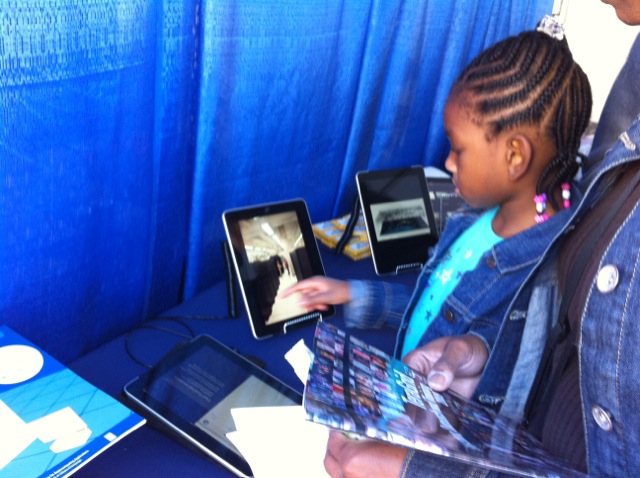
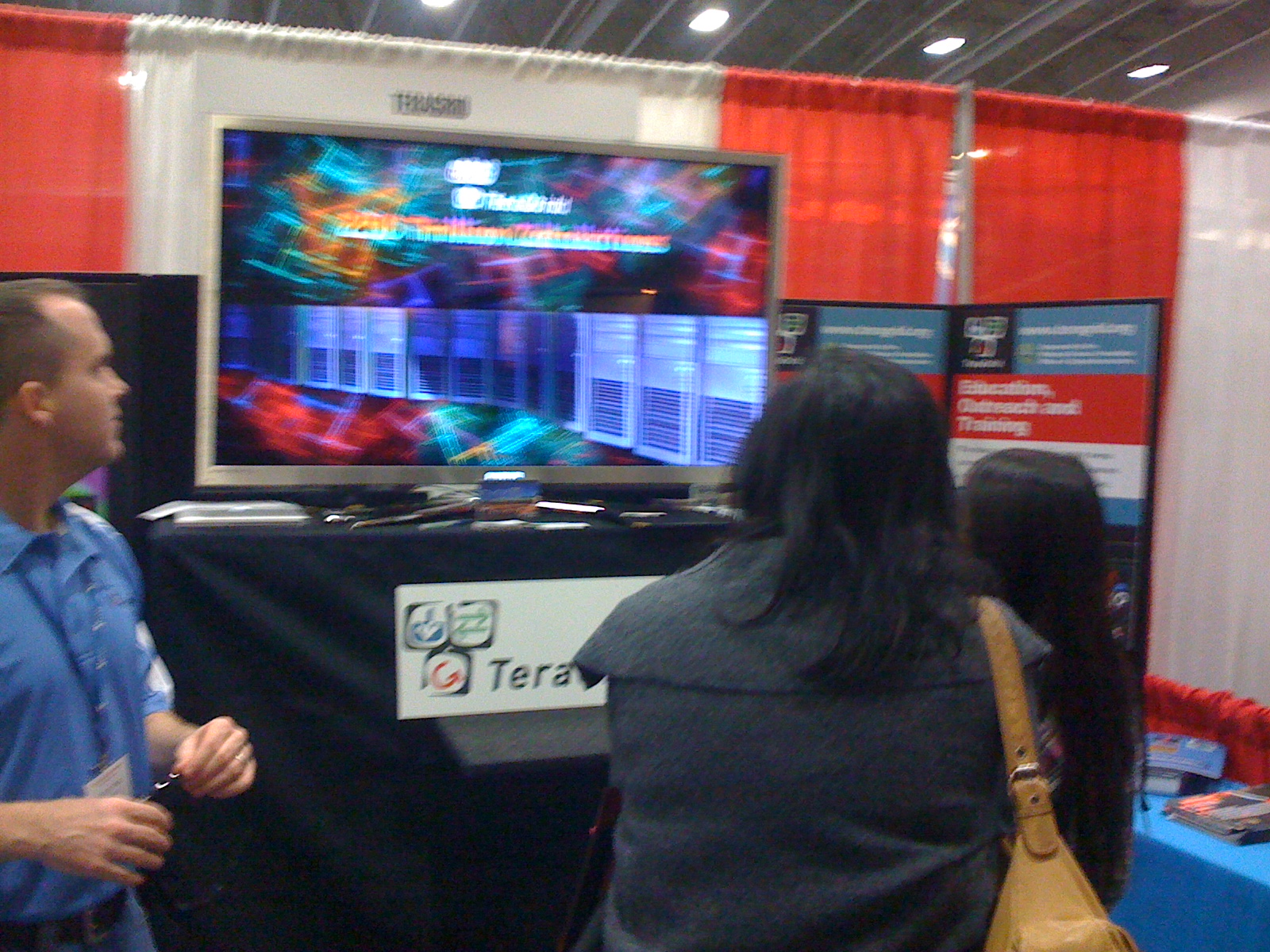
Transforming Teacher Use of Technology with Use of Teragrid Outreach Resources

 
Sharing the Vision of THe Teragrid

Family Science Days AAAS Teragrid Outreach
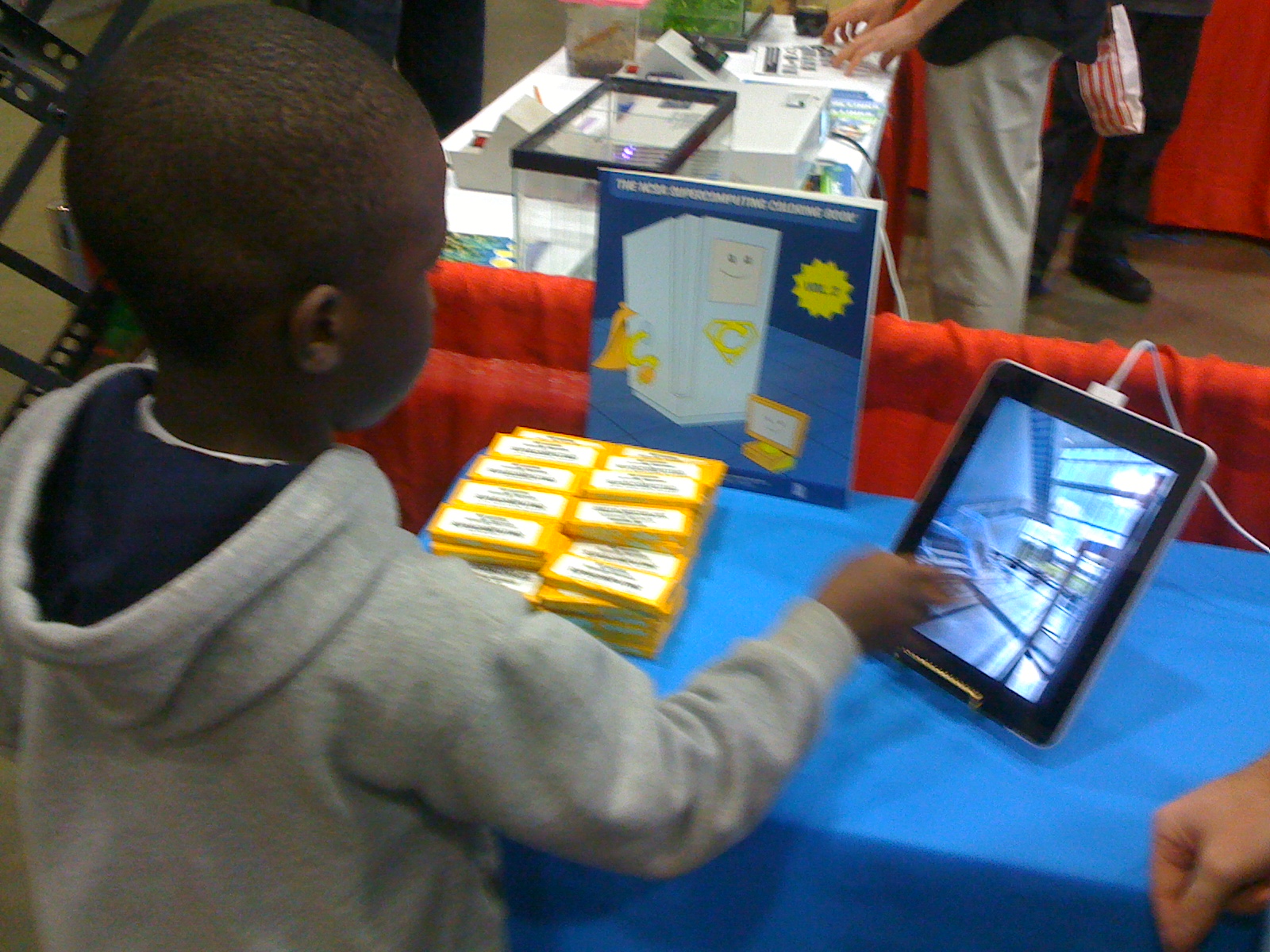
Three Dimension/Film of the Teragrid Outreach in the AAAS Science booth

You may ask, what is the Teragrid?

Teachers find it an empowering resource…

A formal definition is this:

TeraGrid is an open scientific discovery infrastructure combining leadership class resources at 11 partner sites to create an integrated, persistent computational resource.

Using high-performance network connections, TeraGrid integrates high-performance computers, data resources and tools, and high-end experimental facilities around the country. Currently, TeraGrid resources include more than 2.5 petaflops of computing capability and more than 50 petabytes of online and archival data storage, with rapid access and retrieval over high-performance networks. Researchers can also access more than 100 discipline-specific databases. With this combination of resources, the TeraGrid is the world’s largest, most comprehensive distributed cyberinfrastructure for open scientific research.

TeraGrid is coordinated through the Grid Infrastructure Group (GIG) at the University of Chicago, working in partnership with the Resource Provider sites: Indiana University, the Louisiana Optical Network Initiative, National Center for Supercomputing Applications, the National Institute for Computational Sciences, Oak Ridge National Laboratory, Pittsburgh Supercomputing Center, Purdue University, San Diego Supercomputer Center, Texas Advanced Computing Center, and University of Chicago/Argonne National Laboratory, and the National Center for Atmospheric Research.

The research community supports teachers, and education through outreach in several ways.  Each of the research communities has a specific education section . Gateway if you will to the use of the research .

San Diego Supercomputing Center features the subject of Computational Thinking using a well thought out project that was written by Pat Phillips of Microsoft. You can find that here:  http://education.sdsc.edu/resources/CompThinking.pdf

You may have noticed that the major teacher organizations, CSTA, ISTE, CoSN, and SITE featured papers, workshops and discussions on the use of computational thinking in the classroom. This was a planned outreach started by the network of educators and researchers within the Teragrid network.

Here is one of the papers presented at the Consortium for School Networking in New Orleans in 2011:

http://etcjournal.com/2011/04/01/white-paper-21st-century-education-computational-thinking-computational-science-and-high-performance-computing-in-k-12-education/

Executive Summary

The 2010 National Educational Technology Plan says “…technology is at the core of virtually every aspect of our daily lives and work…. Whether the domain is English language arts, mathematics, sciences, social studies, history, art, or music, 21st-century competencies and such expertise as critical thinking, complex problem solving, collaboration, and multimedia communication should be woven into all content areas.”

Since the late 1990s, the US has been trying to describe what a 21st century education should look like. Futurists are trying to divine the skills that will be needed for jobs that do not yet exist, employing technologies that have not yet been invented. However, a careful look around can allow us to see many areas that have been virtually unnoticed by those who are focused on 21st century skills.

Supercomputing – sometimes called high performance computing – is not a new technology concept, but the supercomputers of 25 years ago were about as powerful as a cell phone is today, and likewise the supercomputers of today will be no better than a laptop of 10 to 15 years from now. As the world of the biggest and fastest computers has evolved and these computers have become increasingly available to industry, government, and academia, they are being used in ways that influence everyday life, from the cars we drive, to the food in our cupboards, to the movies we enjoy.

Supercomputing is not an end in itself, but rather the technological foundation for large scale computational and data-enabled science and engineering, or computational science, for short. It is a collection of techniques for using computing to examine phenomena that are too big, too small, too fast, too slow, too expensive, or too dangerous to experiment on in the real world. While problems with small computing footprints can be examined on a laptop, the grand challenge problems most crucial for us to address have enormous computing footprints and, thus, are best solved via supercomputing.

As a result, in order to be competitive as a nation, we need to produce knowledge workers in far greater numbers who understand both what supercomputers can do and how to use them effectively to improve our understanding of the world around us and our day to day lives.

The thinking about large scale and advanced computing has evolved, too. Today, we realize that, while not everyone will be using big computing in their jobs, they will need to understand the underlying concepts.

These concepts collectively are referred to as ‘computational thinking’, a means of describing problems and how to solve them so that their solutions can be found via computing (paraphrased from Jeanette Wing, Jan Cuny, and Larry Snyder). Computational thinking includes abstraction, recursion, algorithms, induction, and scale.

Our 21st century citizens, entrepreneurs, leadership, and workforce will be best positioned to solve emerging challenges and to exploit new opportunities if they have a strong understanding of computational thinking, how it applies to computational science, and how it can be implemented via high performance computing. These are true 21st century competencies that will serve our nation well.

The authors of the paper have been immersed, involved and integrated into the Teragrid community through attending workshops, NCSI initiatives, online contact with the researchers and outreach specialists over a period of time that has proved to create a powerful network of educators sharing the story of possibilities within the Teragrid.

An initial outreach , Teacher Bridge Day , which preceded  an ISTE and CSTA conference, united teachers and educators who then continued to work together over the period of months . The teachers benefitted from the combined efforts of the many researchers and outreach specialists who participated and contributed to the very first workshop.  Following that workshop, there were involvements with ITest through Joyce Malyn Smith.

I am pleased to say that this year , Joyce and the educators at SITE.org reported a large number of people interested in the strand. Joyce took the idea and developed it into a specialized strand for the ITest Community.

Here are a few of the 2011 presentations from the Aera Annual Meeting.

There may be more resources that link to the outreach of the Teragrid. I have chosen these to share.

Joyce was also a force at the SITE conference in Nashville, TN. The informal outeach team, those of us who try to broaden engagement and show diversity were there to shake up the force within SITE.org . We established a SIG for Computational Thinking and fielded a number of workshops.

We worked also at the K-12 levels of technology in Texas at TCEA.

Everything  is Big in Texas:  TACC and Supercomputing , at  TCEA

Ranger?    Stallion ? Computational Thinking and Learning

I  go to Texas a lot. My brother lives there, friends live there,  NASA holds events. I have been to Lockhart for BBQ, to Galveston for a wedding, to San Antonio and other places. I even know lots of recipes and ways to BBQ. But Austin put the icing on the cake for those of us doing digital outreach and broadening engagement in Supercomputing.I took classes at Rice (Teacher Tech) with a Supercomputing scholarship.  I have digital sisters and brothers in Texas.

TEXAS

Why not? Texas is a huge state and I have found lots of friends and educators who support my ways of thinking there.

I participated in a Teacher Tech  workshop at Rice University in Houston, and met Karen North and Dr. Richard Tapia. For a long time I was in constant email touch with a LOT of Texans. We were not sure what kind of reception we weuld get in 2011, this being a new topic to many people. I have been to Austin a lot, so when I see the statue of Barbara Jordan and the big guitars, I feel at home. We had a Supercomputing conference in Austin a few years ago as well.

Ray Rose, Henry Neeman, Vic Sutton and I have been a team at other conferences, we were literally breaking the ice in Austin for educators. It was scary to do.

. (It was very , very cold)  The keynote was a very warm one by Leigh Anne Touhy. The Blind Side was written about her true life experience. She set the tone for broadening engagement and social justice for me. She shared how her life was changed . I had not seen the movie , but I will.

We think that in education there is a blind side to the understanding of technology, particularly computational science, so we put together a workshop for Supercomputing and the use of the Teragrid and we did  a workshop for Emerging Technologies, and a tour of the TACC center.on the campus.

TCEA  Supercomputing and the Teragrid…  no limits, remember?

Henry Neeman has a great presentation , ” What in the World is Supercomputing!“. We took it to a state conference. Did I mention he is from Okahoma? They razzed him a lot, but he just kept on presenting. The interesting thing about it is that he is a reseacher, who can bring the ideas down to earth with fun, and understanding. Henry can do this in person, on line or in a course online. You can fund a lot of the information here.

http://www.oscer.ou.edu/Symposium2003/neeman_bio.html

Nothing like being with him in person however. Think Puzzle. Think a guy moving around at the speed of light, absolutely able to help you understand Supercomputing. This is Henry.

http://www.facebook.com/photo.php?pid=5653613&l=8267b33412&id=593996326

Dr. Neeman also has taught a series of workshops titled “Supercomputing in Plain English”, directed at an audience of undergraduates, graduate students, faculty and staff not only in computer science but also in a variety of physical science and engineering fields. Dr. Neeman’s research interests include high performance computing, scientific computing, parallel and distributed computing, structured adaptive mesh refinement, scientific visualization, Grid computing and computer science education. You can find his materials on line. He is the Education and Outreach Chair for Supercomputing 2012 in Seattle.

We embarked , engaged, energized , and educated teachers so that they could be empowered to understand the computational sciences. We had outreach materials from the Teragrid. So well put together, and such a hit with the educators.

All three of the sessions were a success. We did not have supertech people except one or two and we had about 50 people in the first workshop.

TOURING TACC

The second was the tour.My heart fell when I went to the bus, because at first I could not see it was full. We had a grand tour of TACC. I love the visualization images .http://www.tacc.utexas.edu/scivis-gallery/

The University of Texas at Austin is one of the nation’s leading universities, an academic institution of enormous breadth and depth, with 50,000 students and 3,000 faculty. It’s an economic powerhouse that pumps more than $8.2 billion into the Texas economy each year. It ranks fifth in the world for academic citations and is the recipient of more than 400 patents. Seven of its doctoral programs rank among the top 10 in the nation.

The University of Texas’ intellectual firepower extends far beyond its classrooms and labs. In addition to ongoing research in 18 colleges and schools, the university sponsors 100 separate research units and 10 organized research units, such as the Texas Advanced Computing Center (TACC).

TACC plays a pivotal role in the new culture of computational science at The University of Texas at Austin and is central to UT’s success as a major public research university. TACC boasts world-class resources and expertise that enable scientists and researchers to find solutions to the biggest problems facing science and society. From climate change to medical research to energy resources, traditional and renewable, advanced computing provides the tools that are critical to discovery in science and across disciplines. Faith Singer-Villalobos lead the presentation and discussion.

TACC’s education and outreach programs support their mission to enable discoveries that advance science and society through the application of advanced computing technologies. We all benefit from advanced computing in our everyday lives, from more accurate weather reports, to safer automobile designs, to smaller, lighter electronic gadgets.

TACC’s education & outreach programs introduce K-12, undergraduate and graduate students to the power of advanced computing for science, technology, computer science, engineering, and mathematics. It believes that the students are the next generation of Einsteins, Curies, and Hawkings, who will someday make breakthrough discoveries that we can’t even imagine today.

We wanted to touch the future through sharing with the teachers what the university and supercomputing had to offer.

Teachers touch the future.

Our last presentation was to identify the real 21st Century Literaraies.  about data visualization, and computational thinking, data mining and global collaborations. We were able to share partnership organizations to teachers for field experiences, National Geographic, Earthwatch, NASA , NOAA but most importantly to show ans share curriculum opportunities that were free.

Shodor.org

http://www.shodor.org/activities/

and Scalable Game Design

http://scalablegamedesign.cs.colorado.edu/wiki/Scalable_Game_Design_wiki

http://scalablegamedesign.cs.colorado.edu/gamewiki/index.php?title=Scalable_Game_Design_wiki&oldid=3534#Game

Meanwhile San Diego is doing outreach of this kind.

Upcoming Computer Science Courses for High School and Undergraduate Students

http://education.sdsc.edu/

Introduction to C++ Programming
Mondays, January 10 – March 14, 2011– 4:30pm- 6:30pm (weekly)

This class  introduces programming concepts to students, with no previous programming experience required, and will focus on learning to read and write programs in C++. The class will focus on in-class programming and participation. The course will move quickly and students are required to have access to a computer at home. The course will cover IDEs, programming basics, compilation, execution, flow control, functions, arrays, pointers, file I/O, structures and classes. Weekly homework assignments solidify understanding in preparation for a comprehensive final project.

Introduction to Programming in Python ( this already started)
Tuesdays, January 11 – March 15, 2011– 4:30pm- 6:30pm (weekly)

This course offers an introduction to computer programming via the Python programming language. Students listen to weekly explanation-demonstrations of and gain simultaneous practical experience with basic coding concepts such as calculations, string formatting/manipulation, conditional statements, iteration, file i/o, and the abstraction of functions, as well as programming style. Weekly homework assignments solidify understanding, and a final project offers the opportunity to creatively deploy the class materials. This course is designed to prepare students for the class’s final project, the creation of a computer program that generates a poem.

In our network we can identify lots of opportunities for K-12. Teragrid even features them in a booklet.

How much data is that? Check out the visual idea of it.

http://www.focus.com/images/view/52784/

The National Broadband Map. Be Active ,Report your Broadband Speed


It is a tool for your use. Here is what you can do with it. You can go to your school board and demonstrate broadband use in your community.

You can share your speed and help to fill out the National Broadband Map.

In case you missed it, it is a kind of citizen transparency project.


Last week some of us were treated to a sharing of the National Broadband Plan http://broadbandmap.gov/ this was from the office of

Karen Cator at the Dept of Education and they shared data on the schools. This was one of the great workshops presented at CoSN.


It is an amazing tool. Here is the workshop for that in a PDF.

http://www.ntia.doc.gov/broadbandgrants/090724/BroadbandMappingWorkshop_090724.pdf. The Dept of Education and NTIA collaborated on that presentation. The broadband map can be used to analyze.

This is the section of the map that shares what you can analyze. This is taken from the web site.

Analyze

Use the tools on the map to rank an area by a specific broadband attribute, generate summaries of broadband availability for a given area and download reports containing popular statistics.

Use the rank  tool to compare broadband availability in different areas. Generate a national list of states, counties, Metropolitan Statistical Areas (MSA), Congressional Districts, census designated places or Universal Service Fund (USF) study areas by broadband speed, technology, number of broadband providers or demographic information. The tool also generates ranked lists within a state, including by county, census designated place, Congressional District, state legislative district, MSA and USF study area. You can compare areas.

Use this tool to generate an overview of broadband availability for any state, county, state legislative district, Metropolitan Statistical Area (MSA), Universal Service Fund (USF) study area, or Native Nations. This should be helpful to your learning community, your school board, and local consumers.

Popular Reports »

View and download popular reports.

  • ▪  Broadband Availability in Urban vs. Rural Areas
  • ▪  Number of Providers by Speed Tier
  • ▪  Access to Broadband Technology by Speed

The National Broadband Map Created and maintained by the NTIA, in collaboration with the FCC, and in partnership with 50 states, five territories and the District of Columbia.

Understanding Actual Broadband Performance by Visualizing over 1,000,000 Tests Every Day

Last week, I spent time with Vint Cerf. I know him from the time at the National Infrastructure  Information Advisory Council. He was keynoting a forum at the New America Foundation on Broadband,

You can demonstrate the technology he used.

He showed us a number of variables by which we could use the measurement lab to access real time data about the Internet.Measurement Lab. You can demonstrate this tool.


Google Inc.PlanetLab ConsortiumNew America Foundation’s Open Technology InstituteHere is a second tool.

Google has a different tool. Kind of  Gapminder for Broadband and it is international as well as national.

Here is what the mapping does.

Google maps 300TB of real-world Internet speed data

How fast is your broadband?

M-La, a partnership between the New America Foundation and Google meant to measure Internet connections, has given Google two years worth of actual broadband connection data, as measured by users. That’s more than 300TB of data, which Google has imported into its Public Data Explorer for easy viewing and analysis. The results are remarkable.

Measuring Internet access has been tricky for years. Sascha Meinrath of the New America Foundation told Ars back in 2009, when M-Lab got underway, that detailed network data about speeds, latency, jitter, and more used to be in the public domain until the government-run NSFnet was privatized in the earlier 1990s. Today, though, it’s hard to know what speeds ISPs are actually offering (knowing what speeds they advertise, by contrast, is simple).

M-Lab has distributed testing tools for two years now and its servers have recorded data on the results. One of the most basic measurements is pure speed, measured in megabits per second. When these real-world speeds are charted on a map, they make Internet speed differences obvious in a way often obscured by simple lists and numbers. For instance, the two images below compare Internet download speeds in US states to Internet download speeds in European countries (many of which are the same size as US states). Speeds are medians.

More Resources?

M-Lab is one of many projects exploring ways to help users more clearly understand the performance of their broadband connections. If you’re interested in exploring further, here are a few other active projects that we know about. (Note that these projects are not associated with M-Lab.)

  • The FCC’s “Test My ISP” project:
    Together, the FCC and Samknows are setting out to provide US consumers with reliable and accurate statistics of their broadband connections. If you are interested in using one of our units to measure your home broadband connection, then please sign up below. You will get to play a part in changing the face of the American broadband industry and you also get a free high-speed wireless router!
  • The Electronic Frontier Foundation’s “Test Your ISP” project and Switzerland client: “[Switzerland is] an open source software tool for testing the integrity of data communications over networks, ISPs and firewalls. It will spot IP packets which are forged or modified between clients, inform you, and give you copies of the modified packets.”
  • Northwestern University’s Aqualab Project and Network Early Warning System plugin for Azureus: “Passively monitor[s] your BitTorrent performance and check[s] for changes that might indicate problems with the network.”
  • Harvard Berkman Center‘s & StopBadware.org‘s Herdict: “Herdict Web aggregates reports of inaccessible sites, allowing users to compare data to see if inaccessibility is a shared problem.”
  • BroadbandCensus.com: “A user-generated census of broadband speeds and availability.”
  • SamKnows Broadband: Provides broadband information in the U.K. and runs aperformance testing program in collaboration with individual users.
  • University of Washington’s Web Tripwires: “Measur[ing] how often web pages are changed [by an intermediary] after leaving the server and before arriving in the user’s browser.”
  • NNSquad: “An open-membership, open-source effort, enlisting the Internet’s users to help keep the Internet’s operations fair and unhindered from unreasonable restrictions.”
  • GCTIP Forums: “a free discussion environment to act as a clearinghouse for all stakeholders (technical, consumers, ISPs, government-related, etc.) to interact on the range of “network transparency” and associated topics.”
  • A group of researchers at Georgia Tech have created NANO, a Linux-based application that identifies performance degradations resulting from differential treatment of specific classes of applications, users, or destinations by a network operator. Future versions of NANO plan to make use of the M-Lab platform.
  • The Netalyzr analyzes various properties of your Internet connection that you should care about — including blocking of important services, HTTP caching behavior and proxy correctness, your DNS server’s resilience to abuse, NAT detection, as well as latency & bandwidth measurements — and reports its findings in a detailed report.


Test Your Internet Connection

GO HERE..http://www.measurementlab.net/

Use these tools running on M-Lab to test your internet connection and

About the tools:

  • By using these tools, you help advance research by contributing valuable data about broadband performance.
  • The tools only collect data related to the specifically orchestrated communication “flows” between your machine and the M-Lab server.
  • The tools do not collect information about your other Internet traffic, such as your emails, Web searches, etc., or any personally identifiable information, unless you affirmatively provide it in response to a specific request, such as a form that asks you to provide your email address, etc..
  • All data collected by the tools will be made publicly available.
  • All tools are created by individual researchers, not M-Lab itself.

    Network diagnostic tool

    Test your connection speed and receive sophisticated diagnosis of problems limiting speed.

    Glasnost test

    Test whether certain applications or traffic are being blocked or throttled on your broadband connection.


Digital Divide, Digital Equity … and Access? Digital Equity is the New Civil Rights Issue


Are we there yet/

New Technologies for New Times.. are you stuck in dialup?

Teragrid Resources, using IPad

Long ago there was a book written about “Invisible Man” by Ralph Ellison. Here is the Wikipedia stub for the book.
Invisible Man is a novel written by Ralph Ellison, and the only one that he published during his lifetime . It won him the National Book Award in 1953. The novel addresses many of the social and intellectual issues facing African-Americans in the early twentieth century, including black nationalism, the relationship between black identity and Marxism, and the reformist racial policies of Booker T. Washington, as well as issues of individuality and personal identity.In 1998, the Modern Library ranked Invisible Man nineteenth on its list of the 100 best English-language novels of the 20th century. Time magazine included the novel in its TIME 100 Best English-language Novels from 1923 to 2005.[1] You might have to read the book to get the connection with the lack of broadband. Read the first chapter. The story is sad, but , it works for this analogy.


This statement could work for those who have limited or no access.

“I am an invisible man….I am a man of substance, of flesh and bone, fiber and liquids – and I might even be said to possess a mind. I am invisible, understand, simply because people refuse to see me.”
— Ralph Ellison (The Invisible Man)

Got Broadband?

For those people who are not currently online with broadband access, they may seem like the invisible man that was in the novel. Groups championing the use of technology, point to their online resources and information. Those groups who used to have paper magazines and handouts decided not to offer them anymore. Everyone is online  they thought? Think again.

Even the new broadband map has its critics. The San Jose Mercury News  has this to say.

It is frustrating to see that after two years of work, some of the information is incomplete, incorrect or out of date. There’s much you might like to know that the map and its accompanying database don’t provide, most notably how much broadband services cost in your area. The map just launched, so it is likely to get better over time. The government is allowing anyone to download and use the database and is providing tools to allow other websites to access the map and data. It also is taking input from consumers to identify errors that will be corrected in updates. Here’s hoping that the government regulators follow through on those revisions and seriously consider updating the site more often. Because the National Broadband Map has the potential to be a very useful tool for consumers — but it’s not there yet.

For the people who are learning about Cloud Computing and online content , the devil is in the details. For the school systems who are reading the new technology plan, which is a good plan there is just one problem. How to , if there is no connectivity in the broadband sense.

If you are rural, One Third of Rural America Has Access
http://online.wsj.com/article/SB10001424052748703561604576150691269105816.html

You can check the reality of the New National Broadband Map here
National Broadband Map
Popular Reports: Quick access to download the most frequently generated reports. … goal of embodying the spirit of the Internet by delivering the National Broadband Map …
broadbandmap.gov

http://broadbandmap.gov/

http://arstechnica.com/tech-policy/news/2011/02/navigating-the-us-national-broadband-map.ars
 

arstechnica.com

The US government’s long-awaited National Broadband Map has arrived, with tons of ways to discover what kinds of Internet services are (or aren’t) available in your area. We’ve got a guided tour of the site.

Is there Digital Equity in your community?

The Digital Equity Toolkit. The toolkit points educators to free and inexpensive, high quality resources that help address the digital divide in the classroom and community. This toolkit was developed by Robert McLaughlin and  associates and has been re-edited for tofay’s times.

I have been working with and helping to point our inequity since I was on the NIIAC and we framed the policy that we thought would bring us national broadband much earlier.  We thought that students, families and communities would be able to get access through libraries, community centers, and schools.

Bonnie Bracey Sutton

PowerofUS Foundation

If you read our statement , we aim to change the face of schooling by creating digital equity in a national transformation of schooling.

Emaginos.com.

Here be Dragons..Maybe the Dragons in Education are Ancient Practices

Not Reform, Transform, Here be Dragons.. I think not….Dragons may be the people stuck in ancient practices.

Not Reform, Transform Schools, Look Toward the Future, Not the Pastby bonniebraceysutton on January 25, 2011

Not Reform, Transform, Here be Dragons.. I think not….Dragons may be the people stuck in ancient practices.

Bonnie Bracey Sutton, Power of US –

Reflections from a Truthout Article

http://www.truth-out.org/lets-not-reform-public-education67006

Who can disagree with reform? Who can be against helping children stuck in a bad school system?

What the corporate reformers have done well is to essentially trademark “reform,” branding in the public mind their diagnosis of what’s wrong with schools and the harsh, chemotherapeutic remedy.They own reform. They are the people of Aspen, the digerati that meet and greet and talk about the future. Few real teachers, or administators, or community membersin real educational situations are a part of these conversations. Most have never experienced or know the real areas of difficulty, in education. Their experience of bad school systems is filtered. There are people suffering from really being involved who have a real perspective on the problems. But, they have hardly been consulted.

Rhee Goes Rogue

What’s wrong with the school system, according to corporate reformers, is the bad teachers, their unions and “special interests,” as Rhee claims practically unchallenged in her Newsweek cover story and across the corporate media, including in “Waiting for Superman,” which earned ample air time on Oprah’s “Shocking State of Our Schools.” The corporate media has adopted this diagnosis, as is best illustrated in Tom Brokaw’s segment in “Education Nation,” an NBC special applauding the corporate reformers featuring Rhee and Gates (Gates also appeared in “Waiting for Superman”). The Bill and Melinda Gates Foundation was also one of the sponsors of Education Nation, and Gates was a star of his own show. Not surprisingly, Brokaw – a reporter, not a pundit – claims, as fact, that there is a “teacher establishment,” which is part of the problem, echoing Rhee and other corporate reformers sponsoring the event..

I have been involved in some of the digerati discussions, in places where the rich and famous gather to discuss ideas. For the most part there are few genuine educators present. But there are “scholarships” for a chosen few.

The audience is of powerful people with big ideas. Think Aspen, Ted, PopTech,  and other specialized groupings that are a digital divide, well a monetary divide as well.There re are some wonderful things that happen as a result of these powerful meetings. Clark County in Nevada has demonstrated some wonderful projects as a result of Gates Funding. I enjoyed learning in their schools of the future

.http://www.facebook.com/album.php?aid=43472&id=593996326

Often the diagnosis, the corporate reform remedy is obvious: take down the “teacher establishment,”

For the most part, teacher voices are left out of the conversation.

The real stories of schools in Washington DC were never told.

Slowly, the effects are being judged.

I personally taught for three years in DC and ran screaming for the suburbs.Children were sleeping under my car, Children were following me because of need in the neighborhood. Children were falling down elevator shafts.There was  no nurse in the schools. The school I taught in stank when the heat was turned on from years of old urine. We had rats. But I did stay three years. When we had to teach on a bench in the gym during some remodeling, that was too much for me. We were not in touch with the community. We did do the technology mentoring , and some learning took place. But the culture of the educational community and the support of the learning community parents was what we worked on for the most part. We had measured success.

I live in Washington DC. I know the lay of the land and the needs of the schools. While in the Clinton Administration we worked to help Ballou High School.’Actually not much helped, there was the culture of those who feel deserted, the lack of infrastructure, the lack of real training of teachers and we tried, but lots of people had bandaid solutions. I am not sure that anything worked. Don’t tell me that they had a wonderful band that went to the Superbowl. I don’t care about that.

What did Rhee Leave in her Wake...

This headline did not make the national news . But , it should have.The press does not follow up on their highly flambouyant stories. We don’t have a movie of the reality of rural, poor, minority and reservation schools. Perhaps the story is too hard to tell. Probably they are afraid that teachers won’t come to teach in areas of need. maybe reporters just need a very media ready story.

Private contractor failed Dunbar High’s students, D.C. says

http://www.washingtonpost.com/wp-dyn/content/article/2010/12/14/AR2

There are other stories to think about as well.

The press does not tell the bad stories in education. The bad stories are depressing. Some children live the bad stories every day of their school life.

Say it isn’t so on IMPACT, Mayor Gray

http://voices.washingtonpost.com/answer-sheet/dc-schools/say-it-isnt-so-on-impact-mayor.html

By Valerie Strauss, Washington Post Reporter

“Here’s why I was so disappointed to read my colleague Bill Turque’s report on a plan by D.C. schools officials to have the flawed IMPACT teacher evaluation system reviewed by a Harvard think tank:

1) I was optimistic that new Mayor Vincent Gray was serious about fixing the problem when he said at a recent public forum that the evaluation system –instituted under former Schools Chancellor Michelle Rhee — was unfair to teachers. In his own words:

“I guess I would say at this stage… it’s a step in the right direction, but it’s got a long way to go to be a fair evaluation of our teachers. And frankly any system that isn’t sensitive to the differences in challenges of the kids in the schools only encourages teachers to teach in one part of the city and not in the other parts.”

But, the national news does not pick up the examination of Rhee’s work under the microscope of public and academic opinion. The voters had their say and the press moved on.

There are reasons to be concerned about the legacy of Michelle Rhee.

Those of us who work, and who try to impact, change and help transform the schools know a lot of stories that the press is not talking about. Sometines the truth may be too ugly to tell.Sometimes the press does not tell the good things that happen either.  The George Lucas Educational Foundation is left to sort the stories out. Emaginos  says on their web site.

The Need To Transform K-12 Education

As President Obama recently told Congress and the American people,“In a global economy where the most valuable skill you can sell is your knowledge, a good education is no longer just a pathway to opportunity — it is a prerequisite. Today, three-quarters of the fastest-growing occupations require more than a high school diploma. And yet, just over half of our citizens have that level of education. We have one of the highest high school dropout rates of any industrialized nation. And half of the students who begin college never finish. This is a prescription for economic decline, because we know the countries that out-teach us today will out-compete us tomorrow.”

Emaginos has the concept of transforming educational practice through example at the Tracy Learning Center in Tracy, California, a time tested learning project.

Tracy Learning Center

The Tracy Learning Center is the first in a network of research and development schools implemented to demonstrate Emaginos Learning. The Tracy Learning Center is a dynamic response to the compelling need to revolutionize teaching and learning. The foundation for Emaginos Learning has its beginning in the vision, creativity and innovation used to design the Tracy Learning Center. The Tracy Learning Center opened in July 2001 and operates as a K-12 charter school. The Tracy Learning Center serves as a model for both public schools and learning in the private sector. It is an innovative collaborative of industry, education and government that provides a positive change in the process of learning.

The center involves, parents, community, learners and the community colleges. http://www.emaginos.com/tlc.html

TEACHER VOICES?

I like the NFIE project which probed teachers about their learning a href=”http://www.nfie.org%3E/“>www.nfie.org>;.”To improve schools we must focus on the teachers,” said Judith Rènyi, executive director of the National Foundation for the Improvement of Education, (NFIE) in releasing this report .

Teachers Take Charge of Their Learning “Schools can only be as good as the teachers in them. This is something that all other so-called ‘reform efforts’ have missed. It’s what teachers know and can do that will make the difference in improved student performance..When I am on the road, I learn that most teachers have little or no knowledge of the documents, and kinds of support they can get. People keep giving us lesson plans, and more websites, webcasts, nings, and other way to communicate, But a basic understanding and fluent knowledge of the new ways of participatory cutlure, and deep curriculum, is important. We need web 2.0. an understanding of Cloud Computing and we need to know the significance of the use of mobile technologies.

Children with their hands on the keyboard have access to knowledge beyond the textbook, teacher, and sometimes the local library resources.

Cyberbullying

.They need to know the resources for

Cyberbullying. http://www.stopcyberbullying.org/.

http://www.facebook.com/album.php?aid=207765&id=593996326

Beyond this web site is a tool kit for the use of computers for community, school, and personal use. Here are pictures of an event that took place in Washington.

What we need is applications of pedagogy. These should be delivered up close and personal. A website to a techno-terrifed teacher is of NO significance.The website can be a wonderful link after teachers have developed a vision for driving technology into their personal school tool armature.   If we look at the way in which people are attracted to technology, there are several routes, courses, games, mentoring, and use at school that entice people to use technology..

Clark County Schools in Nevada have some wonderful showcase schools.

These are my pictures but there are discussions of the various schools in the Edutopia web site.

My tour of Clark County Schools

http://www.facebook.com/album.php?aid=43472&id=593996326

Pedagogical Tools

Technofluency fir teacchers  is the word

.http://www.tpck.org/tpck/index.php?title=Main_Page.

It is also described as TPCK – Technological Pedagogical Content Knowledge

Bloom’s Digital Technology is the word. And construct to think about. Bloom’s Taxonomy Blooms Digitally, Andrew Churches

http://shar.es/3aHuL

Computational Thinking is the word. www.shodor.org

Every day we read, use, employ and get information from computational tools, and resources. We access the weather, read the oceans, find our way in cars, use the Internet, get medical treatment using imaging, and so on. There are gatesays to  the use of superconmputing that we learn about in the press, but not as a part of preparation for the future in school. Why is that?

If you say supercomputing, or computational thinking few people know what that is, or cloud computing, yet they use it every day.

Teachers are sometimes still in the dark ages of education, using tools that my mother and others used 80 years ago. Chalk and Talk. Globaloria is an example of a state effort to teach teachers, with collaboration, connectivity and community. Here are photos of teachers taking charge of their learning. It was a wonderful event.

http://www.facebook.com/album.php?aid=247311&id=593996326

How Many Teachers Use Technology?

An ETLS survey showed these points…Connecting Teachers and Technology

Research shows that helping teachers learn how to integrate technology into the curriculum is a critical factor for the successful implementation of technology applications in schools. Most teachers have not had the education or training to use technology effectively in their teaching. As technologies are ever evolving and many times professional development is a very short interface. Some esteemed professors feel that technology has no place in the curriculum and I do not debate them on line because they have made their minds up to the contrary, but use the technology to tell us that the participatory culture does not work , excuse me?

In medieval times, the scripters, the careful monks who painstakingly copied books, had most written knowledge in their hands. The monks and priests had a network even then to disseminate knowledge to the capitals of the countries that the Jesuits served. The “knowbots” of medieval times were the intellectuals who could read, write, and discourse, and they made decisions or were able to influence the decision making of that era. In those dark ages, information was available, but very few were privileged to be a part of the sharing of knowledge. Once the printing press was invented, the industrial secrets of that world and global niches of specialization were quickly shared. But even then, the movement of ideas was based on a person’s ability to read and to purchase or have access to a book. It took a long time to bring the cost of books down to a level that the general public could afford. Hence, the town criers. Oyez! We are undergoing change that is more widespread and just as transformational, if allowed.

The New America Foundation brings up the images of dragons. Here be Dragons…

Maps in the old days often included depictions of sea dragons or lions to connote unknown or dangerous terrain. Unfortunately, when it comes to a future that will be altered in unimaginable ways by emerging technologies, society and government cannot simply lay down a “Here Be Dragons” marker with a fanciful illustration to signal that most of us have no clue. Many of the nay -sayers have no clue but lots of press presence. I remember when the Pope, Oprah, and others warned of the Dragons in the use of the Internet. Check out their web pages. Lots of the people made a lot of money raising red flags about technology. Remember Todd Openheimer? He is probably somewhere quietly counting his money.

Many teachers are not far removed from those primitive ways of communication. We are still using the book for our basic teaching and the voice for the delivery of the program with a little help from some current technology, some hands-on projects, and a few field trips. The current economic crisis strikes hard in places along the digital dark road, where Internet is suspect, and teachers have little or no training in the use of technology.”

In the book, 21st, Century Skills, Learning for Life in our tines, Bernie Trilling and Charles Fadel remar that the world has undergone foundational shifts in recent decates-widespread advances in technology, and communications, increased competition, and the escalation of global challenge from financial meltdowns. They query , how can we prepare students to meet the challenge of our century if our schools remind virtually unchanged?

They focus on Learning and Innovation Skills

Creativity and Innovation Critical Thinking and Problem Solving, and Communication and Collaboration

, Digital Literacy Skills

Information Literacy , Media Literacy and ICT Literacy( this should include an understanding of Cyberbullying and the whold concept of the participatory culture.

Many teachers , schools and communities don’t have a concept that defines Wired Safety.

Here’s a place to get a start. http://stopcyberbullying.org/

Career and Life skills.

Many of us call these skills workforce readiness skills.

Flexibility and Adaptability, Initiative and Self Direction, Social and Cross Cultural Skills, Productively and Accountability , Leadership and Responsibility.

How do we transform practices?

The good news is that many teachers are using the new cells of virtual communication and networks that exist on the Internet to reconstruct and improve their teaching practices. The number of people involved in network communications is larger than the cable and television viewing public. Teachers are learning multimedia and using platforms to create learning environments that are rich in motivation and interest and cater to different learning styles. Our link is the computer, online telecommunications, and our virtual communities of thought, conventions, and teacher organizations.

We are just beginning to develop new ways of learning. Unfortunately, we are like the monks. Most people outside our sphere do not understand our words when we talk about the information highway, any more than the peasants understood Latin from the monks. There are more people who do not understand this hue and cry about the information highway than those who do.

What is interesting is that most of the people talking about education are not educators.

Even the experts in education are ignored. Here is the questions. Do or should reporters be the experts, choose the experts?

Educators

The digital world will change education as much or more as the printing press did. For years we did not understand the changes the printing press made in the storage and retrieval of information. The digital world will change learning as much or more than books. Frank Withrow

The corporate reformers have reached the hearts of the public, blinding them with a beautifully rendered fiction.Even though Ravitch is very visible, even though she has powerful data and analysis to support her conclusions, which are widely published and read, she hasn’t been successful in capturing the public imagination, as there is no story – no hero or villain – for the American public to easily grasp, to reduce into a simple plot with an obvious moral. There is no heartwarming tale to sell newspapers or to draw viewers to the evening news or sob-filled theatres.

On our present course, we are disrupting communities, dumbing down our schools, giving students false reports of their progress, and creating a private sector that will undermine public education without improving it. Most significantly, we are not producing a generation of students who are more knowledgeable, and better prepared for the responsibilities of citizenship. That is why I changed my mind about the current direction of school reform.

Ms. Ravitch is author of “The Death and Life of the Great American School System: How Testing and Choice Are Undermining Education,” published last week by Basic Book

Powerful Learning : What We Know About Teaching for Understanding

The nation’s leading education experts present the best teaching strategies for powerful learning

Teaching: what works, what doesn’t, and why? Within the fields of reading, math, and science, bestselling author Linda Darling-Hammond and colleagues describe, in clear and practical terms, the best teaching methods for K-12 student understanding. Rich classroom stories show that students designing and working together on engaging projects are challenged to do more than just memorize facts. This invaluable resource offers innovative strategies to support student learning.There is a wrinkle. We are talking often as if everyone has access to the new technologies and broadband. The hope today is that wireless technologies will vault the Digital Divide. What do you think?

Communications technologies have continued to evolve and now increasingly provide opportunities for deploying low-cost broadband. However, conventional commercial business models for providing broadband often create bottlenecks to spreading connectivity. Over the past five years, successful community and municipal wireless networks have been overlooked and often dismissed, yet they hold tremendous promise for improving our nation’s approach to building communications infrastructure, empowering local communities and addressing the digital divide. This event will launch an important report that reviews community and municipal wireless networks across the United States and Europe.

I Kids..IPhone, I Read with Joy..I Read

Recently a small relative, who is under 2 yeas old made me think a lot about the new ways of learning that we should be considering and monitoring, and learning from. The participatory culture has a new addition. None readers can do interactive learning. He had books, and I think I saw Nemo over and over again until I was tired of it. But the IPad changed his habits. I also had some other tricks up my sleeve, but I never had to use them. He still gets a good reading activity from his mother, a bedtime story that is in traditional form.

Using the IPad

New ways of exploring learning, vaulting the digital divide

The article, the rise of the IKids caught my attention.

http://www.mercurynews.com/news/ci_16860666?nclick_check=1

I am from the Grandma and Me generation. That is there were some CD Roms, that I used to teach students , at a higher level than non reader, and I was fascinated then by the attention, time and interest of students.  A principal challenged me to make use of the programs and I did. Unfortunately, the programs worked so well, that I had to find a new way to schedule students into the lab. We were a small school with a tiny lab, with a window to the world.  Linda Roberts did not approve of the programs, but I used them to enrich and change the interest level of readers. Ok, I also was able to do individualized conferencing since all of the kids were busy, and to introduce children to many books in that format with ease, no matter which language they spoke at home. The school I worked in was a school in which there were many immigrant children. English was.. sort of spoken by most , but not necessarily by the book.

I started the use of the CD Roms ( which I found in a closet) with special education students. I liked the individual ways in which students could progress through the materials and it also gave me time to do small group work.

I knew the materials were a hit when some of the children literally ran with their walkers to the lab with a smile on their faces trying to escape going to recess. There were about ten programs in this category and those that I did not have, we purchased.

A lot of people would say.. how is that reading??  Well the program could read to you, you could click on the images on the program, and you could go through the program in Spanish, in English and Japanese.  There were variable resources as well. Many people thought that these little books were not academic enough. I saw them as an invitation to read, to explore, to think, to be imaginative to get lost in the reading experience. Living Books they were called. I individually purchased every one I could get. They were that inspirationally different from the thick , boring textbook with the workbooks and word tablets that were never ending. I am not sure but this is what Wikipedia says about where the Living Books are and how they can be found except on UTube.  I am just learning to be a facilitator for a pre-reading child. I should explain that I escaped teaching for a while, the tedium of the reading circles got to me.  But I did return.

“The Living Books series was a series of interactive animated multimedia children’s books produced by Brøderbund and distributed on CD-ROM for Apple Macintosh and Microsoft Windows. The series began with the release of Just Grandma and Me (an adaptation of the book by Mercer Mayer) in 1992; other titles in the series included The Tortoise and the Hare,Arthur’s Teacher Trouble (and other adaptations of books by Marc Brown), Dr. Seuss andBerenstain Bears titles. [1]

Living Books became quite popular in the mid-1990s and were even used in some classrooms to teach English. Some home-computer users reported purchasing CD-ROM drives and sound cards specifically to run Living Books.

Many of them had selections for other languages, namely Spanish and Japanese.

The series did have an official website, http://www.livingbooks.com[1], but after the series was canceled by Broderbund, the site was up for grabs and bought by Scholastic. It was then converted into a jungle book series website that sold books published by Scholastic.

So , now on IPad and IPhone there are newer interactive programs. How do we use them in schools? Do we?

Little Critter certainly helped me to charm a group of students who were not all that interested in reading to read. We progressed to the Jack Prelutsy poetry, to the other offerings of this genre. The special education teacher and I were on a roll for a long time until the teachers saw the excitement in the lab through our goldfish window. Then, even the teacher who gave me the programs stating that the were useless, demanded lab time.

We had a solution. earphones from the Dollar Store, and a selection of the programs for the special education class so that they could continue their explorations during class.

Reading is a very special joy, interactive reading , is a new way of sharing. Soon there was the Cat in the Hat and other offerings.. I loved being able to take the kids from the CDRoms to a real book, but I also had surprises. One day a child spoke the story to me in Japanese.

This opened my eyes to limitations we place on students with gated reading. Often teachers would not let you go to the next level. You know, it was a grade leveled thing reading. NOT.

The IPad and other reading programs give wings to students who enter the world of reading with true interest, and joy. The little relative who wanted to find sites on IPad, was introduced to the stories, and demanded them from time to time. I have been told that there are applications on the IPhone as well that are of interest to students.

Award Reading uses the magic of the technology in a cloud based reading program and I suppose that there are other programs who see the new ways of learning that are personal. interative and individual. Certainly the textbooks as we know them, good stories carved out of books that are a year long assignment are doomed.

Individualized learning … personalized learning. Do read the article. It is an eye opener.

Here is a small segment. This will calm the fears of those who think we will run out of reading materials and ideas in teaching and learning.

“Before, during and even between classes at Hillbrook School this fall, seventh-graders have been spotted on the Los Gatos campus, sometimes burbling Spanish or Mandarin phrases into the glowing screen in their hands, other times staring into it like a looking glass.

iPads — the Apple of almost every adolescent’s eye — are being provided to students at several Bay Area public and private schools this year, including Hillbrook, which claims to be the only K-8 school in America using tablet computers in class and sending them home. This has led to a lot of 12-year-olds swanning around the wooded hillside campus, talking to their iPads.

“Summoning up a virtual keyboard recently, Sophie Greene quickly typed a note to herself in iCal, a calendar program, then played back an audio file in which she was speaking Spanish. “We record a conversation, e-mail it to our teacher, Señorita Kelly,” she explained, “then she critiques the lesson in Spanish and sends that back to us.”

Conquering the digital divide to provide the mobile tools. Well, that’s another problem. Not mine to solve. I believe that the inattention and the behavior problems in schools of need are caused by the old fashioned idealogy and ideational scaffolding .. using industrial models of reading to teach 21st Century media kids. There are probably students who would love school even more with the right tools. I know that the students I had loved games, books, and the personalization of knowledge. We must transition into new ways of sharing good ideas. What are yours in reading? What magic have you seen?

I have a friend who does 3 dimensional reading .. but I don’t know if that work is in books. One of the things that Living Books did was to encourage me to have students write their own books. Little books. Now with gaming technology , I believe we could at higher levels create some animations of our own to share the ideas of the book.

What have you seen? What captures your imagination in new ways of reading?

I love technology, but I still have a house full of books. That however is a different discussion we can have. What is the best mobile  tool? I certainly don’t know.

What is the power of us to make reading exciting, enchanting, involving and imaginative? That power, give to the disaffected students can change their world and ours. I am thinking three dimensional books. Works for me.

The Digital Divide Is the New Civil Rights Issue in America


My friend Allan Jones gave me this title from a piece that he wrote to describe the inequity of learning in the US. We were thinking about the effects of the PISA report in the US. We were also thinking of places where new ideas and participatory learning are not a part of the program. We have plans to transform education.

The “digital divide” that persists in Internet use is  based on income, education and community means people are not acquiring the digital fluency that is required to operate in to-day’s world.

The part that bothers, us, worries me , is that lots of people who are well connected technologically do not have an awareness of the level of difficulty that others have in reaching technofluency based on connections and awareness.

There is also a level of learning, a depth of knowledge that is lacking in many schools , and learning places.

“To put it quite simply, America is a diverse society in which educational differences have the potential to become a progressively larger source of inequality and social conflict. Many people now recognize that eliminating these differences has become a moral and pragmatic imperative.”

College Board, Reaching the Top(1999)

There is a concern about the status of education in the nation. The recent publication of the  PISA 2009  results have caused a wringing of hands and a contemplation of why the US has declined in education. In minority areas and in underserved areas we have always lived with these kinds of statistics. We are always racing to catch up to whatever is just regular. Broadening engagement is our goal. I was delighted with the US Department of Education Technology Plan. To implement it, however we need assistance. Those of us in minority communities have always been striving to catch up. We never seem to make it.

Rural, urban, distant and compromised describe some of the schools, students adn communities not making use of the Internet. The Internet has gone global in a big way. Here are some interactive ways to share how the web works, resources and the state of and power of the Internet, from the BBC.

What are we talking about? The Web

How the Web Works

Explore this interactive graphic to find out which are the biggest sites on the internet, as measured by the Nielsen company. This feature is part of SuperPower, a season of programs exploring the power of the internet.

Resources

BBC

Interactive program from the BBC- SuperPower

resources from Superpower

We need support for teachers.

I wrote years ago of the importance of teacher support.http://www.ait.net/technos/tq_04/4bracey.php

There are many teachers who simply want to help kids as best they can. What is the motivation for the change from chalk and talk to the use of technology as a tool? In American education, the textbook remains the basic unit of instruction. Absorption of its contents tends to be the measure of education. How can we change that? What motivation is there to take on the task of change?

Many teachers and instructors use chalk and talk to convey information. Students are often recipients of instruction rather than active participants in learning. When teachers upset the industrial model, what are the predictable differences? How do we convey to the public the models of this change and the reasons why U.S. education should change?

In the past, even the most dedicated, skilled, and caring educators needed paper, pencils, and books to ensure that their students got the knowledge they needed to succeed in the society they were being prepared for. To succeed in the society of the 21st century, however, today’s students must graduate with more than the memorized knowledge of the past. They must be able to synthesize and analyze information, not just memorize it. Today’s students must learn to think for themselves. And they must be able to adapt to a world in which the only constant is rapid change and the participatory culture is desired by students to be a part of their learning .

Most schoolteachers work largely in isolation from their peers, and many interact with their colleagues only for a few moments each day. In contrast, most other professionals collaborate, exchange information, and develop new skills on a daily basis. But teachers are often in the classroom, where the bell and the loudspeaker or PA system are the most significant technology. Although half of this nation’s schoolteachers use passive video materials for instruction, only a small fraction have access to interactive video, computer networks, or even telephones in the classroom. And these technologies offer opportunities for collaboration in spite of distance.

While computers are a frequent sight in America’s classrooms and training sites, they are often used simply as electronic workbooks. The interactive, high-performance uses of technology that the NII will allow—such as networked teams collaborating to solve real-world problems, retrieving information from electronic libraries, and performing scientific experiments in simulated environments—are all too uncommon in our schools. U.S. schooling is a conservative institution that adopts new practice and technology slowly.

So how do we teachers make the change? We have a variable set of needs: access to hardware, some familiarity and training, on-site permission, and patience and support within the educational setting. The support should hopefully be systemwide and involve all of the layers of funding; parents and community members; and—to effect significant national change—teacher inservice and training. And, finally, time: teachers need time to learn technology, to understand the applications, to synthesize ideas so they can use technology as a tool that will enhance the teaching process. All of these ideas are considered in detail in the NIIAC’s KickStart Project.  This was written years ago, and for many people the world has changed significantly, but there are those still toiling in pre-technology stages.

Here us a simple test for thinking about the level of teacher use of technology. Take the test.

Examples of Need In areas of the US – What about your Neighborhood?

Need

Without ready access to computers, students struggle

Even wealthy Fairfax is forced to contend with a digital divide

Fairfax County , Virginia USA

http://www.washingtonpost.com/wp-dyn/content/article/2009/12/05/AR2009120501746.html?wprss=rss_education

Need


Teachers describe administrative failings at Dunbar

http://www.washingtonpost.com/wp-dyn/content/article/2010/12/11/AR2010121102464.html?hpid=sec-education

Her account is one of several that have emerged since Bedford was ousted, less than three years after it was hired  by former Chancellor Michelle A. Rhee to turn around Dunbar. City records show Bedford has been paid $1.2 million this year as part of a three-year contract to overhaul Dunbar and Coolidge high schools. The firm remains in control of Coolidge. of course, Rhee is gone but this was her project.

Need

Private Operators Ousted at Dunbar

http://www.washingtonpost.com/wp-dyn/content/article/2010/12/08/AR2010120807351.html?sid=ST2010121102563

Rural

There are rural schools in which I have worked that do not welcome the use of the Internet for various and sundry reasons.I have traveled tribal regions with Karen Buller of NITI, in the  Navajo nation and am impressed by the Hogan to the Internet program start. I work with Idit Harel Caperton in West Virginia, so I know the rural challenges. Her example of facilitation of the power of technology.

Lots of good examples of what works can be found at the NASA, National Geographic, NOAA and Edutopia Sites

Case studies , resources, and video are at www.edutopia.org.

Some Programs that work/Projects

http://www.Globaloria.com/.

http://www.facebook.com/share.php?u=http%3A%2F%2Fwww.edutopia.org%2Fblog%2Fcomputer-science-education-girls-increase-interest-suzie-boss

I loved this learning experience also.

Scalable Game Design

Our main goal is to bring computer science to middle schools with the ultimate aim of developing a larger IT workforce to address the IT crisis.

http://www.agentsheets.com/products/scalablegamedesign/index.htm

Community Outreach for IT

NCWIT’s “Programs-in-a-Box” offer turnkey solutions to pressing issues facing the IT community. Programs-in-a-Box provide all the components necessary for quick and strategic action — right out-of-the-box. Each Box includes instructions, letters, templates, slide presentations, and other resources designed for practical use by IT professionals. Roll over the boxes below to read descriptions and find the one that’s right for you, then click a Box to download and get started.

Power Across Texas

Interactive Sites that Demo Good Use

There are also some groups that are restricted by disability in powerful uses of the Internet because new tools and ways of working are not commonplace, and well known.

Shodor

/ Curriculum for Computational Thinking

Will Mobile Devices Solve the Digital Divide?

” Learning in the 21st Century, Taking it Mobile

A report on a conference and resources for teaching and learning

Bonnie Bracey Sutton

The title of the conference was “Mobile Learning for the 21st Century”. We know that the policy, process and technology infrastructures that are adopted over the next few years will shape education for decades. We also know that the lack of broadband is a problem in many places in the US. We have been talking about 21st Century adaptations and transformation for many years. It is still a goal. There is a dark side of the digital divide without broadband. Everyone assumes that people can access high powered sites. The FCC is busy working to create broadband for all but the realization of this will probably be a long time in coming. The sad part of this is the lack of classroom access in some parts of the US. We are told the new E-rate will help to solve this, but it is a BIG problem. The media has not much interest in this topic so it was exciting to be there with educators, vendors, people from the Department of Education, professors, reporters and futurists all talking about mobile devices. Some of the people who were there were Chris Dede, of Harvard University, Elliot Soloway of Michigan University, Julius Genachowski of the FCC, John Harris of Politico, Dr. Paul E. Jacobs of Qualcomm and Julie Evans of Project Tomorrow to name a few of special people there.

Other interesting people to note who were there were Bernie Dodge, Steve Midgely, and Danny Edelson (of the National Geographic). Lots of people involved in technology were there the people who create conferences and who take the ideas to the educational community. They were out in full force. I call them the digerati. Some of us have been around in technology education for a long time. There were interesting networking opportunities and breaks that were scheduled to facilitate this networking.

*An International Research Report that was made available was “Energy Efficient Displays for Mobile Devices,” and there was a display and use of mobile devices as a part of the conference.

You may be interested in the questions that were given to the participants.

What do mobile wireless devices contribute as a platform for bringing education innovation and best practices to scale?

What do mobile wireless devices contribute as an enabler of innovative powerful methods for teaching and learning?

How can we complement the current educational infrastructure( computers, wires) with the emerging wireless mobiles, cloud based infrastructure? What are key challenges in financing, implementation and policy?

How can we plan to accommodate the rapid evolution of mobile devices?

How would you answer these questions?

One way the conference answered the questions was to have field trips to various local classrooms to share real use of the mobile technologies.

Another way was to share use of mobile technologies by having us to use our technologies to respond to queries. The phones and devices were a part of the bring your own technology demonstration.

There were also case studies of the uses of mobile devices in schools, and communities with people reporting out in various planned workshops.

An exciting part of the cconference was a line up of presenters to answer to the audience all sorts of questions., and there was on site interview with us as the audience as silent participants.

My question to educators would have been how do you understand the cloud? What are its advantages or disadvantages? What do you know about the cloud?

Moblie Device at Blue Waters Kiosk at NSF Expo Exhibit

Mobile Devices capture the attention of students..


Research

There were reports that were the background for this conference. Project Tomorrow, 2010 and Our Future, Students Speak Up about Their Vision for 21st Century Learning http://www.tomorrow.org/

Edutopia

The Internet is an astonishing source of educational resources: Lesson plans, classroom-product reviews, and even psychological support for those dark days when your students (or your coworkers) are straining your mental balance are only a Google search away. The trick, however, is getting that pipeline of online information flowing throughout your school, including directly into classroom PCs. Computers are often centralized in a media center, building codes can be prohibitive for setting up a broadband feed, and most schools are short-changed when it comes necessary tech support.

Here is a recipe for wireless access for those on the digital dirt road or for the understanding of those who did not get to attend the conference from the George Lucas Educational Foundation that is a how to.


Welcome to the Digital Generation

http://www.edutopia.org/digital-generation-project-overview-video


What Devices?

There are a lot of devices that can be included in this discussion. The ones I know are,mobile and associated technologies, smart phones, IPod, IPhones, Netbooks, digital clickers, chargers and battery packs ,mobile interactive whiteboards.


Wireless to the Rescue

http://www.edutopia.org/tech-teacher-wireless-rescue


Taking it Mobile

Access to smartphones has more than tripled among high school students since 2006, according to a survey report from Project Tomorrow®, a national education nonprofit organization, and Blackboard Inc.

The report ,Learning in the 21st Century: Taking it Mobile!

shows that students now view the inability to use their own devices in school, such as cell phones, smartphones, MP3 players, laptops or net books, as the primary barrier to a successful digital education. The various reports can be found here.


Can we Change the Digital Divide with Mobile Devices?

The FCC Chairman indicated in his discussions early in the year that Digital Tools may be the solution to the digital divide

Mobile Divide…. What Can we Learn about Making a Difference with Mobile Technology?

Philosophy of the Mobile Divide In the US

Mobile Digital Divide– According to a new study on U.S. consumers and mobile from the Pew Research Center, an unprecedented 60% of adults in the U.S. access go online wirelessly, whether by laptop or cell phone. Two factors are driving this trend, and shaking up any preconceived notions about America’s digital divide.

Finding #1:“Cell phone ownership is higher among African-Americans and Latinos than among whites (87% vs. 80%) and minority cell phone owners take advantage of a much greater range of their phones’ features compared with white mobile phone users. In total, 64% of African-Americans access the internet from a laptop or mobile phone, a seven-point increase from the 57% who did so at a similar point in 2009.”

Finding #2: “Young adults (those ages 18-29) are also avid users of mobile data applications, but older adults are gaining fast. Compared with 2009, cell phone owners ages 30-49 are significantly more likely to use their mobile device to send text messages, access the internet, take pictures, record videos, use email or instant messaging, and play music.”

What’s driving more blacks and Hispanics, and older adults, to mobile?

According to Pew spokesman Aaron W. Smith, increased mobile web usage is driven by two key factors: age and economics. A younger demo with an annual income of $30,000 or less a year has jumped in usage, and African-Americans and Hispanics are younger and have less money than the general white population.

Mobile is thus bridging the digital gap between the traditional distinction of haves and have-nots, and while it’s a positive trend, it’s still a gap between those with cellphone-only access and those with computers as well.

About 18% of African-Americans use a cellphone as their sole device for Internet access compared to about 10% of whites. That said, laptop ownership has risen from 34% in 2009 to a current 51% among African-Americans.

Overall, 59% of Americans now access the Internet through mobile devices as opposed to 51% a year ago. So mobile may prove to be the ultimate equalizer, at least on the digital playing field.

Other interesting facts from the study reveal that Americans are using their mobile devices to (as ranked by Pew’s latest stats vs. April 2009)


The most interesting discussions were about the way in which wireless can be deployed. Bring your own wireless, netbooks using the cloud, and a variety of ways to solve the digital divide were proposed.

The highlight of the conference was the presentation by Elliot Soloway, and the genius of Chris Dede in providing a userfriendly, well timed, resource rich conference that allowed real networking time.

Elliot Soloway
Arthur F. Thurnau Professor, Dept. of EECS, College of Engineering
University of Michigan

Elliot SolowayElliot Soloway 

Elliot Soloway is an Arthur F. Thurnau Professor in the Dept of CSE, College of Engineering, School of Education and School of Information, University of Michigan. For the past 10 years, Soloway’s research has been guided by the vision that mobile, handheld – and very low-cost – networked devices are the only way to truly achieve universal 1:1 in schools – all across the globe.

Soloway has been crusading for Mobile Learning since the early Palm Pilot days. They have been exploring ways to use such personal technology to transform – not merely to enhance or enrich – teaching and learning. Finally, with the coming of the cell phone, low cost, easy to use, truly personal, i.e., truly portable, not just transportable, computing devices their vision is realizable in schools – worldwide! In various sessions, Norris and Solowayl described how classrooms all over the globe that are employing mobile technologies to dramatically improve student performance. Twitter: @cathieANDelliot


The Case of the Misinformed Manifesto

You may be aware of a recent article published in the Washington Post.  The article was called, “How to Fix Our Schools: A Manifesto”.  The article was written by a group of well-intentioned but apparently uninformed or misinformed school superintendents including Joel Klein, Michelle Rhee and other education leaders.  I say uninformed because I don’t think that they intentionally lied in writing the manifesto, but they are clearly wrong on several of the ‘facts’ that they cite to bolster their opinions.  The only part of the manifesto that we might agree with is the closing paragraph.  In it, they say:

“For the wealthiest among us, the crisis in public education may still seem like someone else’s problem, because those families can afford to choose something better for their kids. But it’s a problem for all of us — until we fix our schools, we will never fix the nation’s broader economic problems. Until we fix our schools, the gap between the haves and the have-nots will only grow wider and the United States will fall further behind the rest of the industrialized world in education, rendering the American dream a distant, elusive memory.”

To read the full manifesto, go to http://www.washingtonpost.com/wp-dyn/content/article/2010/10/07/AR2010100705078.html

For a well-reasoned response that details the false statements in the manifesto, go to http://voices.washingtonpost.com/answer-sheet/guest-bloggers/manifesto-should-be-resignatio.html

The degree of recognition and frustration with the many problems associated with today’s K-12 education system in America continue to grow.  And every time I read another article, I am more encouraged about the work we are doing.  We have by far the best solution available to this complex issue.  In the words of Victor Hugo, “There is nothing so powerful as an idea whose time has come.”

Allan C. Jones
President
Emaginos Inc.- Customizing education for every child in America
571-222-7195(Office)
703-357-3055(cell)
571-222-7032 (home)
Campbell’s Law is an adage developed by Donald T. Campbell.
“The more any quantitative social indicator is used for social decision-making, the more subject it will be to corruption pressures and the more apt it will be to distort and corrupt the social processes it is intended to monitor.”[1] [Think NCLB and high-stakes testing.]

Teacher Community Angst.. What is a Bad Teacher?


Who is a bad teacher? Who decides?

When Innovation and STEM were considered unusual...


In some of the press, recently teachers have been attacked in many different ways. The initial assault was months ago with a pose of Michelle Rhee on the cover of a national magazine. The story gained national attention and the story started a whole new perspective , a look at what is called a BAD teacher.  Since that time there have been a raft of stories with test scores as the reason that teachers were being tagged as being unfit. There was even a teacher suicide that was hardly reported. The suicide was based on the LA TImes ” revelation or assumption ” that the teacher was unfit,

What is a Bad Teacher?

I am not sure what most people consider a bad teacher but the press began to collect evidence , or build the case for bad teachers and the articles continued, without a stop until the movie, “Waiting for Superman” . By that time the stories were at a fever pitch. The Los Angeles Times created even more furor by publishing information on teachers that had to do with testing and the assumption that a teacher was a bad teacher if the students had low test scores.

I think I would have been considered a bad teacher in some of the schools in which I taught though I taught , gave, contributed and worked overtime to make a difference. I taught in Washington DC. I am a long time teacher and have lived through the fashion of educational change of decades. I have lived through unit methods, team teaching, new math, a Nation at Risk, New Standards. I probably have missed a few of the educational dictates.

New Ideas in Teaching and Learning

Think  benchmarks, Hands On Science, New Math , Independent reading vs Textbook reading, the pendulum changed with the dictate of political pressure.

Sometimes I moved to new schools, and sometimes I stayed and tried to wait until the new educational mandate came. I never feared for my job but once or twice, but I have been harassed, bullied, and transferred to another school. Sometimes it was personality, sometimes it was that I worked too hard without involving other teachers , and was successful. Sometimes it was that I was dazzling parents and community members, school children with the expertise that I gained from learning partners, NASA, National Geographic, NSTA, Earthwatch, NCTM, AAGE, .. How I loved attending the workshops, using the resources, the various outreach that happened by working with learning partners. I was so pleased to be an AAAS demonstration teacher.

My mother and father were teachers and when I got upset, they calmed me and advised me. I admit that being a teacher who helped to integrate schools across the spectrum was hard. I never experienced difficulty from other teachers until I started to use technology. Playing , with computing I was told was a problem. I was taking away valuable time from teaching. Doing field trips often and going to learning places, what a waste of time. Other complaints doing enrichment using resources from NASA. Inside my head, as I was winning awards nationally and getting in difficulty with administrators because I was becoming a teacher ” star” I was probably considered to be a bad teacher.

I am of color, I am a minority, I came from schools that were marginal in their preparation of me and others as a teacher. I graduated without difficulty and with honors.  When I had taught for three years, I escaped the profession by going to Europe to teach. The first three years of my teaching were hard years. I wanted to make a difference in the lives of my students.

There are secrets in teaching that bothered me. I was trying to teach everything, some other teachers mocked me as I taught science, and social studies, .. eventually I was told , teach reading , math and spelling .. the rest is extra and if you have time fill it in. Well, I never did that .. I had been trained as a gifted and talented teacher and loved teaching science and new math. That made me a BAD teacher. I wanted to teach the kids that were not identifies as Gifted and Talented.. I worried about tracking.

There were students who had all kinds of problems, homeless students, poor students, students who had parents going through divorce, a couple of girls who were suffering from sexual  relationships against their will and even more difficult problems. Once a child who was being sexually compromised as an adoptee, shared her angst with me. Interestingly enough my pursuit of her concerns made me a bad teacher.

I was able to survive because I wrote grants, got national attention and learned to involve community.

So what is a bad teacher…I know what I wanted to do with that broom that Ms. Rhee used in her pose. I admit that I was hurt, angry and saddened that a person who had the power to change teaching and learning could so openly blame tie ills of society on teachers .

Teaching is hard work. Being a good teacher or one of the best is even harder work. The press has been unmerciful and mean. It is time to stop trashing teachers and look at the problems of society that affect our children. Most of the time I have loved working with students. The current media position on teachers even for teachers in the District of Columbia, does not consider the reality of the job, parental involvement or not, and or problems of the community.

Teachers and students work together in some schools that are pointed toward the future.  The power of us is to make change and to demonstrate the possibilities.

MetLife Survey of the American Teacher

The MetLife Survey of the American Teacher: Collaborating for Student Success examines the views of teachers, principals and students about respective roles and responsibilities, current practice and priorities for the future, addressing the issues of effective teaching and leadership, student achievement and teaching as a career (2009).ED509650

The Survey report was originally released in three parts, which have been combined into the document posted above:

  • Part 1: Effective Teaching and Leadership examines views about responsibility and accountability; what collaboration looks like in schools, and if and to what degree it is currently practiced.
  • Part 2: Student Achievement examines views on student goals, teacher expectations, and what educators believe would increase student achievement.
  • Part 3: Teaching as a Career examines collaboration in the context of teacher professional growth, experience level and career paths.

Home-to-School Connections Guide: Tips, Tech Tools, and Strategies for Improving Family-to-School Communication

Edutopia shares with youtheir  latest classroom resource guide highlighting new solutions for connecting home and school in order to improve student learning and success.

Whether you’re a teacher, parent, or district administrator, this new guide provides  relevant and valuable tools and resources for how best to strengthen the bonds between schools, families, and communities.

http://www.edutopia.org/home-to-school-connections-guide