Too Much Tech? Really ? Got Tech??? Sort Of…

Girls learn ... we can do technology, science and math with good teachers.

There was a New York Times article that spoke of too much tech in children’s life.

It requires a careful reading. There are some very good points in the article but what is too much tech?
What is not spoken of is too little training by teachers who use what technology is available for them to use in the schools.What is not shared is that the IT person sometimes becomes just another administrator instead of a helping hand. Another layer of administration in some schools.

Many people have never achieve access, gotten adequate technology, and /or learned to integrate technology, never mind flipping the classroom.

COMPUTATIONAL THINKING
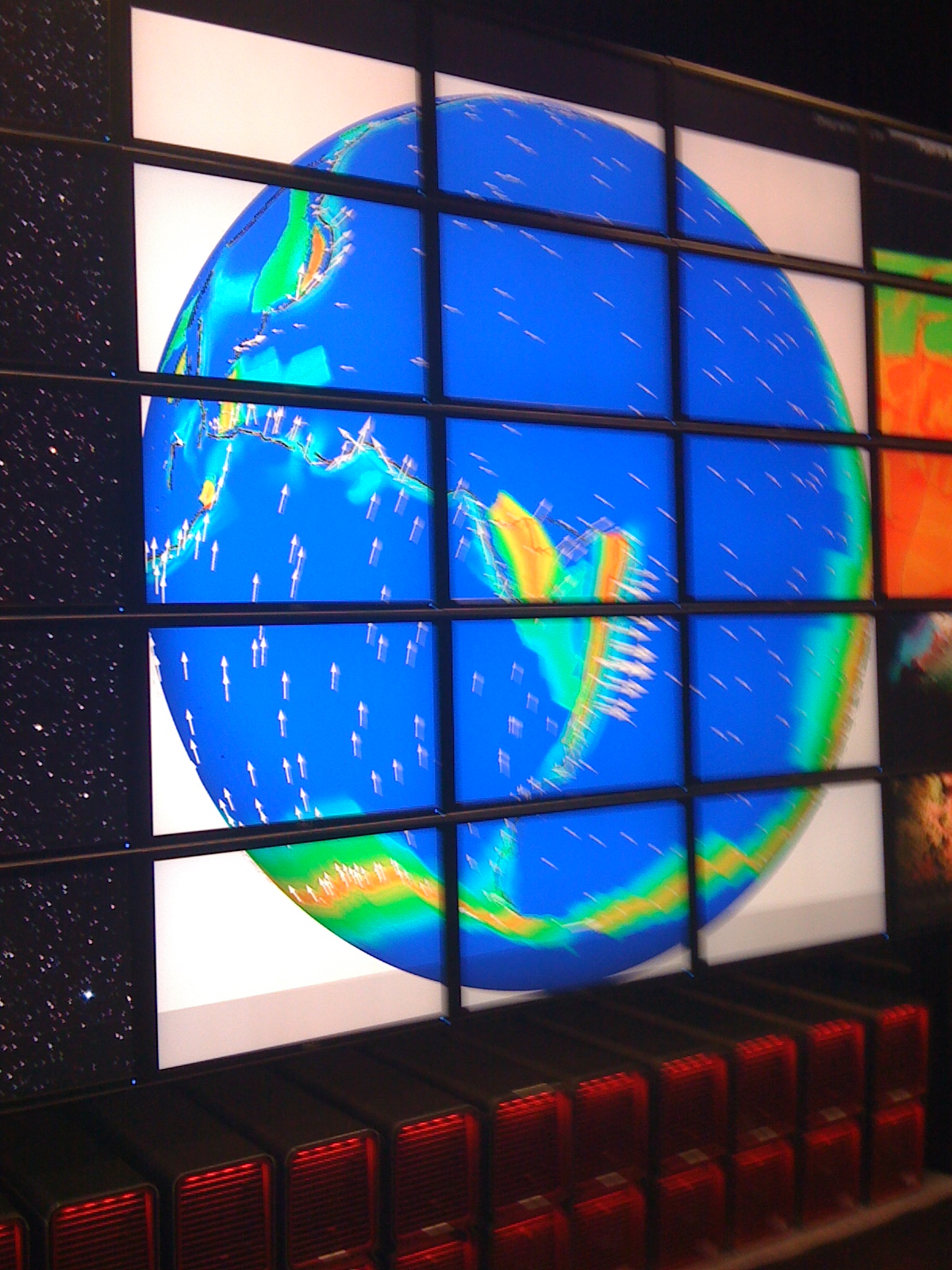
This is from a supercomputing model at TACC

If you think you can compete with visual media. think again

GOT THIS TECH?

008

Many schools do not teach geography. The resources of National Geography are vast and that means content. It’s free.There are alliances, there are projects like BioBlitz, and interactive mapping.

OK Glass!!

OK Glass!!

MapMaker Interactive

http://mapmaker.education.nationalgeographic.com/?ar_a=1&b=1&ls=000000000000

An interactive mapping experience with rich layers of information on the physical Earth, oceans, culture, and more.

http://education.nationalgeographic.com/education/?ar_a=1

GOT SCIENCE ON A SPHERE?

https://upload.wikimedia.org/wikipedia/commons/c/cc/Esrl4_072009.jpg

Have You Got This Tech? Cyberlearning?

The NSF 2015 Teaching and Learning Video Showcase: Improving Science, Math, Engineering Computer Science, and Technology K-12 showcases cutting-edge NSF-funded work to improve teaching and learning, and will allow colleagues affiliated with MSPnet, CADRE, CIRCL, CAISE, STELAR, CS10Kcommunity, and ARC to view, discuss, and comment on each others’ work.

It will also allow each project to disseminate their work to the public at large, helping NSF achieve its goal of broad dissemination of innovative work. All videos and discussions will be archived for future access.

The 2015 Teacher and Learning Video Showcase is available from the
http://resourcecenters2015.videohall.com

112 (3-minute) videos from innovative project work conducted by researchers in multiple NSF programs.
http://resourcecenters2015.videohall.com
Over 260 presenters and co-presenters have submitted 112 videos

Do You Know Supercomputing? Most teachers don’t..Some have resources that have been developed for their use in Cyberlearning and in various programs from the National Center for Supercomputing Applications.

GOT SUPERCOMPUTING? Visualization and Modeling? Big Data?

IMG_0078

Some of us were lucky enough to be a part of the Christa McAuliffe Institute, i.e. there were two groups of us who worked together through the NEA. We seized the ideas of minority technology, and attempted to share what we knew about technology teacher to teacher and region to region. We were minority, male and mostly female and we did workshops and initiatives all over the USA.

The five first chosen were called Christa McAuliffe Educators and we were trained, given professional development with the latest of tools and the best of professors over many months.( Chris Dede and Seymour Papert. and there were others).Yvonne Andres shared Fred Mail, and we also learned from NASA and the National Center for Supercomputing. It was radical at the time.
We did some special programs with the NSF and learned about their outreach as well.

Being involved in transformational education through NASA

We never mentioned the word Supercomputing, we just did it.

At the time there were many NASA programs . We had people who demonstrated astronomy from the Hubble Space Telescope and the Young Astronaut Program.

http://www.nasa.gov/mission_pages/hubble/main/index.html

Challenger Center for Space Science Education is a nonprofit educational organization with its headquarters in Washington, DC. It was founded in 1986 by the families of the astronauts who died in the Space Shuttle Challenger disaster on January 28, 1986.

The organization offers dynamic, hands-on exploration and discovery opportunities to students around the world. These programs equip students with the knowledge, confidence, and skills that will help better our national social and economic well-being.http://www.challenger.org

There was also Space Camp . If you look at the information in the link even back then there was awesome tech.

Space Camp was the brainchild of rocket scientist, Dr. Wernher von Braun. Von Braun led propulsion activities that launched the Apollo-era U.S. manned space program and envisioned an aggressive schedule for America’s space-bound pioneers. Von Braun, then director of the NASA Marshall Space Flight Center, reasoned there should be an experience for young people who were excited about space. Under the guidance of Edward O. Buckbee, the first director of the U.S. Space & Rocket Center, Space Camp was born.

Camps are available for fourth grade through high school-age students. Additional programs are offered for trainees who are blind or visually impaired, deaf or hard of hearing and those who have other special needs. Space Camp programs are also available for adults, educators, corporate groups and families. Family programs may include children as young as seven years old. I can’t really list all of the programs then or now. Space Centers helped us to find all of the projects that were available. Some teachers did Moonbase America, and others did project based NASA projects. We learned about raising food in space, basil, tomatoes, and thinking about ways to raise tilapia.

Being a Science Teacher with Outside Resources.. Try these NASA resources !!
We created an institute at Stanford where we invited teachers who applied to share their technology. We also presented our special projects. It was a sharing of the best of the best. We created more ways in which to do STEM which was called at the time SMET.

That is one level of technology. Have you considered that there was a synergy of space and Star Wars? The movie propelled a lot to be interested in Science Fiction. The force of interest drove many students to robotics.

Many Children Have Parents to Share New Ways of Learning with Them

This is from Family Days at AAAS.

George Lucas also pioneered Edutopia.Technology Integration examples were shared to help us all
explore new tools and strategies for empowering students to fully participate in a connected, techology-rich society. But this is the problem. At the time we talked of the digital divide. That was before a lot of people had access, tools, training, and/or permission to use technology in schools.

There was not BYOT Bring your own technology , and even with the tools we had there was a content divide. I know that in rural, distant , urban and some tribal areas we have a bigger divide.

Some people are not at the level that we think. There is a lot of tech, but it is not in all schools.
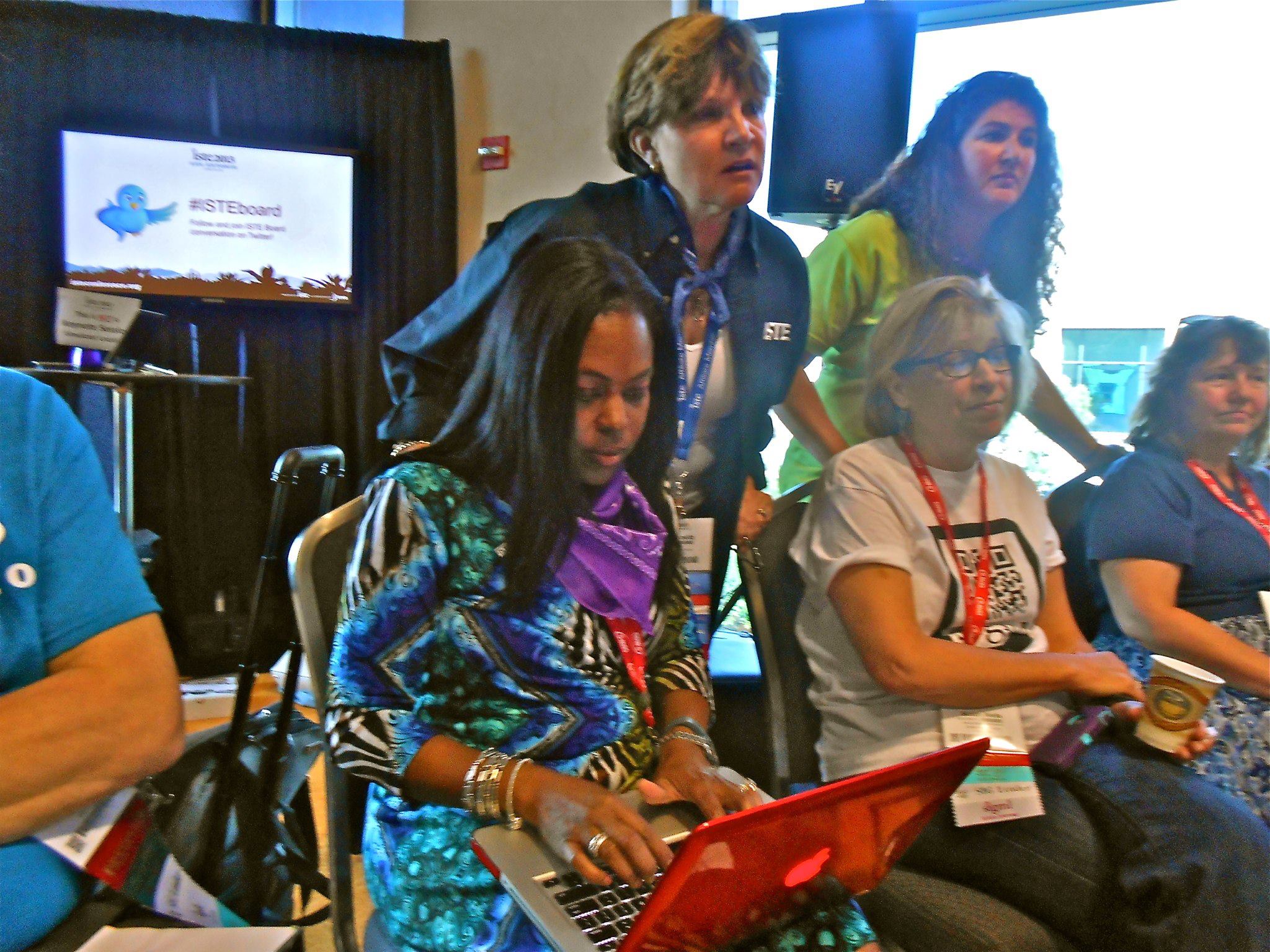
Changing the Equation by an Uncommon Gift- A Surface Tablet

ISTEI am at the ISTE conference in San Antonio.

I enjoyed the SIG work, I participated in sharing my concerns with the board, I attended some workshops,  did the conference floor, but also I witnessed some empowerment that was caused by the gift of a computer to 10,000 ISTE participants.

Microsoft gave away 10.000 Surface tablets to ISTE participants who signed up to get them. I have of course been reading various articles on the use of mobile technologies for groups who need help.  To understand the need? Read “ Falling Behind: A Technology Crisis Facing Minority Students.”

The access problem is something the White House is dealing with. You can read about it here.

surface instruction

Tablets have been disruptive. Pew tells us here about the statistics , this is a summary of the full report.

For the first time, a third (34%) of American adults ages 18 and older own a tablet computer like an iPad, Samsung Galaxy Tab, Google Nexus, or Kindle Fire—almost twice as many as the 18% who owned a tablet a year ago.

Demographic groups most likely to own tablets include:

  • Those living in households earning at least $75,000 per year (56%), compared with lower income brackets
  • Adults ages 35-44 (49%), compared with younger and older adults
  • College graduates (49%), compared with adults with lower levels of education

“One of the things that is especially interesting about tablet adoption compared to some of the patterns of other devices we’ve studied is how these technologies’ growth has played out between different age groups,” Research Analyst Kathryn Zickuhr said. “With smartphones, for instance, we’ve seen a very strong correlation with age where most younger adults own smartphones, regardless of income level. But when it comes to tablets, adults in their thirties and forties are now significantly more likely than any other age group to own this device.”

ABOUT THE SURVEY

The findings in this report are based on data from telephone interviews conducted by Princeton Survey Research Associates International from April 17 to May 19, 2013, among a sample of 2,252 adults ages 18 and older.  Telephone interviews were conducted in English and Spanish by landline and cell phone. For results based on the total sample, one can say with 95% confidence that the error attributable to sampling is plus or minus 2.3 percentage points.  More information is available in the Methods section at the end of this report.

surface

Of all of the years I have been working in technology, I have not witnessed such a sharing. Everyone says that all of the students are digital natives.. but there are many students who do not have the tools. the teachers who know it , or the broadband access to be able to share the new technology and ideas. Thank you to those who still remember that teachers are an important part of the equation.

Yes, there Still is a Digital Divide, and a Broadband Problem , There Should Be a National Consideration of Digital Equity

Future Learning

Wireless shows the way to the future ways of learning
if we can conquer the digital divide.

Bonnie Bracey-Sutton

I was the only K-12 teacher on the National Information Infrastructure Advisory Council. I have been waiting years for transformational change to happen.We still have need, lack of access, and a broadband problem.

Let’s start with this set of charts.  Source (http://mashable.com/2013/06/14/digital-divide-problem/)

I have been researching and working with these issue for a long time.

Take a look at this info-graphic. (http://mashable.com/2012/02/05/digital-divide-infographic/)

Early exposure and interest

Early exposure and interest are key!

Recently people talked to me and said, you know, people are tired of hearing about the digital divide, and broadband access, it is boring.Why don’t you do something that is more interesting!( It was depressing to hear) But recently the White House, and other reports confirm the concerns that I had about the  two Americas we have in technology. Most people with the technology went their merry way , not remembering that many had neither the tools, technology or knowledge to make the change we want for 21st century learning. see this report from NTIA.

RESEARCH PROOF

Here’s a bit of disappointing but not-so-surprising news: according to a new report from the nonprofit think tank Center for American Progress (CAP), U.S. schools aren’t doing enough to enable technology in the classroom to live up to its potential.

Oh really? Oh really…

Not only are students across the country frequently using technology for basic skills (for example, middle school students are mostly using computers for drills and practice exercises, not data analysis or other activities that really take advantage of computing power and sophisticated software), schools aren’t looking at the returns on their technology-related investments. The CAP also found that students from high-poverty areas were less likely to get access to rigorous science and technology learning opportunities.

“In this analysis, it quickly became clear to us that many schools and districts have not taken full advantage of the ways that technology can be used to dramatically improve education-delivery systems,” the report said.

The White House

The White House’s new broadband report is embedded below. What can be done to bridge the digital divide? Share your thoughts in the comments.

White House Broadband Report

( This is a document that can be downloaded )

This isn’t about faster Internet or fewer dropped calls. It’s about connecting every part of America tothe digital age. It’s about a rural community in Iowa or Alabama where farmers and small business owners will be able to sell their products all over the world. It’s about a firefighter who can download the design of a burning building onto a handheld device; a student who can take classes with a digital textbook; or a patient who can have face-to-face video chats with her doctor.”
– President Obama

 ” Committing to high-speed connectivity for all our students in five years will unleash the potential of the education technology market, where a lack of infrastructure has held back innovation.”

In June , the White House announced an initiative  to expand high-speed broadband Internet access to virtually every school in the country. The program is expected to cost several billion dollars; according to a senior administration official. The White House argues that the expanded Internet access will provide teachers with more tools; make learning more engaging and better prepare students for 21st century jobs. The plan does not require congressional approval. Instead; an existing program that subsidizes Internet access in schools and libraries. E-Rate is funded through fees on monthly telephone bills. The White House officials said officials expect the president’s plan would add no more than 40 cents to every phone bill per month for the next few years. The proposal would be a one-time investment with the goal of providing schools with Internet connections of one gigabit per second—about 100 times faster than the average home broadband connection. The White House expects 99 percent of students to have access to at least a 100-megabit-per-second connection within five years. The administration notes that many schools currently rely on a single slow connection for hundreds of students and teachers. The officials argue that next-generation Internet speeds will allow students to download up-to-date learning materials.

The announcement was a relief to me , it signified that official Washington understood that the new initiatives based on technology, digital textbooks and common core , and other STEM initiatives are not possible without new infrastructure.

Richard Bennett in a recent article states that

“The major causes for low subscribership, as extensive survey research shows, are low interest in the Internet and minimal digital literacy. And too many American households lack the money or interest to buy a computer. As a result, more Americans subscribe to cable TV and cellphones than to Internet service. Our broadband subscription rate is 70 percent, but could easily surpass 90 percent if computer ownership and digital literacy were widespread.”

Indeed, the most critical issue facing American broadband has nothing to do with the quality of our networks; it is our relatively low rates of subscribership.

What ever the reason. There is digital inequality in the US. Mr. Bennet may not work or travel in rural and distant areas. I assume that he has no real experience with the schools in these areas.

White House Initiative

http://www.whitehouse.gov/blog/2013/06/06/bringing-america-s-students-digital-ageImage“In this analysis, it quickly became clear to us that many schools and districts have not taken full advantage of the ways that technology can be used to dramatically improve education-delivery systems,” the report said.

What ever the reason. There is digital inequality in the US. Mr. Bennet may not work or travel in rural and distant areas. I assume that he has no real experience with the schools in these areas. There are some efforts kind of complicated to get people comfortable with being on line.

Google also sees the problem and this is one of their solutions.

Most of you might have heard of Google's new global Internet access 
experiment - Project Loon. 

See http://www.pcmag.com/article2/0,2817,2420540,00.asp 

Check out the beautifully done motion graphics video at 

http://www.youtube.com/watch?v=m96tYpEk1Ao

Read More about the Digital Divide and STEM here.
http://www.scoop.it/t/broadband-and-connectivity-in-america

Digital Divide, Digital Equity … and Access? Digital Equity is the New Civil Rights Issue


Are we there yet/

New Technologies for New Times.. are you stuck in dialup?

Teragrid Resources, using IPad

Long ago there was a book written about “Invisible Man” by Ralph Ellison. Here is the Wikipedia stub for the book.
Invisible Man is a novel written by Ralph Ellison, and the only one that he published during his lifetime . It won him the National Book Award in 1953. The novel addresses many of the social and intellectual issues facing African-Americans in the early twentieth century, including black nationalism, the relationship between black identity and Marxism, and the reformist racial policies of Booker T. Washington, as well as issues of individuality and personal identity.In 1998, the Modern Library ranked Invisible Man nineteenth on its list of the 100 best English-language novels of the 20th century. Time magazine included the novel in its TIME 100 Best English-language Novels from 1923 to 2005.[1] You might have to read the book to get the connection with the lack of broadband. Read the first chapter. The story is sad, but , it works for this analogy.


This statement could work for those who have limited or no access.

“I am an invisible man….I am a man of substance, of flesh and bone, fiber and liquids – and I might even be said to possess a mind. I am invisible, understand, simply because people refuse to see me.”
— Ralph Ellison (The Invisible Man)

Got Broadband?

For those people who are not currently online with broadband access, they may seem like the invisible man that was in the novel. Groups championing the use of technology, point to their online resources and information. Those groups who used to have paper magazines and handouts decided not to offer them anymore. Everyone is online  they thought? Think again.

Even the new broadband map has its critics. The San Jose Mercury News  has this to say.

It is frustrating to see that after two years of work, some of the information is incomplete, incorrect or out of date. There’s much you might like to know that the map and its accompanying database don’t provide, most notably how much broadband services cost in your area. The map just launched, so it is likely to get better over time. The government is allowing anyone to download and use the database and is providing tools to allow other websites to access the map and data. It also is taking input from consumers to identify errors that will be corrected in updates. Here’s hoping that the government regulators follow through on those revisions and seriously consider updating the site more often. Because the National Broadband Map has the potential to be a very useful tool for consumers — but it’s not there yet.

For the people who are learning about Cloud Computing and online content , the devil is in the details. For the school systems who are reading the new technology plan, which is a good plan there is just one problem. How to , if there is no connectivity in the broadband sense.

If you are rural, One Third of Rural America Has Access
http://online.wsj.com/article/SB10001424052748703561604576150691269105816.html

You can check the reality of the New National Broadband Map here
National Broadband Map
Popular Reports: Quick access to download the most frequently generated reports. … goal of embodying the spirit of the Internet by delivering the National Broadband Map …
broadbandmap.gov

http://broadbandmap.gov/

http://arstechnica.com/tech-policy/news/2011/02/navigating-the-us-national-broadband-map.ars
 

arstechnica.com

The US government’s long-awaited National Broadband Map has arrived, with tons of ways to discover what kinds of Internet services are (or aren’t) available in your area. We’ve got a guided tour of the site.

Is there Digital Equity in your community?

The Digital Equity Toolkit. The toolkit points educators to free and inexpensive, high quality resources that help address the digital divide in the classroom and community. This toolkit was developed by Robert McLaughlin and  associates and has been re-edited for tofay’s times.

I have been working with and helping to point our inequity since I was on the NIIAC and we framed the policy that we thought would bring us national broadband much earlier.  We thought that students, families and communities would be able to get access through libraries, community centers, and schools.

Bonnie Bracey Sutton

PowerofUS Foundation

If you read our statement , we aim to change the face of schooling by creating digital equity in a national transformation of schooling.

Emaginos.com.